Kang Khek Ieu: 'They all had to be eliminated'
Kang Khek Ieu was known as 'Cambodia's Himmler', a torturer who oversaw the deaths of 17,000 people. As he prepares to go on trial, he gives a chilling insight into the Khmer Rouge – the most detailed account yet from a top henchman
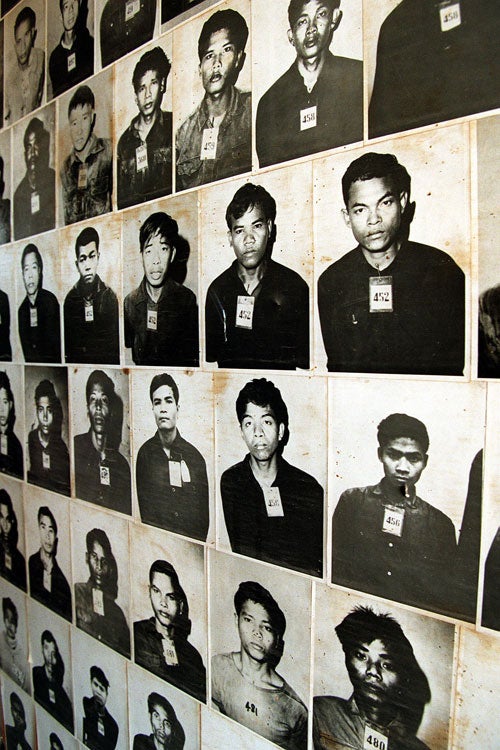
He was Pol Pot's trusted henchman, the brilliant mathematician who calmly fashioned an efficient apparatus of torture and death out of a Phnom Penh high school and who oversaw, during the Khmer Rouge's reign of terror, the interrogation and cudgelling to death of some 17,000 Cambodians.
In the West he has been called "Cambodia's Heinrich Himmler"; since Pol Pot himself and his lieutenant Ta Mok cheated justice by dying, he is the most vivid symbol of the Khmer Rouge left alive. His name is Kang Khek Ieu, but he is better known by his nom de guerre, Duch (pronounced "Doik"). This spring, 28 years after fleeing Cambodia ahead of the Vietnamese army, his trial for mass murder may finally get under way.
Now, in the first interview he has given since his capture more than eight-and-a-half years ago, he talks freely about how and why he sent 17,000 Cambodians to their deaths in the killing fields.
And even as he waits to confront the proof of his crimes, it is clear that, for him, there was never any choice: anybody who was thought to pose a threat to the revolution had to be tortured and killed. Asked whether he had any moments of uncertainty, any doubts or feelings of rebellion while he set about wiping out his country's entire intellectual class, he answered: "There was a widespread and tacit understanding.
"I and everyone else who worked in that place knew that anyone who entered had to be psychologically demolished, eliminated by steady work, given no way out. No answer could avoid death. Nobody who came to us had any chance of saving himself."
The command had come from above, he said. "All the prisoners had to be eliminated. We saw enemies, enemies, enemies everywhere." He could not have rebelled or fled, he insisted. "If I had tried to flee, they were holding my family hostage, and my family would have suffered the same fate as the other prisoners in Tuol Sleng. If I had fled or rebelled it would not have helped anyone."
Between 1975 and the beginning of 1979, under Pol Pot, two million men and women, almost a third of the Cambodian population, were brutally eliminated by the Khmer Rouge – an extreme Marxist movement that aimed to take Cambodia back to "Year Zero", cutting it off from the outside world and imposing their leaders' vision of an "agrarian utopia".
Of its two million victims, more than 17,000 – party officials, diplomats, Buddhist monks, engineers, doctors, teachers, students, musicians and dancers, were brought to a former school in the heart of Phnom Penh that had been converted into a torture centre. Only six came out of it alive.
Codenamed S-21, the centre was run by Duch, a former maths teacher who had become the head of the regime's secret police. In the former classrooms, over a period of 40 months, Duch oversaw the extermination of the entire Cambodian intellectual class with mathematical rigour.
Confessions were extracted by primitive torture: prisoners were strapped to iron beds, suspended upside down from ropes, threatened with drowning, tormented with knives and pincers, locked in tiny cells. Then, at night, they were taken by lorry to the outskirts of Phnom Penh and killed in the rice fields. The Khmer Rouge were obsessed with killing by night.
Now at last, after years of argument between the Cambodian government and the United Nations, the surviving members of the Khmer Rouge hierarchy are finally being brought to justice. They will be tried under a hybrid UN-Cambodian tribunal known as the Extraordinary Chambers in the Courts of Cambodia; the pre-trial hearings began in November and are still going on. Pol Pot, of course, is long dead, having died under house arrest before he could be tried in 1998. The bloodiest of his comrades, Ta Mok, died in 1996. But five senior leaders including Khieu Sampan, the Khmer Rouge president, await trial.
Duch made his first appearance in court in November when his lawyer asked for him to be let out on bail because his "human rights had been violated, even if he was not beaten or tortured". A ripple of ironic laughter ran round the courtroom. The request was rejected.
My quest to interview Duch had begun nearly three years ago. I first visited S-21, soon after the fall of the Khmer Rouge. Since his arrest more than eight years ago, nobody from the outside had even clapped eyes on him. Now, finally, I was looking at this frail, 66-year-old man with his protruding, irregular teeth, bug eyes and washed-out grey clothes. I was confronting the mystery of the banality and the innocence of evil.
Throughout our interview, his voice was low, respectful like a mantra, a Buddhist prayer, rather than what it really was; the soundtrack of a nightmare still freighted with questions. His mild-mannered almost frail appearance in no way suggested the role of a mass murderer.
For the interview, conducted at the end of 2006 after six years of negotiation, the rules were strict: no tape recorder, no camera, no talking to him directly in French or English but only through a Cambodian interpreter, and no publication until the trial was imminent. General Neang Phat, Cambodia's Secretary of State, and other generals were sitting in the same room, listening to and scrutinising this indefinable and unfathomable man. Some of them, too, have evil memories of the Khmer Rouge years. But Duch was the exact picture of the banality and innocence of evil.
Duch, the nickname he assumed when he was young and joined the guerrillas, told me that the torture centre at Tuol Sleng was set up in August 1975, four months after the Khmer Rouge entered Phnom Penh, and began work two months later.
"I was given the task of creating it and starting it up, although I never found out why they chose me. Before 1975, when the Khmer Rouge lived in hiding, in the jungle, or in the liberated zones, I was the head of Office 13, I was the chief of police in the special zone bordering on Phnom Penh."
He described a routine of bureaucratic monotony. "Every day I had to read and check the confessions. I read from seven in the morning until midnight. And every day, towards three in the afternoon, Professor Son Sen, the minister of defence, summoned me. I had known him since my time as a high school teacher. It was he who had asked me to join the guerrillas.
"He would ask me how my work was going. Then a messenger would arrive, an envoy, who collected the confessions that were ready and took them to Son Sen. These messengers were the only links between one office and another."
I wanted to know if Duch had any moments of uncertainty, doubts, feelings of rebellion while he was wiping out his country's entire intellectual class.
He admitted the idea had crossed his mind. "When the work started at Tuol Sleng, I asked my bosses now and then, 'Do we really have to use all this violence?' Son Sen never answered. Nuon Chea, the No 2 Brother in the power structure, who was above him, told me: 'Don't think about these things.'
"I personally had no answer. Then with the passing of time, I understood. It was Ta Mok who had ordered all the prisoners to be eliminated. We saw enemies, enemies, enemies everywhere.
"I was cornered, like everyone in that machine, I had no alternative. Pol Pot, the No 1 Brother, said you always had to be suspicious, to fear something. And thus the usual request came: interrogate them again, interrogate them better."
Sometimes Duch was tempted to be merciful, he claimed – and his superiors began to mistrust him. He recalled the time a cousin was brought to S-21.
"I knew him well, we had formed sincere family ties but I had to eliminate him anyway. I knew he was a good person but I had to pretend to believe that confession extorted with violence. So in order to protect him I didn't analyse those statements too rigorously. And on that occasion my superiors began to lose full trust in me. At the same time I didn't feel safe any more."
But the moment of official doubt passed. The interrogations and executions continued, remorselessly until the end.
"You kept your post until the end," I said. "Did you always carry out your orders thoroughly?"
Duch answered: "I obeyed. The work carried on until 7 January 1979, when the Cambodian liberation forces, supported by the Vietnamese, conquered Phnom Penh. There was no escape plan, no pull-out plan ..."
But, after the fall of the Khmer Rouge, the executioner blended back in among his countrymen, and disappeared, as so many did in the post-war chaos, swallowed up by the void.
Many years later he was converted to Christianity by American missionaries. His true identity was discovered in 1998 and soon afterwards he was arrested. He remains the most disquieting witness of the political madness planned by the Khmer Rouge, after the death of Pol Pot and Ta Mok, the one-legged "butcher".
I asked him how he converted to Christianity and why that happened. "I became convinced that Christians were a force, and that this force could beat Communism. At the time of the guerrilla war, I was 25 years old, Cambodia was corrupt, Communism was full of promise and I believed in it. But that project failed completely."
So if Duch has repented now, what is his attitude to all those thousands of victims of his violence? There was no alternative for people like himself, trapped inside the machinery of the Khmer Rouge, he said.
"If someone goes looking for guilt, and the various degrees of guilt, I say that there was no way out for anyone who entered the power system conceived by Pol Pot. Only at the top did they know the real situation in the country, but the intermediate functionaries did not know. And then there was that obsession with secrecy.
"Of course, you are asking me whether I could have rebelled, or at least fled. But if I had tried to flee, they were holding my family hostage, and my family would have suffered the same fate as the other prisoners in Tuol Sleng. If I had fled or rebelled it would not have helped anyone."
Join our commenting forum
Join thought-provoking conversations, follow other Independent readers and see their replies
Comments
Bookmark popover
Removed from bookmarks