Karzai sticks to his guns on 2014 military takeover
As Kabul is locked down for summit, world leaders struggle to find a united voice
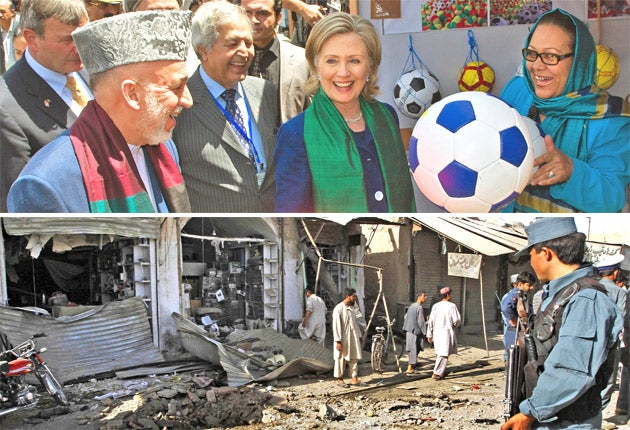
An international conference in Kabul intended as a vital stage in bringing security to Afghanistan was marked by tactical disagreements and mixed messages over the timing of the West's withdrawal from the costly and ferocious war.
Western officials at the half-day summit yesterday, attended by delegates from 40 countries, highlighted President Hamid Karzai's "pledge" that Afghan troops would be responsible for military operations by 2014 – with the interpretation that British and other Nato forces would be returning home by that date.
However, following Mr Karzai's statement that he "remained determined" that Afghan forces would take the lead, the Nato secretary general, Anders Fogh Rasmussen, stressed that this would not mean a withdrawal.
"International forces would not leave. They will simply move into a supportive role," he said. "Our mission will end when – but only when – the Afghans are able to maintain security on their own. The transition to Afghan-led security would be based on conditions not calendars."
But as the summit finished, news came that two American trainers and an Afghan soldier had been killed by a member of the Afghan army. The attack came within a week of three British soldiers dying at the hand of another local recruit, underlining the problems faced in achieving a key plank of the exit strategy – preparing the nation's forces to take over security.
However, David Cameron, on a visit to Washington, maintained that withdrawing UK forces by 2014 was a "realistic" goal. "We're training the Afghan army month by month and it's actually on target," he said.
According to diplomatic sources, the final communique for the conference was agreed only on Monday night because of disagreements within the international community.
The Europeans, including Britain, it is claimed, preferred more emphasis on anti-corruption measures while the United States – which plans to start withdrawing troops from July next year – wanted stronger caveats on the process of reintegrating Taliban fighters.
The Russians, affected by one of the main export routes for Afghan opium running through their country, pressed for more focus on bolstering counter-narcotics efforts.
The result, according to officials, was that some of the wording of the communique's final draft was changed, such as the phrase "a clear and detailed road map to the restoration of full Afghan sovereignty" altered to "a commitment to the Afghan people".
The Afghan government had gone to great efforts to offer a tranquil setting for the VIPs to discuss issues at their prestigious showpiece. They could meet for discussions at a specially designed retreat of fountains, pools and wooden bridges with a rose garden decorated with animal figurines in marble and onyx and carpets and with rugs to rest on.
Outside this secure zone the population of the capital, apart from a selected greeting party, were conspicuous by their absence in a city effectively under siege.
The airport was closed to commercial flights and roads into the city were shut off. The silence was broken by helicopter gunships clattering overhead and rings of armed checkpoints choking the Afghan capital, the only sign of life in the empty streets.
Rocket attacks overnight had forced the flights of some of the visiting dignitaries, including the United Nations secretary general, Ban Ki-moon, and the Swedish Foreign Minister, Carl Bildt, to be diverted from Kabul to the US military base at Bagram.
This had been preceded by the Taliban trying to show its reach and power with a mass prison break, suicide attacks and bombings in the cities. Last month was the deadliest for Nato forces since the fall of the Taliban in 2001 and 17 American and British personnel had been killed in the last 10 days.
President Karzai said that Afghanistan and its Western allies share "a vicious common enemy" but there was agreement on one proposal to try to reduce the escalating violence.
A programme to re-integrate insurgents who want to change sides would start with a $180m (£120m) fund provided by the West, and Mr Karzai is believed to have been given backing in his efforts to hold talks with the Taliban and other militant groups.
The move, however, has caused deep concern among Tajik, Uzbek and other minority groups who fought the Pashtun Taliban during the long years of the civil war, as well as among human rights activists who fear hard-won civil liberties may get sacrificed to reach accommodation with Islamists.
President Karzai also got his request that more foreign aid money should be channelled through his government rather than the present one-fifth of the annual total, estimated to be around $14 bn. The conference agreed that this would be raised to 50 per cent, lower than the amount the Afghan leader had wanted.
The Karzai administration is deeply tainted by allegations of corruption and the US Secretary of State, Hillary Clinton, stated at yesterday's conference that much more should be done to combat it.
"There are no short-cuts to fighting corruption and improving governance," she said. "On this front, both the Afghan people and the people of the international community expect results."
As the delegates flew back home, Afghan commentators cautioned against viewing the conference heralding major changes.
Haroun Mir, a political analyst and parliamentary candidate, said: "Everything is similar to the other conferences – nice speeches but unfortunately these are words.... The international community has decided to give responsibility to the government because they don't want it any more.
"Everybody knows we're moving towards a political settlement and everybody is aware this is the last chance. If the Afghan government can't deliver, Karzai will become irrelevant and the international community will have to negotiate with the Taliban."
Mir Ahmad Joyanda, an Afghan MP, said: "I doubt the army and the police will be strong enough [to cope with a handover of security duties] but we have to support the plan... We've had conference after conference after conference.
"Politically it's important to have the backing of the international community but Afghans are totally tired of the continuing situation."
View from Kabul: 'This conference means nothing for Afghans'
Del Agha, 20, mechanic
Our government only looks to its own security in Kabul even though there is instability across the country. If we had another 20 conferences we still couldn't fix Afghanistan. I didn't watch it on TV so I can't discuss the speeches but I doubt they will bring change to Afghanistan. President Karzai doesn't do anything for us. We have people who are jobless but Karzai can't pave the way for us to work or provide for our families. And all the foreigners are here for their own benefit and can't solve our problems. They don't understand ordinary Afghans either.
Safiullah Naibkhel, 28, handyman
The conference is Afghanistan's last chance before the foreign troops leave. The government and the President need to be smart and they need to work out how to take over security from the foreign forces. But they can't even keep Kabul secure.
Mohammad Aslam, 38, security guard
Previous conferences haven't achieved anything. I hope this one is different but I don't believe in my heart that will happen. President Karzai doesn't understand the problems of normal people. Maybe this time he'll get it but he doesn't know the difficulties poor people go through. This conference is for Karzai and the foreigners, not the people of Kabul. To him and his government it's just money in their pockets.
Khairullah, 37, baker
This conference means nothing for Afghans. It created lots of problems for us. I went to the city yesterday and it took hours to walk back. They should have held this somewhere less busy. I saw three people trying to get to hospital with sick relatives. If the conference produces peace then it's great but otherwise it's just more problems for ordinary people. It's better than its predecessors because it has been organised by Afghans. President Karzai and the international community are trying to fix our country but until they have God's help they can't do anything.
Join our commenting forum
Join thought-provoking conversations, follow other Independent readers and see their replies
Comments