Killing Fields executioner faces justice
He may be the most prolific torturer and executioner the modern world has known.
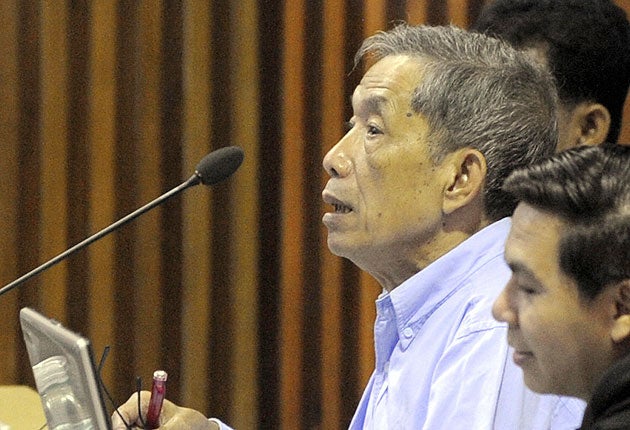
Kaing Guek Eav, otherwise known as Duch, sits behind a wall of bullet-proof glass, headphones on, listening to the court's proceedings. The 66-year-old has a choice of three languages to choose from: Khmer, English and French.
He's a wiry, compact man, expressionless, his silver hair combed tidily to the side.
Today he is wearing small, neat glasses and all the markers of advancing years - his impressively large teeth have degenerated into tombstones, his long face emphasised by the loose skin of his neck pouching into the collar of his light blue shirt.
It's been at least 30 years since Duch committed the last of the many acts which see him here today. He has confessed to atrocities, but insists he was acting under orders.
Upon this trial, the first of five for former Khmer Rouge leaders, lies the hopes of millions that justice might finally be found. But there remain serious doubts whether this can be achieved.
The the Extraordinary Chambers of the Courts of Cambodia lies on the outskirts of Phnom Penh, about 25 minutes by taxi.
When my partner Mike, a former refugee laywer, and I first came last July, it took 24 hours to find a driver who knew where the courts were. No one seemed to know anything about the war crimes trials of the Khmer Rouge leadership. But by February this year, as the world's media descended upon Phnom Penh, tuktuk, taxi, and bus drivers were confidently touting for business.
The long, hot drive is distinguished by kilometres of building sites, elaborate mansions soaring from rickety bamboo scaffolding, sprouting between the shacks, dust and roadside waste. Somewhere among the poverty is money; cynics say war crimes trials are big business, as diplomats flood into town.
The court is a military base specially converted to host the trials. The impressively appointed courtroom is ordered and organised. A wall of attack-proof glass separates the court officials from the 500-seat gallery. Security is paramount. Outside, some 50 metres from the courthouse, is a benign cream and yellow villa which houses the cadres who will stand trial.
These five defendants are deemed the most responsible for crimes committed under the Khmer Rouge regime, and have been charged with crimes against humanity and war crimes: Nuon Chea "Brother No. 2", Ieng Sary, "Brother No. 3" and the former Minister for Foreign Affairs, his wife Ieng Thirith the former Minister of Social Affairs, Khieu Samphan, the former President of Democratic Kampuchea, and Kaing Guek Eav.
Missing is Brother Number 1, the infamous Pol Pot, who died in 1998.
Duch is the former commandant of Tuol Sleng (S21), the once-secret, now notorious prison where up to 20,000 lost their lives. Among those killed there was New Zealander Kerry Hamill, brother of Olympic rower Rob Hamill, whose yacht was captured by the Khmer Rouge in 1978.
Now a museum, the walls are lined with photos of hundreds of victims, each one in black and white, most staring blank-eyed into the lens. Tortured and forced to confess to startling offences - being KGB, CIA, or Vietnamese spies - most victims were peasants who were "smashed".
They had their fingernails ripped out, were beaten, raped, electrocuted, suspended, near drowned, then finally murdered at the infamous Killing Fields. This is the legacy of the Khmer Rouge's attempts between 1975-79 to return their people to Year Zero, an agrarian utopia of equality, where "enemies" of the unsparing regime were "re-educated" through slavery, starvation, and torture. Up to two million lost their lives.
Some 20 years after the fall of the regime, Duch was tracked down in the jungles near the Thai border. He was working, ironically, for ARC (the American Refugee Committee).
The irony was all the more perverse for his conversion to Christianity, a faith he at least credits with accepting some responsibility for crimes committed under the Khmer Rouge. Last year Duch was taken back to the Killing Fields by court officials. He sank to his knees, apparently sobbing as he recalled the babies and children who were smashed to death against trees there, allegedly at his command. When Duch's lawyer, Francois Roux, announces his admission of responsibility in court, Duch's composure is broken. He sits upright, his eyes widen, then sinks back.
Speculation has it that he's the first defendant to stand trial because this admission increases the likelihood of a conviction, thereby taking the pressure off the trials of the more senior cadres. Thirty years have now passed since the fall of the regime and the five accused are now elderly, a couple quite ill. There is a real fear that, like Pol Pot, they'll die before justice can be meted out. The theory serves as a pointer to the controversies which have besieged this process.
The ECCC, a joint initiative by the Cambodian Government and the United Nations, has laboured under persistent allegations of corruption and political interference, which last year saw crucial funding frozen.
When we were there court officials were in a flap, crying impending bankruptcy. "If this happens," worried spokesman Sambath Reach, "The court will collapse ... justice will be denied."
Information Minister Khieu Kanarith brushed aside the concerns, declaring the international funding unnecessary - "We can hold the trials ourselves." But whether Cambodia can conduct trials that deliver justice to international standards is highly arguable and unlikely, requiring, as it does, a degree of independence, extensive funds and the ability to employ the raft of lawyers, researchers, officials, and judges needed.
What does Cambodia want?
Khieu Kanarith says the ordinary Cambodian neither knows, nor particularly cares, about the trials. Their significance lies only in "reminding people" of the horrors to avoid a repeat performance.
But for those at the court, like rare Tuol Sleng survivor Vann Nath, the memories are fresh and the trials crucial: "I have waited for this day for 30 years. I want the world to know what happened."
Perhaps some hope might be found in the remarks of Francois Roux at the end of his Duch's initial hearing. "Duch wishes to ask forgiveness from the victims and the Cambodian people. He will do so publicly ..."
From The New Zealand Herald. Miriama Kamo is a journalist with TV2's 20/20 programme
Join our commenting forum
Join thought-provoking conversations, follow other Independent readers and see their replies
Comments
Bookmark popover
Removed from bookmarks