Kung fu monk fights his critics
The head of the fabled Shaolin monastery has been accused of selling out heritage for commercial gain, reports Clifford Coonan
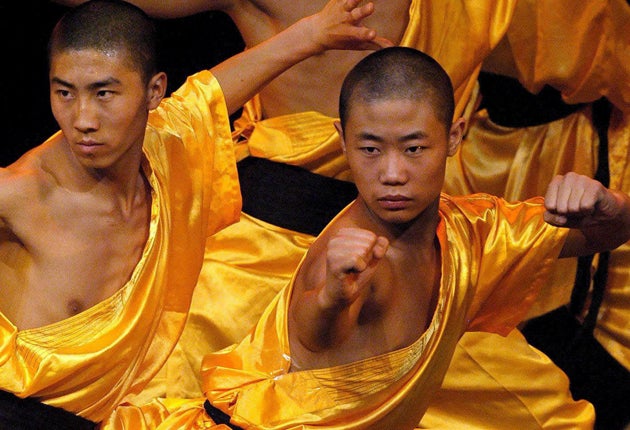
The Shaolin monastery is the birthplace of an ancient, elegant fighting code, where fists of fury and the way of the dragon have for thousands of years peacefully coexisted alongside calm Buddhist meditation.
But the temple, built in AD495 as a place of contemplation and discipline, is now a thriving tourist destination and multinational business venture, run by a monk who has won the respect of many for his business sense and canny marketing skills.
Purists and critics say, however, that he is an overly commercial opportunist. The latest controversial business venture of the "CEO of Shaolin" – as the temple's abbot, Shi Yongxin, is known – is a foray into modern tourism and finance. The local government of Dengfeng city has linked up with the state-owned China Travel Service to launch a travel venture using the Shaolin name. The new company aims to promote the Shaolin culture and tourism to Songshan Mountain.
The Shaolin temple is widely regarded as the birthplace of Shaolin kung fu. Shi Yongxin took over as abbot in 1999 and has divided opinion on whether he is selling out the temple's ancient heritage. "The Shaolin temple is the cradle of kung fu, which brings with it the great responsibility of promoting kung fu," the abbot has stated in defence of his business ventures.
The portly 44-year-old does not look like a kung fu star but, as anyone who has seen Kung Fu Panda knows, appearances are deceptive when it comes to martial-arts skills and, in this yellow-robed monk's case, commercial nous.
Mr Shi was roundly criticised a couple of years ago for accepting a brand-new luxury car for his services to the local tourist industry. In November, a hacker replaced the Shaolin website's front page with a fake letter of remorse in Shi's name. In it he was accused, yet again, of selling out.
On Thursday, the abbot, who is also deputy director of the Buddhist Association of China, was back on the defensive after reports suggested that the temple would go public. He denied that Shaolin would become a shareholder in the new tourism company which will seek to list in 2011 in either Hong Kong or on the Chinese mainland. The core remit of the temple, said the monk, was to "organise religious activities to meet the demand of religious followers".
The Shaolin monastery features in scores of martial-arts films in both Hong Kong and the mainland. But outside China it is best known as the setting for the 1970s television show Kung Fu in which Kwai Chang Caine or "Grasshopper", played by the late American actor David Carradine, studied the lessons taught to him by Master Po and Master Kan.
As with most of China's monasteries, Shaolin was badly damaged and then closed down during the Cultural Revolution, a decade of ideological frenzy between 1966 and 1976 when many ancient temples and artefacts were destroyed. Its resurgence since then has been remarkable, although it is not quite what many might expect a Buddhist temple to be.
Whatever his critics say, it is undeniable that Mr Shi has done much to popularise the town. It has more than 80 martial arts clubs and schools with a total of 60,000 students. Last year the temple had 1.6 million visitors who paid 100 yuan (£9) each to come to see it and watch the spectacular kung fu show. Among past tourists was the then Russian President, Vladimir Putin, who in March 2006 became the first foreign leader to visit the temple.
Thanks to the abbot's canny marketing, the temple's list of commercial achievements would put any theme park to shame. Last year, the monastery was the setting for the launch of the latest kung fu epic, the £18m blockbuster Shaolin. It stars the Hong Kong movie legends Jackie Chan, Andy Lau and Nicholas Tse, as well as the rising mainland star Fan Bingbing, and it will be directed by Hong Kong's Benny Chan. Filling out the cast will be stars including Wu Jing and Yu Shaoqun, and thousands of Shaolin disciples from the temple.
In another sign of the Shaolin monks' growing financial sophistication, the media wing of the temple, the China Songshan Shaolin Temple Culture Communication Centre, will team up with Hong Kong's Emperor Motion Pictures, and the Chinese production companies China Film Group, Huayi Brothers and Beijing Silver Moon Productions. This is a high-profile production, and the tie-up shows just how careful the abbot is about protecting the brand.
"We felt that it was important not to rush into a film project just for the sake of making another film," he said. "It has taken us a long time to find the right partners who had all the right elements for something as monumental as this."
Four years ago, the temple hosted the K-Star Global Chinese Kung Fu Star TV competition, which put 108 martial artists through their paces and offered the winners a shot at stardom. The martial-arts enthusiasts were ranked by virtue, kung fu ability and artistry. In June 2008, the Shaolin monastery launched its own website, allowing martial-arts enthusiasts to buy such items as a pair of Shaolin slippers, kung fu tea towels and T-shirts, chopsticks and bowls for those delicate balancing movements, while a kung fu manual for around £90 gives you the lowdown on the five fighting styles of the Shaolin warrior: tiger, leopard, snake, dragon and crane.
Shaolin may be a place of spiritual contemplation but it is now also one of commercial genius.
Shaolin style: Fighting skills
*Kung fu is a generic term for many different skills and is used mainly in the West. In China, people use the word wushu to refer to martial arts. Practitioners say other martial arts, like karate, originated from kung fu.
*The Shaolin temple in China is widely regarded as the birthplace of Shaolin kung fu. Originally 72 basic fighting movements, the form has grown to 170 moves divided into five styles: the Tiger, Leopard, Snake, Dragon and Crane.
*Children between four and 10 are handed over to kung fu schools by their parents for a strenuous regime of fitness and martial arts training.
*An Indian monk, Bodhi Dharma, began spreading Zen Buddhism in the Shaolin temple, and started its martial arts tradition.
Join our commenting forum
Join thought-provoking conversations, follow other Independent readers and see their replies
Comments
Bookmark popover
Removed from bookmarks