Nobel laureate's death sparks a diplomatic breakthrough
North Korean delegation lays wreath and burns incense at a tribute to rival state's former leader
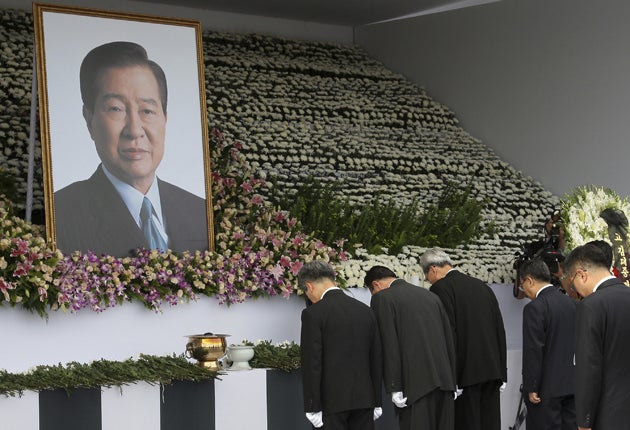
They shook hands with the sons of South Korea's late peacemaker president, bowed their heads at the portrait of the deceased, burnt incense at the mourning altar and finally left a wreath, emblazoned with the name of their boss, Kim Jong-il.
This was North Korea's first dispatch of envoys to Seoul in nearly two years, reviving hopes that the reclusive communist state might be ready to resume negotiations, nearly three months after a nuclear test that shocked the world.
The man they were saluting was the late South Korean president Kim Dae-jung, who won the Nobel Peace Prize for his long, stubborn and eventually successful efforts to start rapprochement with the North. He died this week aged 85 and his funeral is tomorrow.
The new peace moves began after a visit to Pyongyang by Bill Clinton earlier this month on what was characterised as a purely private errand of mercy, to plead for the freedom of two American female journalists who had been sentenced to 12 years' imprisonment in a labour camp after apparently straying across the border from China.
The liberty of the two women was speedily obtained, and since then North Korea's behaviour has undergone a dramatic change.
Last week it released an employee of the North-South industrial joint venture Hyundai Asan who had been arrested four months earlier. Later, Kim Jong-il had a four-hour lunch with the South Korean woman who heads the venture and reportedly promised a slew of concessions, including the resumption of reunion meetings between families separated by the Korean War, the return of South Korean tourists to the north, and the re-starting a joint venture industrial park in the north. Meanwhile, two diplomats in North Korea's mission to the UN in New York, who are never normally allowed far off base, were welcomed to Santa Fe, New Mexico, by the state's governor Bill Richardson, an intermediary between Washington and Pyongyang under President Clinton.
After the meeting Mr Richardson told CNN: "They feel... that by giving us the two American journalists, that they've made an important gesture... They do feel they are owed a gesture on the US part." He added that he noticed, "a lessening of tension, good vibrations" from the North Korean side.
It was the arrest and conviction of the American journalists that precipitated Mr Clinton's diplomacy. But it was the nuclear test in June, with all the perils it menaced, that made a new dialogue with North Korea urgent.
The test provoked what were called "unprecedented sanctions" by the UN, "teeth that will bite" according to the American ambassador to the UN, Susan Price. But the world was reminded how narrow its options regarding the hermit crab really are.
"Finding a way to resume talks on ending the nuclear programme may appear to reward Pyongyang's bad
behaviour," wrote an analyst with the International Crisis Group in June, "but diplomacy is still the least bad option... Getting North Korea back to talks will require significant changes in the way the portfolio is handled in Washington, including a high-level approach by the US".
Now that new approach seems to be underway. Washington continues to repeat the mantra – as reiterated this week by an administration official – that "the six-party talks" with South Korea, Japan, China and Russia "are the best forum" for negotiations over the de-nuclearisation of the Korean peninsular. But as Mr Richardson admitted this week: "They don't like the six-party talks. They want a new format... direct talks with the United States." Now Kim Jong-il is moving steadily towards that goal.
Join our commenting forum
Join thought-provoking conversations, follow other Independent readers and see their replies
Comments