Obama hits out at China's censorship
Chinese students draw President into subtle attack on internet restrictions and the 'Great Firewall of China'
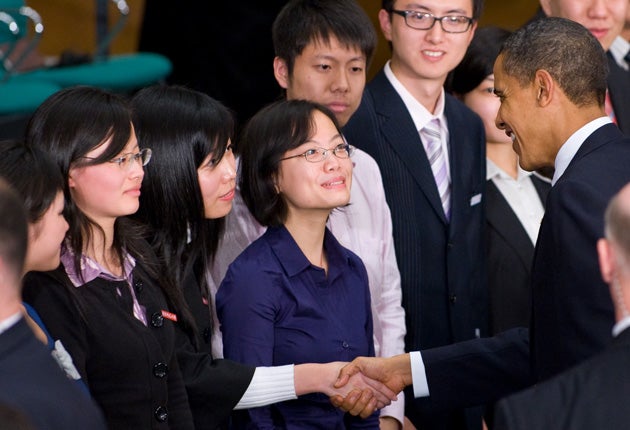
Barack Obama used his first day in China to offer a carefully worded critique of Beijing's record on freedom of speech, telling an audience of students that it was good for leaders to be forced "to hear opinions that [they] don't want to hear".
But by the end of the day that pointed message had been wrapped in a deferential approach apparently designed to avoid any serious clash with America's largest foreign creditor.
Mr Obama, on his first trip to Asia as US President, spent the evening in one of the great bastions of contemporary Chinese power, eating dinner with Hu Jintao – who had described the student meeting as "lively" – at the Diaoyutai State Guesthouse. Earlier, he had been welcomed at Beijing's international airport for the second leg of his maiden China voyage by Vice President Xi Jinping, the man tipped as most likely to succeed Mr Hu in a leadership transition expected in 2012.
On a trip that has a knotty agenda, with tough talking ahead on subjects from China's undervalued yuan currency to climate change, he struck a cordial tone even in his criticism.
"We do not seek to contain China's rise. On the contrary, we welcome China as a strong and prosperous and successful member of the community of nations," said Mr Obama. The US leader is likely to continue to take pains to foster good relations on a trip to the ancient Forbidden City in Beijing today.
Still, his words at the "town hall" style question and answer session with students in Shanghai included comments that were unmistakably critical of the Chinese government: politely, but firmly, defending calls for greater freedoms, and in particular with regard to the internet. China employs some of the world's tightest controls over the 250 million of its citizens who are internet users. Indeed, online news stories about Mr Obama's comments were quickly deleted.
In answer to a controversial question about the so-called "Great firewall of China", Mr Obama said: "I'm a big supporter of not restricting internet use. The more open we are, the more we can communicate." And he added: "I have a lot of critics in the United States who can say all kinds of things about me, [and] I actually think that that makes our democracy stronger and it makes me a better leader."
The reaction among ordinary Chinese to Mr Obama's visit has been mixed. "I think the more freedom the information enjoys, the stronger society will be. I strongly oppose censorship. But Obama is not our general secretary. His words are ineffective in China," wrote Lin Shixue on Sohu.com.
But Wu Jiangqi, 25, a graduate student in Beijing, said: "Obama is a special US President not only to American but also to Chinese. I still have big expectations for him. I hope he can maintain a good Sino-US relationship."
So far, Mr Obama has not mentioned Tibet or other issues that could have drawn ire ahead of formal talks today. He will sit down with Mr Hu in the Great Hall of the People in Tiananmen Square.
Mr Obama has said he will bring up human rights, which is likely to irritate his hosts, although not forcefully. This has long become routine in Sino-US dialogue, and rarely raises expectations on the US side nor hackles on the Beijing side. Nor does it appear to deliver much progress, although individual cases may be discussed in private.
On economic matters, China has bluntly rejected calls to raise the value of the yuan, which would make the country's exports more expensive.
Politically, it will be important to see how the leaders compare on strategic issues in the region, specifically the nuclear ambitions of Iran and North Korea.
Climate change will also feature on the agenda. Both countries have agreed on the need to reduce emissions ahead of the Copenhagen summit.
Join our commenting forum
Join thought-provoking conversations, follow other Independent readers and see their replies
Comments
Bookmark popover
Removed from bookmarks