Obama's exit strategy for Afghanistan
President will end weeks of White House division with plan for more troops and a 'civilian surge'
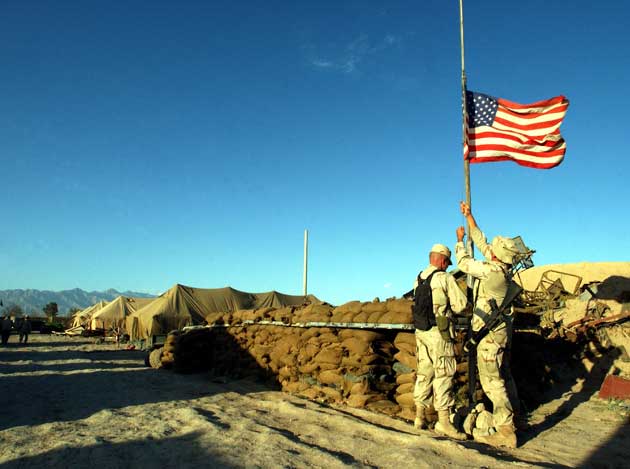
Barack Obama will vow to end the "drift" in the war in Afghanistan with a new plan to assert greater American control over the conflict, simultaneously ramping up attacks against the insurgents and deploying a "civilian surge" to bolster state institutions with the aim of leaving the country within three to five years.
First details of the long-awaited review, which will explicitly acknowledge there can no longer be any separating US actions in Afghanistan from relations with Pakistan, were revealed by Mr Obama to congressional leaders at the White House last night.
He is expected to publicly unveil the multi-pronged plan as early as today. It will be the moment that Mr Obama redefines the drawn-out Afghan war on his own terms. The announcement, which will not just determine strategy in Afghanistan but will also set the tone for US foreign policy more widely, will be made after weeks of divisive debate inside the fledgling Obama administration. It comes just ahead of an international conference on Afghanistan to be hosted by the Dutch government on Tuesday, and a Nato summit in Strasbourg at the end of next week.
Mr Obama has to explain why beefing up US commitments remains crucial to root out the al-Qa'ida threat while simultaneously trying to lower expectations about what constitutes "victory". Notably absent will be expressions of the utopian goals favoured by his predecessor, George Bush, about forging a Western-style democracy.
The decision to take a firmer grip of the tiller in Afghanistan will meet mixed reactions from other troop contributors, including Britain. It reflects American frustration both with the reluctance expressed by Nato allies to maintain troop numbers as well the shortcomings in coordination between the Nato contingents on the ground. The war is now in its seventh year and recent polls have shown fast-shrinking American support for it.
For all its promise of a new focus on a conflict that many believe was largely neglected by Mr Bush, the new strategy is likely to attract scepticism from foreign policy experts, some of whom will see it as half-cooked. And while a week ago President Obama said in a television interview that he will have an exit strategy for the war, it is not clear that setting a three- to five-year deadline will convince anyone.
"The big questions have not been grasped," said Daniel Korski, the author of a report on Afghanistan for the European Council on Foreign Relations. "Now there is an opportunity to do something serious, with the meeting in The Hague next week and the Nato summit providing an opportunity to step up to the plate very creatively."
In settling divisions between his advisers, Mr Obama has necessarily been forced to compromise, notably between voices who argued for a strategy of purely targeting and destroying Taliban and al-Qa'ida camps and those who wanted to take on the much broader task also of building institutions and protecting Afghan civilians.
According to sources close to the debate, the resulting document offers a four-headed strategy, including the adoption of the so-called "AfPak" approach in which Afghanistan and Pakistan will be handled jointly under the leadership of the special US envoy Richard Holbrooke. There is also a new emphasis on involving all neighbouring powers, including Iran, in the search for peace and regional stability.
The US State Department will be given responsibility for the "civilian surge", recruiting as many as 1,000 new non-military personnel to improve the functioning of state institutions, the police and preparing for the presidential elections due in August. The number of US officials is set to grow by at least 50 per cent. Mr Holbrooke has already spoken publicly of the need to reinforce the Afghan police.
Certain to trigger controversy is the fourth leg of the plan that envisions placing a much higher priority on bolstering provincial governments and institutions, a change of tack for which the United Nations has long been pressing. It will be interpreted in some quarters as a tactic to drain the importance not just of Kabul and the central government but also of President Hamid Karzai, who has increasingly been seen as a weak figurehead.
On the military front, Mr Obama has already ordered the deployment of an additional 17,000 US troops. They will join 38,000 US soldiers and 30,000 from assorted Nato allies who are already there. It is likely the new forces will largely be deployed in the troubled south of the country and border areas. The review is not expected to signal ground deployments in Pakistan because of resistance from Islamabad.
Another issue of furious debate inside Washington has been the idea of opening channels with so-called "moderate" Taliban leaders in Afghanistan to recruit them to the rebuilding effort. This approach, which may include financial inducements, drew early support from Mr Obama but was resisted by the Pentagon. Some officials believe Washington wants to reach out to mid-level Taliban commanders. Others believe the "reconciliation" effort will be more ambitious in scope – targeting senior Taliban officials directing the insurgency from outside Afghanistan.
Certainly, there is no consensus that simply increasing the American presence in Afghanistan will do any good. "We still have this idea that with more resources, more men, more money, we can do the job. And we cannot, actually. We need a new strategy. And there is nothing clearly indicating that we are at that point right now," Gilles Dorronsoro, an analyst at the Carnegie Endowment for International Peace, argued this week.
Washington, meanwhile, intends to press home the case for a more coherent Nato presence.
Join our commenting forum
Join thought-provoking conversations, follow other Independent readers and see their replies
Comments
Bookmark popover
Removed from bookmarks