Pakistan faces biggest human flood since 1947
Half a million people are being displaced by Pakistan's military operations against the Taliban
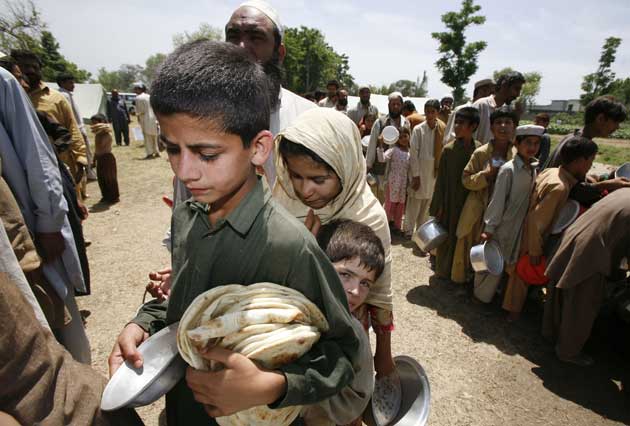
Her name was Sahin and in a matter of hours her world had been broken. As fighting raged in their hometown of Mingora – fighter jets screaming overhead and mortar fire pounding – she and her husband tried to escape with their 10 children. Amid the chaos, her husband was killed by an artillery shell. There was hardly time to bury him in the courtyard of a neighbour's house before Sahin was forced to think of the children and of somehow leading them to safety by herself. They walked for "hours and hours" before, in a neighbouring town, they found a bus. That bus brought them to a camp for the displaced, a place for the beleaguered, for those with nowhere else to go.
Now huddled with her six girls and four sons – three of whom are disabled – Sahin, in her early 50s, can barely think of the future. "Even if the conflict stops we cannot go back as the house has been destroyed," she said. Her family has barely more than the clothes they were wearing when they fled.
Across a 50-mile swathe of north-west Pakistan, countless stories similar to Sahin's could be told. Pakistan's military has mounted what appears to be a major operation against Taliban fighters who have seized control of several districts little more than 60 miles from the capital, Islamabad. "This is not a normal war. This is a guerilla war," Pakistan's prime minister, Yusuf Raza Gilani said yesterday. "This is our own war. This is war for the survival of the country." The army said 55 militants were killed in clashes around Swat yesterday.
Aid groups have warned of a human tide of up to 500,000 people fleeing their homes. The UN said an estimated 200,000 have fled the Swat valley and its main town, Mingora, in the past few days alone, while another 300,000 are poised to flee if they get the chance. This would create a total of one million people forced from their homes by fighting in the past 12 months. It represents the biggest internal displacement of people in Pakistan since independence more than 60 years ago.
"People are in shock. In some cases their homes have been destroyed by mortar shells. They are wondering when they'll be able to go back. Others say they will not be able to go back," said Antonia Paradela, an official with Unicef who interviewed Sahin and other refugees in the Sheikh Shehzad refugee camp near Mardan, a city in the south of the Swat valley. "This is the place where the families are coming. They are tired, sweaty, dusty. There are whole families crying because they have lost someone. But there is also a sense of relief to be out of the danger."
Under mounting international pressure, the government of Asif Ali Zardari and Pakistan’s military launched this week’s operation to drive the Taliban from the former tourist destination of Swat after a controversial, three-month ceasefire with the militants fell apart. After a previous military effort failed to dislodge the militants who had extended their violent influence throughout the valley over a two year period, the government in February signed a peace deal which included an agreement to establish Sharia courts in Swat and some neighboring areas.
The Taliban, however, failed to meet its end of the agreement and lay down its arms. Indeed, emboldened by the government's acquiescence, the militants then spread from Swat into the neighbouring and strategically important Buner valley. The army is also battling to drive the Taliban from Buner and nearby Lower Dir.
While journalists are, in effect, prevented from reaching the war zone, the military's operation – which involves more than 5,000 troops pitched against an estimated 5,000 Taliban fighters – appears unexpectedly firm, and officials said that 140 militants had already been killed in the past two days. Some observers had wondered whether the army, trained and prepared to fight a conventional war against India, had the will or the capability to take on a well-trained guerrilla enemy.
There was also speculation whether, in the week that Barack Obama outlined his new "Af-Pak" strategy to Mr Zardari and the Afghan leader, Hamid Karzai, in Washington, there may have been a reluctance to fight what could have been seen as another battle in America's war. The Obama administration's policy of using missiles fired from unmanned drones at suspected militant targets and the subsequent civilian "collateral damage" this causes is hugely unpopular in Pakistan.
Yet this time, several things appear different. From the start, the battle for Swat has been pitched as a battle for the future of the Pakistan – and one that has been directed by the Pakistani authorities rather than Americans. In a televised address on Thursday as the military operation was formally announced, the Prime Minister, Yousaf Gilani, said: "In order to restore honour and dignity of the country, the armed forces have been called in to eliminate militants and terrorists. We will eliminate those who have tried to destroy the peace of the country."
The seemingly widespread support for this operation, as opposed to Washington's drone strikes, appears based in large part on growing public dismay with the Taliban. With the Taliban having embarked on a policy of burning girls' schools and beheading their opponents, only to be "rewarded" with a deal that saw Sharia law enacted, the Pakistani public is growing more anxious as the militants' threat has increased rather than reduced.
Those involved in brokering the ceasefire say the Taliban have now exposed their true colours and must be dealt with by force. "What the people know is that we tried everything possible. The Taliban had their own agenda and that has become clear to people," said Bushra Gohar, the vice-president of the Awami National Party, which heads the regional government in the North West Frontier Province (NWFP). "We hope this will be a clearly targeted operation that will go after the training camps and the leadership."
Analysts say the operation to drive the militants from Swat and then hold the ground to allow the return of a civilian administration could take months. With the militants having established themselves across Swat's mountainous terrain over the past two years, even if the military succeeds in forcing them from Mingora and other towns, the Taliban could retreat to smaller adjacent valleys and strike back with bomb attacks on convoys, checkpoints and military camps. It is also likely that the militants could increase suicide strikes on targets outside Swat to act as a diversion.
Some commentators have speculated that in such circumstances, an inconclusive but bloody campaign with a large number of civilian casualties would undermine public support for the operation. The army says it is determined to succeed. "The army is now engaged in a full-scale operation to eliminate the militants, miscreants and anti-state elements from Swat," said the army's spokesman, Major General Athar Abbas. "They are on the run and trying to block the exodus of civilians from the area."
As a result, hundreds of thousands more people like Sahin are likely to be rushing desperately out of Swat and towards the refugee camps at the southern end of the valley in the coming days. At the moment, only a tiny fraction of the displaced are being housed in the camps – the majority being able to stay with relatives or in rented rooms – but in the coming weeks that could change.
Sahin, her children and some other members of her family have nowhere else to go. Five months ago, when an earlier spike in violence drove them from Swat, they were able to stay with relatives in Peshawar. This time, that option was not available to them, she said. For now the family must sit amid the tents of the camp at Sheikh Shehzad, waiting and wondering.
Join our commenting forum
Join thought-provoking conversations, follow other Independent readers and see their replies
Comments
Bookmark popover
Removed from bookmarks