Pakistan plays dangerous double game
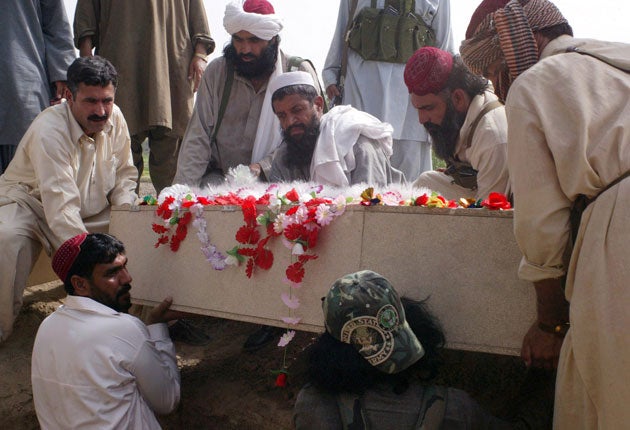
The assassin struck shortly after morning prayers, storming into a room at the compound where Qari Zainuddin was staying and opening up with a volley of fire. The militant leader was rushed to a nearby hospital but declared dead. Meanwhile, the gunman - apparently dispatched by Taliban leader Baitullah Mehsud - escaped in a waiting car.
The following day, in a cemetery of Muslim and Christian graves encircled by fields of maize, the 26-year-old, who in recent months had pitched himself against Mr Mehsud, was buried. The militant leader's funeral was notable for two things. Firstly the town was filled with checkposts manned by both Taliban and Pakistani security personnel. Secondly, when the dead man's brother, Misabhuddin, vowed to reporters that he would take revenge against Mr Mehsud, he also let slip something else. "Jihad against America and its allies in Afghanistan will continue as well," he said.
The killing last week of Mr Zainuddin, who had been staying in a compound provided by the country's ISI security agency, has opened a window on a complicated, controversial and perilous element of the battle against militants inside Pakistan. Mr Zainuddin, himself a Taliban leader who supported al-Qa'ida and jihad against Western troops in Afghanistan, had recently been recruited by the Pakistani authorities to join their battle to kill Baitullah Mehsud, who has emerged as the country's deadliest militant. In essence, Islamabad is recruiting anti-American fighters to bolster a joint US-Pakistani operation.
The arrangement underlines the competing strategic priorities in the region for Pakistan and the US, even as their leaders opt in public for the language of common interests and shared enemies. "Pakistan just wants to concentrate on the Pakistani Taliban. They do not want to go after the Afghan Taliban," said Giles Dorronosoro, a regional expert at the Carnegie Endowment. "The US wants to put the Pakistan-Afghanistan border under control. They have totally different goals. And the issue is not resolvable."
The Pakistan army continues to regard militants who are not fighting against it as enduring assets and in recent years a distinction has been made between "good Taliban" (pro-government) and "bad Taliban" (anti-government). In most cases, that distinction is between militants who fight in Afghanistan and those who fight in Pakistan
Indeed, for all his loathing of Mr Mehsud - a lot of which was based on historic, personal reasons - Mr Zainuddin was scarcely the model of a hero rising up against the local tyrant. In interviews that catapulted him from obscurity, Mr Zainuddin pledged fealty to Mullah Omar, the leader of the Afghan Taliban, declared his fondness for al-Qa'ida, and voiced support for holy war against US and NATO forces. Part of his quarrel with Mr Mehsud was a difference over the focus of their militant activities. While Mr Mehsud and his allies in the Swat Valley were principally fighting against the Pakistani military, Mr Zainuddin believed that it was wrong to attack fellow Muslims.
For the administration of Barack Obama, Pakistan's recruitment of such individuals poses a pressing dilemma. Since the beginning of the year and the emergence of Washington's new Af-Pak policy, a decision has clearly been taken to try and eliminate Mr Mehsud, a former bodybuilder, and a flurry of missile strikes have targeted him, most recently this week.
As a result, while the US might think twice before turning away help in the effort to kill a man on whose head it has placed a $5m bounty, the case of Mr Zainuddin is a powerful reminder that one's enemy's enemy might not always be a friend. "The forces that have been recruited by Pakistan to attack Baitullah Mehsud are our enemies," said Christine Fair, a Washington-based analyst. "The Pakistanis are looking to use one militant against another. So you have people such as Zainuddin and Maulvi Nazir [another militant recruited previously by Islamabad] who are Pakistan's allies. But the problem is that they are the US's enemies because they are supporting attacks in Afghanistan."
Mr Zainuddin clearly had his uses for the Pakistani military. The militant leader hailed from Mr Mehsud's tribe and came from the same area, around the town of Makeen in South Waziristan. The Pakistan army has said it needs local support on the ground to be able to take on such militants like Mr Mehsud. While his claim of having the support of thousands of fighters may have been over-inflated, with his backing the army could potentially have destabilised the Taliban commander on more than one front.
Yet as Ms Fair points out, previous arrangements with "good militants" have come to ruin. In 2007 when Maulvi Nazir of the rival Ahmedzai Wazir tribe in South Waziristan took on Uzbek groups aligned to al-Qa'ida and Mr Mehsud, the Pakistan army backed him. After his men killed 250 Uzbek fighters, the army entered a non-aggression pact with Mr Nazir and his associate Hafiz Gul Bahadur.
Yet the US continued to see Mr Nazir as an enemy as he was still mounting attacks across the border. CIA-operated drone attacks showered his base. Enraged, Mr Nazir and Mr Bahadur shed their differences and formed a new alliance with Mr Mehsud earlier this year. Indeed, the creation of that alliance may been a factor in the US deciding to begin targeting Mr Mehsud. Now, all three groups could be lined-up against the Pakistan army when it presses ahead with its counter-insurgency operation in South Waziristan.
More publicly, but with comparably damaging results, was Pakistan's brief embrace of Sufi Muhammad, the hardline cleric it enlisted to broker peace in the Swat Valley earlier this year. In late 2001, he led hundreds of young men to fight in Afghanistan. Jailed upon his return, he was released last year on the condition he disavow militancy.
Faced with the prospect of Swat falling to fighters led by Maulana Fazlullah, the cleric's son-in-law, the government halted its faltering military operation and sued for peace. Mr Muhammad was tasked with urging his relative to lay down his arms in return for the government's implementation of Islamic law. Within weeks, however, it not only emerged that the Taliban had no intention of changing their ways, but Mr Muhammad turned from a supposed pacifier to an active enabler of their activities.
Join our commenting forum
Join thought-provoking conversations, follow other Independent readers and see their replies
Comments
Bookmark popover
Removed from bookmarks