Pakistani spies helped Kabul bombers, US says
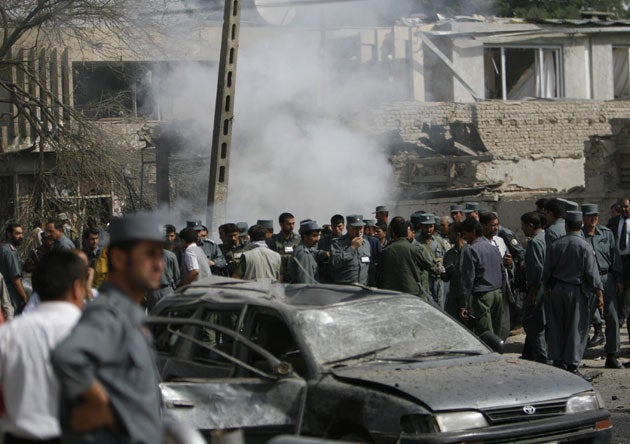
The US has accused Pakistan's notorious intelligence agency of assisting the militants who carried out the recent bombing of the Indian embassy in Kabul that killed 41 people, saying it has direct evidence to show the involvement of Pakistani officials.
In an unprecedented allegation, the Bush administration has also accused officials inside the powerful Inter-Services Intelligence (ISI) agency of passing on sensitive information to militants to enable them to escape attacks by the US military inside Pakistan. Two weeks ago, senior officials from the CIA travelled to Islamabad to confront the government with concerns about the involvement of "mid-level" officers.
While many in Washington have long expressed doubts about the commitment of some parts of the Pakistan establishment in confronting militants and while the ISI has long been known to have links with the Taliban, the new allegations represent the most serious charges levelled by the US administration since 11 September 2001. In the aftermath of the attacks on New York and Washington, the US has provided Pakistan with at least $10bn (£5bn) in exchange for its co-operation in the so-called war on terror.
"It confirmed some suspicions that I think were widely held," a state department official told The New York Times. "It was sort of this 'a-ha' moment. There was a sense that there was finally direct proof." While the officials who briefed the newspaper have so far declined to reveal the full details of the evidence they say they have, they revealed it was based on intercepted communications between the militants blamed for the attack and Pakistani intelligence officers.
Separately, one administration official said there was evidence that "rogue" elements inside the ISI had tipped off militants with information that allowed them to launch more effective attacks from inside Pakistan's tribal regions against Afghan and Western troops. There is particular concern about links between some Pakistani intelligence officials and the network of Jalaluddin Haqqani, who has been blamed for the attack on the Indian embassy on 7 July.
In the aftermath of the attack, both Afghan and Indian officials blamed "elements" inside Pakistan for assisting the bombers. The rhetoric between Pakistan and India sharply increased and India's Foreign Secretary Shiv Shankar Menon said the peace talks taking place for the past five years had become stressed as a result.
Yesterday Pakistan again rejected the allegations directed at the ISI. A Foreign Ministry spokesman, Mohammed Sadiq, said the newspaper report was "total rubbish" and that there was no evidence of ISI involvement. He added: "The foreign newspapers keep writing such things against ISI, and we reject these allegations."
The timing of the US allegations is somewhat curious. There has been mounting concern from the West as well as the Afghan authorities about the failure of the new Pakistan government to halt the flow of militants into Afghanistan. The US in particular has been critical of the policy of Pakistan's recently elected civilian government to try to broker peace accords with militants in the border region.
Yet the Pakistan army has continued to confront militants and, in the past six weeks, has launched several major military initiatives, including one in the area north of Peshawar. Just this week, there were clashes with militants in the Swat valley that left dozens of people dead, including many civilians. Whatever specifically has triggered the decision by the US to confront Pakistan, five days after the Kabul bombing the CIA's deputy director, Steve Kappes, and the chairman of the Joint Chiefs of Staff, Admiral Michael Mullen, travelled to Pakistan for high-level meetings. Apparently they said they had evidence – said to be confirmed by Indian intelligence – that elements inside the ISI were routinely aiding the Taliban and al-Qa'ida. One official said the information being divulged to the militants by the ISI was "not only increasing their offensive capability, but also their defensive capability".
Pakistan's 'state within a state'
No organisation in Pakistan rivals the clout of the directorate of Inter-Services Intelligence, or ISI. Since its founding 60 years ago, it has progressively grown in influence to the point where it is routinely described as "a state within a state" and is suspected of meddling in nearly every aspect of Pakistani life.
Political parties and human rights groups accuse it of rigging elections, intimidating political opponents, "disappearing" hundreds of people without charge or trial and even overthrowing governments. It also resists government control, as evidenced by last week's abortive attempt to place it under the Interior Ministry.
The ISI achieved this eminence under the patronage of Pakistan's military rulers, who have run this country for more than half its history. Most notably, General Mohammad Zia-ul-Haq, right, the longest-serving military dictator – made the agency his chief instrument in the Afghan war against the Soviets. In the 1980s, it served as a key intermediary for channelling covert US funds and arms to the mujahideen – in particular, Gulbuddin Hekmatyar's Hizb-e-Islami party.
In subsequent years, the ISI deepened its links with Islamist militant groups. Hundreds of madrassa students were armed and trained to fight a proxy war against India in disputed areas of Kashmir. The ISI was also instrumental in setting up the Taliban. Squabbling mujahideen groups were united in Afghanistan and later sprung to power. Pakistan saw the Taliban victory as providing "strategic depth" in its efforts to counter Indian influence in the region.
That policy came to haunt Islamabad after 11 September 2001, and General Pervez Musharraf was forced to perform a swift volte-face. It has since been through a series of purges, and repeatedly targeted by suicide bombers. But in Pakistan, as in Washington, suspicions linger that elements within the ISI are not prepared to sever their links with their former clients.
Omar Waraich in Islamabad
Join our commenting forum
Join thought-provoking conversations, follow other Independent readers and see their replies
Comments