Petraeus's first act is to establish militias to fight the Taliban
General persuades a reluctant President Karzai to sign up to tactics imported from Iraq
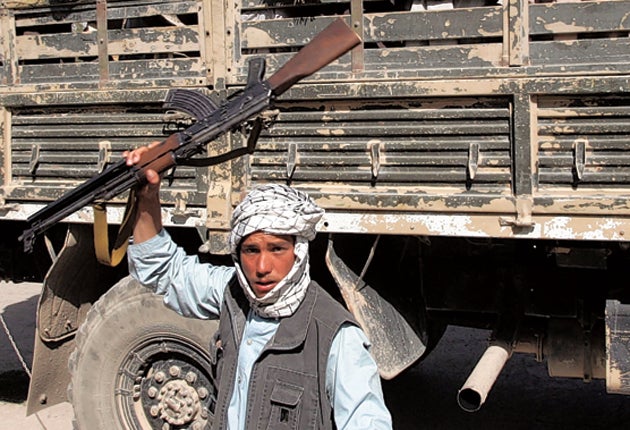
Armed militias of the type used to fight the insurgency in Iraq are to be introduced to Afghanistan in what is seen as a controversial part of the new strategy of General David Petraeus to counter the tide of Taliban attacks.
The setting up of the groups – who will provide up to 10,000 fighters – is the first major initiative by General Petraeus after taking over command of Western forces in the Afghan campaign following the sacking of his fellow American, General Stanley McChrystal.
The move, has, however, faced resistance from Afghanistan's president, Hamid Karzai, who fears that the groups would become power bases for regional strongmen. His spokesman, Waheed Omar, said: "We don't want a short-term objective to endanger a long-term objective for security."
But General Petraeus, who used similar tactics in organising the so-called Sunni Awakening groups during the "surge" in Iraq, holds that local defence forces are vital in rural areas. They will help counter the Taliban while members of Afghan army and police forces are trained, as the chorus of Western politicians clamouring for a timeline for their forces to be withdrawn grows.
According to US sources, General Petraeus took personal charge of the intensive negotiations regarding the establishment of the militias. After 12 days of wrangling, he has managed to persuade the Afghan leader to accept his plan – passing a crucial first test in his relations with Mr Karzai after what has been a turbulent period, with the departure of General McChrystal and mounting Nato casualties.
More than 100 foreign troops have been killed in the past month, and another seven Americans were killed in attacks on Tuesday and Wednesday in southern Afghanistan.
However, the plan to arm Afghans, whose loyalties may be uncertain, is proving controversial. There was a startling reminder of the dangers this week, when a member of the Afghan army killed three British soldiers at Patrol Base Three in Nahr-e-Saraj. Eight months earlier, five British soldiers were shot down by an Afghan policeman in another part of Helmand.
Previous attempts to form irregular forces in Afghanistan have proved problematic, with government-licensed fighters accused of extorting money and favours from local populations.
Colonel Sheren Shah Kobadi, a senior Afghan army officer in Helmand, who would have to work alongside the militias, said yesterday: "My first reaction is that I am against it. This has to be handled very carefully, it has been tried before and has led to trouble. What we don't want are tribes turning on each other because some have government money and weapons and others haven't."
In an attempt to assuage Mr Karzai's concerns, the new apparatus will be formally put under the control of the Afghan interior ministry. "The size, salary and the period for which it will be required will be prepared by the interior ministry," said Hamid Elmi, another government spokesman. But with the ministry lacking the resources or the expertise to oversee such a project, it is expected that Nato's International Security Assistance Force will provide much of the training and funding.
Senior Nato officers have also expressed concerns about private armies already in existence – run, among others, by Mr Karzai's brother, Ahmed Wali Karzai, in Kandahar, the southern birthplace of the Taliban where a US-led military operation is due to take place later this year.
The militias are to be deployed in less inhabited areas, which have seen a drawdown of Western forces in accordance with General McChrystal's decision to concentrate on more populated centres. The groups are expected to be recruited from local communities, with liaison taking place at provincial level.
Taliban insurgents have repeatedly struck at militia groups formed to oppose them, both in Afghanistan and Pakistan. A suicide bombing aimed at such a group in Kandahar last month killed 40 people, while over a hundred died in another suicide attack at a similar target in Pakistan earlier this week.
Money provided by Nato forces to local leaders in southern Afghanistan to form anti-Taliban bands has also led in the past to friction, with complaints from the tribes that did not receive the subsidies. There were also claims that Western-sanctioned groups had used their power to intimidate and dominate.
But US officials insist that the new groups would be far better organised and managed. "These would be government-formed, government-paid, government-uniformed local police units who would keep any eye out for bad guys – in their neighbourhoods, in their communities – and who would, in turn, work with the Afghan police forces and the Afghan Army to keep them out of their towns," said Geoff Morrell, a Pentagon spokesman. "This is a temporary solution to a very real, near-term problem."
Join our commenting forum
Join thought-provoking conversations, follow other Independent readers and see their replies
Comments