Plantation linked to junta is 'destroying' Burmese tiger reserve
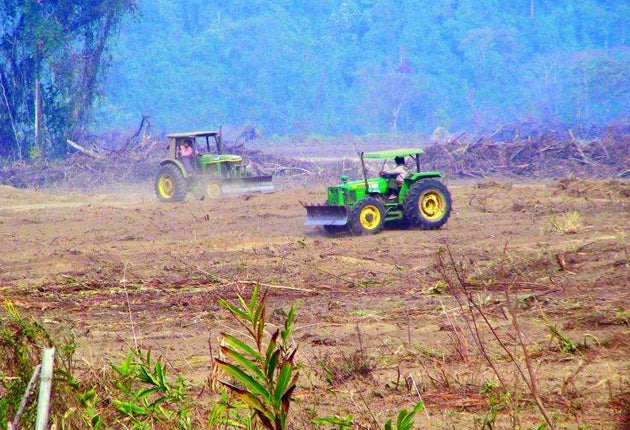
The world's largest tiger reserve, in the wilds of northern Burma, is being rapidly eroded as a businessman with links to the junta replaces trees with cash crops, according to a report published yesterday.
The Hukaung Valley Tiger Reserve in Kachin State was created in 2001 with the support of the Wildlife Conservation Society. When it was expanded in 2004, the society hailed it as "the biggest tiger reserve in the world".
"In the northernmost stretches of Myanmar [Burma]," the society's latest newsletter reported earlier this month, "a valley exists where tigers can just be tigers. Country officials have declared the entire Hukaung Valley a protected tiger area. With 8,452 square miles in which to roam, hunt and hopefully breed, the region's remaining tigers have a chance too few of their kind currently enjoy".
But according to a report by the Kachin Development Networking Group, there has been wholesale destruction of large areas of forest for mono-crop development. Yuzana, a company owned by U Htay Myint, a wealthy businessman close to Burma's ruling generals, has taken over 200,000 acres in the south of the reserve. The Yuzana Integrated Agricultural Project began in 2007 with the junta's blessing.
The company is building a "green zone" enclave, within the project area, containing workers' barracks, a factory and a supermarket and surrounded by two metre-high concrete wall. Clashes have broken out between the company and villagers within the project area, and more than 160 families have been forced to move, the report said. It said with the villagers out of the way, the forest greenery was killed off with herbicide. Then Yuzana's bulldozers and excavators dug out and hauled away the debris, leaving large swathes of flattened and denuded land.
Only the tiger reserve's signposts remained in the cleared areas. "When there are many forests, it is a hot-spot for biodiversity," reads one of the signs. Another sign said: "Mountains and forests are deep; the animals have a good home and food."
The machines then carved deep irrigation canals between the eviscerated blocks of land, allegedly bisecting all but one of the tiger corridors running through the park which are meant to allow tigers and other wild animals to roam and hunt. The threat to the reserve has not gone unnoticed.
In 2007 BirdLife International, a global partnership of conservation organisations, reported on Yuzana's incursions. In March 2008 the organisation said that a strip of forest up to 1.5mile-wide that ran for 50 miles had been almost completely felled and re-planted with sugar cane and jatropha biofuel plantations. The authors of the new report say that "as of February 2010 [we] were unable to see any remaining forests in animal corridor areas [within the agricultural zone]. Only the signboards of the forest department and the Wildlife Conservation Society were left standing."
Ah Nan, spokesperson for KDNG, said: "The destruction in Hukaung makes a mockery of the tiger reserve. Yuzana is doing whatever it likes with the aid of the generals and the silence of the conservationists."
In plans to be submitted to next month's Global Tiger Summit in St Petersburg, Burma's military regime boasts that it will double the country's tiger population by 2022. But last October WCS said that there were fewer than 100 tigers left in the Hukaung Valley Tiger Reserve, a decline from the previous figure of 150.
WCS was not available for comment.
Join our commenting forum
Join thought-provoking conversations, follow other Independent readers and see their replies
Comments