Record rains – but Pakistan is dying for water
Floods kill more than 800, but lack of clean drinking water leaves 600 children dead from disease every day
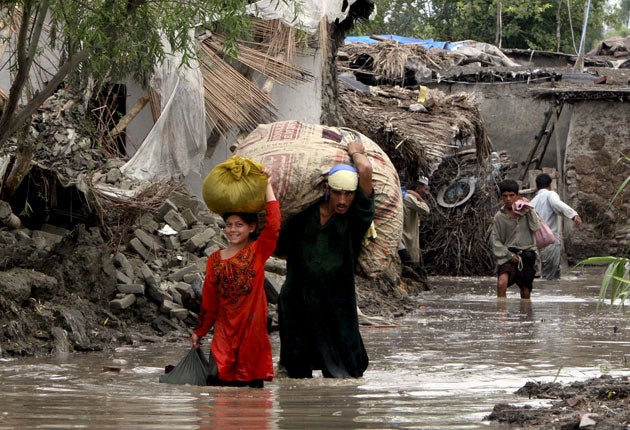
Pakistan is a place used to wretched ironies but few have been so starkly drawn as the one that haunts it this weekend. Record-breaking rainfall has brought floods which have so far killed more than 800 – all in a country that faces a water crisis so severe it will stalk the country for decades after the present torrents have receded.
The lack of clean drinking water has led to a diarrhoea epidemic, with an estimated 630 children dying each day from the disease. Nearly a third of Pakistan's 175 million people lack access to clean drinking water, and water availability per person has fallen from about 5,000 cubic metres in 1947, when the country was founded, to only a fifth as much today.
The lack of clean water threatens the lives of its poor and weakens its sagging economy as a rapidly growing population and parched agricultural sector are deprived of crucial supplies for drinking and irrigation. Despite the national and global attention that is given to the country's troubles with terrorism, insurgency and a fragile political order, it may be Pakistan's little-noticed water crisis that costs the greatest number of lives. In the long term, this may prove its most destabilising political issue. According to a recent report, water and sanitation-related diseases cost Pakistan's national economy nearly £1bn a year. Yet critics say that the government has paid scant attention to the problem and has approached it wrong-headedly. A new water policy is emphasising the need to develop new water filtration plants and adopt better hygiene practices. There is a plan in place to build over 6,000 new water filtration plants, but little progress is in evidence.
Under the government of the fallen dictator General Pervez Musharraf, nearly £100m was committed to a "Clean Drinking Water for All" programme that never saw completion. The major problem, critics say, is that the water residents depend on arrives contaminated by untreated sewage, industrial waste, salts and other chemicals.
Government advice to "boil" water before drinking and pay attention to hygiene does nothing to improve the quality of the water. The government is also either unwilling or unable to act against those who contaminate the water.
In contrast, Pakistan's elite has the means to purchase regular supplies of bottled drinking water, a luxury beyond the reach of most in a country where more than 60 per cent live on less than $2 (£1.25)a day.
To put matters in their depressing context, the number of children who perish daily from water-related diseases is several times higher than the rate at which people perished in last week's devastating floods.
On Saturday, Mian Iftikhar Hussain, the information minister for the north-west province of Khyber-Pakhtunkhwa, said that more than 800 people had died as a result of last week's monsoon floods, the worst since the deluge of 1929.
Desperate rescue efforts are under way, with 400,000 stranded amid perilously high levels of water across the north-west. The United Nations has estimated that one million people across Pakistan will be affected by the natural disaster. Many of those rescued are exhibiting symptoms of fever, diarrhoea, and other waterborne ailments.
The twin hazards of perilously low levels of water for most of the year followed by summer weeks of calamitous flooding illustrate the scale of the problem for countries such as Pakistan. It is often the same countries that suffer limited supplies of clean water that also endure flood devastation.
Poor infrastructure means that there is no effective means of absorbing the effects of heavy monsoon rain. The proposed construction of a number of dams has been halted due to a mixture of political sensitivities and bureaucratic inefficiency. And inadequate resources limit efforts to mount effective rescue operations.
Experts say Pakistan's rapidly depleting supplies of water are a product of an escalating population and the deleterious effects of climate change. Much of Pakistan's water is dependent on shrinking glaciers.
Since Pakistan was founded more than 60 years ago, water availability per person in the country has shrunk by 80 per cent. In 1947, sta-tistics suggested each person had 5,000 cubic metres (175,000 cubic feet) per year; today, they have 1,000 cubic metres.
Over the past six decades, the population has swollen from 34 million in 1951 to nearly 175 million today, making Pakistan the sixth most populous nation on earth. The population continues to grow at a rate of 1.6 per cent.
Water has also featured prominently in Pakistan's long-standing disputes with its arch rival, neighbour and upriver nation India. The 1960 Indus Waters Treaty which set out an equitable distribution of the six rivers that flow from Indian Punjab and Indian-controlled Kashmir into Pakistan is now under severe strain, despite having withstood three wars.
India is pursuing the construction of a water-diversion scheme in Indian-administered Kashmir that would reroute water from the Kishanganga river to the Jhelum river before it is able to reach Pakistan-administered Kashmir. In addition, India has more than 20 hydro projects active on the three western rivers allocated to Pakistan in Pakistani-administered Kashmir. It is proposing to build another 10. India argues these schemes do not violate the terms of the treaty since water is returned downstream after running through dams for power generation.
But Pakistan is worried about the cumulative effects of India's aggressive water policy. Islamabad has sounded an alarm over alleged violations of the treaty, an issue that figured in last month's failed peace talks between the two countries' foreign ministers in the Pakistani capital.
The coveted water supply is a lifeline for Pakistan's agricultural sector, which makes up at least a quarter of the country's economy and employs half of its workforce. Pakistan's worries are focused on Punjab, the country's bread basket where the famed rivers that give the largest province its name are drying. The depleting rivers have ruined small farmers and given burgeoning militant groups there a fresh rallying cry.
Pakistan complains that India is in a position to choke water supplies by manipulating distribution and storing water when it needs it the most. If India chooses to fills its dams at certain moments, entire crops in Pakistan could be ruined. The Kishanganga hydro-electric project in Kashmir, Islamabad claims, will have adverse effects on its own Neelum-Jhelum project, built with Chinese backing. In May, it submitted the case for arbitration.
Pakistan is also in dire need of more reservoirs, particularly for use in the winter. Two-fifths of the river Indus's flow is derived from the summer melting of glaciers in Kashmir. Pakistan's two large dams are silting up. And long-standing proposals for fresh dams, needed to relieve the country's power shortage, have been frustrated by provincial political disputes. Currently, major cities are without electricity for up to 18 hours a day.
But Pakistan is also a victim of its own poor farming and irrigation techniques. More than a quarter of the water used for agriculture is wasted, as many farmers favour the flood irrigation method. Even basic measures such as canal lining, despite heavy lobbying by politicians from agricultural backgrounds, have yet to be implemented. There is little means of water conservation in practice. And, in the brutal summer heat, when temperatures can soar to more than 50C, in excess of a third of the water is lost before it reaches the roots of plants.
Join our commenting forum
Join thought-provoking conversations, follow other Independent readers and see their replies
Comments