Relief for the US as Karzai concedes election run-off
Doubts over whether fresh ballot can be set up before the winter closes in
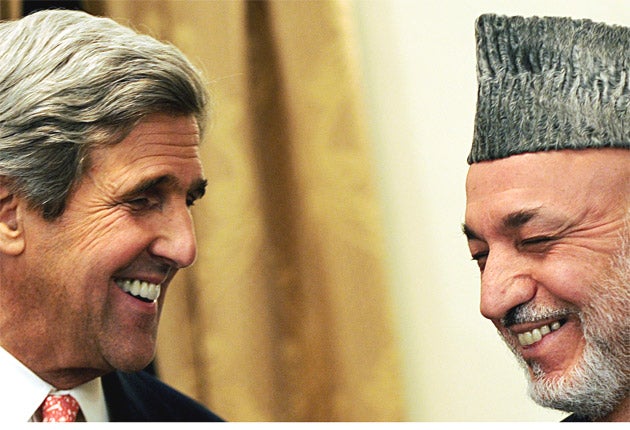
Two months to the day that the people of Afghanistan cast their ballots for president, Hamid Karzai yesterday finally caved to intense international pressure and reluctantly agreed to a run-off vote next month.
Washington, London and Paris all praised his statesmanship for agreeing to a second round with his rival, Abdullah Abdullah, on 7 November. No one mentioned the widespread fraud that had seen the UN election auditors strip Mr Karzai of nearly a third of his first-round votes.
Standing by the Afghan leader's side in the splendour of the presidential palace in Kabul, the US Senator John Kerry congratulated him for transforming "a time of enormous uncertainty... into a time of great opportunity". Yet much remains uncertain.
There are still serious questions about how to organise another ballot in less than three weeks, with the UN secretary general, Ban Ki-moon, admitting it would be a "huge challenge". He said in New York: "We have learnt very valuable but painful lessons from the first election. We must not repeat what they have done last time."
But there are severe doubts that the fraud that plagued the 20 August ballot – when boxes were stuffed and turnout exceeded the number of registered voters in some places – can be eliminated next time around. More than 200 corrupt election officials have been fired, but the Independent Election Commission has been so fixated on wrangling over first-round results that it has done almost nothing to ensure that the thousands of part-time staff needed to man polling centres will be any more competent or impartial.
Last night diplomats had not ruled out a deal between Messrs Karzai and Abdullah that would avoid the need for a second round. Yesterday's announcement of the run-off date was delayed by several hours as power-sharing discussions dragged on, but the parties were unable to find enough common ground.
The Afghan Independent Election Commission, which had initially seemed as if it would reject the UN team's fraud findings, yesterday ruled that Mr Karzai's share of the first-round vote had fallen to 49.7 per cent, down from the preliminary result of 54.6 per cent, and below the 50 per cent needed for an outright win.
As a Pashtun, Afghanistan's largest ethnic group, Mr Karzai is almost certain to win the run-off, although voter apathy will probably reduce the turnout, and the shadow of the first-round fraud will linger. A deal with Mr Abdullah would not only avoid the logistical headache of getting the vote organised before winter cuts off swaths of Afghanistan, but might also remove the incentive for the Taliban to launch a new wave of attacks, as well as allowing Barack Obama to proceed swiftly with a decision about whether to send extra US troops to stabilise the country.
"The message from the international community is, for the sake of your people, reach some kind of agreement," said one Western diplomat in Kabul.
Mr Karzai, who has been engaged in dangerous brinkmanship with his Western allies over the past days, looked uncomfortable at yesterday's press conference, flanked by the top UN diplomat in Afghanistan, Kai Eide, and US Senator John Kerry, who is credited with extracting the concessions from him in five sets of talks over the last 72 hours. The Afghan President praised the patriotism that had led his countrymen to vote despite intimidation by the Taliban, but made scant mention of the U-turn he had just performed.
His biggest headache in cutting any deal with Mr Abdullah is accommodating the interests of the tapestry of warlords and strongmen he collected in his bid for re-election. Many, such as General Abdulrashid Dostum, a serial human rights abuser with a track record of switching sides, only threw their weight behind him at the last minute. If they sense that Mr Karzai is unable to deliver the power they want, they could desert him.
Meanwhile Mr Abdullah is buoyed up by his progress to the run-off stage and knows he is in a strong bargaining position, although he will be under pressure too. Mr Abdullah told the BBC: "Going to the second round... is exactly what I want to do."
Afghan voices: Anger on the streets
Fazel Rahman, moneychanger "100 per cent I'm angry... We have economic problems and security problems and all because of this not announcing the result. Without security there will be no construction, no work, there will be corruption. If we don't have security it means we don't have anything."
Shah Mahmood, businessman "This is the international community's fault and the fault of the government. It's not happening in other parts of the world... We hope that the problems should be solved in the next government, but as long as this system, this Karzai government, is in power it won't solve our problems."
Haji Abdul Hakim, carpet dealer "For two months people have waited. There are lots of problems. Business is very slow. Everyone is making a loss. I am a shopkeeper and I cannot eat. Democracy? The original idea of democracy is good but the UN doesn't know about it. Everybody is angry. There are no jobs, and winter is coming."
Haji Mohammad, shopkeeper "The biggest problems are corruption, the Taliban, instability, and the government because they appointed thieves and smugglers. The fraud in the election is a big problem. It is not acceptable for God, for society, or for the sharia [Islamic law]. And we don't want warlords in the government."
Join our commenting forum
Join thought-provoking conversations, follow other Independent readers and see their replies
Comments