Rift with Karzai worsens as 95 perish in Nato air strike
Deadly attack undermines politicians’ attempts to convince public that Afghan war is worth fighting
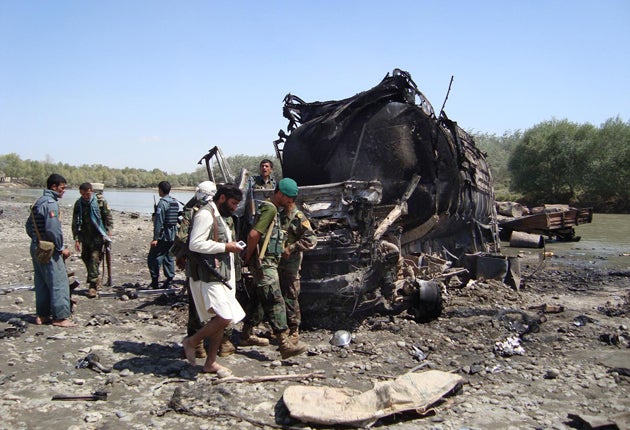
Western forces were engulfed in bitter controversy yesterday after Nato air strikes on two oil tankers hijacked by the Taliban in northern Afghanistan led to carnage with a fireball killing 95 people, dozens of them civilians.
Most of those who perished were burned to death. Nato initially insisted that all the dead were Taliban insurgents but later, after angry protests from residents and officials, they acknowledged there had been civilian deaths.
The attack at the village of Haji Aman, around seven miles from Kunduz, could not have come at a more volatile time in Afghanistan, with intense anger over civilian casualties and an intensifying clash between President Hamid Karzai and Washington over the disputed national election. The incumbent President has repeatedly complained about civilian deaths from Nato air strikes.
The chain of events leading to the Kunduz bloodshed began with Taliban fighters hijacking two fuel trucks near a Nato base on Thursday night. The truck drivers were said to have been beheaded at the roadside before the militants made off with the vehicles. An unmanned drone aircraft was dispatched to track the vehicles. What happened subsequently is unclear.
Those injured in the air strike were ferried by ambulances, taxis, tractors and carts to the central hospital in Kunduz. Sitting in a corridor as a stream of people were taken into adjoining wards, Ghulam Yahya wept: "My brother was burned when the aircraft bombed the fuel tankers, I don't know whether he is dead or alive."
The commander of Nato forces in Afghanistan, General Stanley McChrystal, last night contacted Mr Karzai to say that he was committed to investigating the incident. Questions were being raised specifically over how the events at Kunduz sit with orders issued by General McChrystal that air strikes should not be authorised unless it is first confirmed that there is no prospect of civilian casualties, or allied forces are in imminent danger. The directive is part of the General's new strategy of "protecting the people".
The killings and the subsequent row also take place against the backdrop of dwindling support for the Afghan war in Europe and America, with Gordon Brown forced yesterday to defend the continuing presence of British troops.
The deaths also came just 24 hours after the US Defence Secretary Robert Gates denied that the war in Afghanistan was "slipping through the administration's fingers". He moreover dismissed suggestions that it was time to pull all US troops out of Afghanistan and fight the war only with air strikes and drones. "The notion that you can conduct a purely counter-terrorist kind of campaign, and do it from a distance, simply does not accord with reality," Mr Gates said.
As President Barack Obama reviews a report from General McChrystal on recalibrating the war, he also knows that public support for it is diminishing rapidly. A CNN poll this week showed that 57 per cent of Americans are now opposed to the war.
The United Nations expressed its "deep concern" about what had happened. Peter Galbraith, the deputy head of the organisation's mission to Afghanistan, said: "Steps must be taken to examine what happened and why an air strike was employed in circumstances where it was hard to determine with certainty that civilians were not present."
Two local MPs said feelings against foreign forces were running high in the area. "We are very upset; a lot of ordinary people have been killed," said Mohammed Amin Qaneh. "Why did they have to bomb the tankers? Does Nato put the price of oil higher than the price of blood? We want justice; we want those responsible punished."
Fellow parliamentarian Qaari Niamtullah added: "Everyone is very angry and the Taliban will just exploit this to get support."
Local people said the hijackers had faced difficulty when they reached Kunduz river at the Haji Aman crossing, and asked villagers to help themselves to the diesel. This is when the bombing happened. According to German officials, the unmanned plane's cameras showed no presence of civilians.
Later yesterday a Nato spokesman, Brigadier-General Eric Tremblay, said: "It would appear that many civilian casualties are being evacuated and treated in the local hospitals. There is perhaps a direct link with the incident that has occurred around the two fuel trucks."
The civilian toll: Innocent victims
*December 2001
The US is accused of killing around 100 civilians in a reported attack on the village of Qalaye Niazi.
*October 2006
According to claims by Afghan officials, an erring Nato air strike in Kandahar province kills at least 60 civilians.
*June 2007
Air strikes in Helmand province kill up to 80 people, according to claims by locals.
*November 2008
A wedding party in Shah Wali Kot in Kandahar province is reportedly bombed by a US plane, with around 40 civilians, including 23 children, killed, according to witnesses from the village of Wech Baghtu.
*May 2009
Villages in western Farah province are bombed by US planes, in an attack which, an investigation conducted by the Afghan government concludes, killed 140. The US military claims the figure is lower.
Join our commenting forum
Join thought-provoking conversations, follow other Independent readers and see their replies
Comments