Secret deal to keep Karzai in power
Afghan President's alliance with rival designed to prevent civil war after election
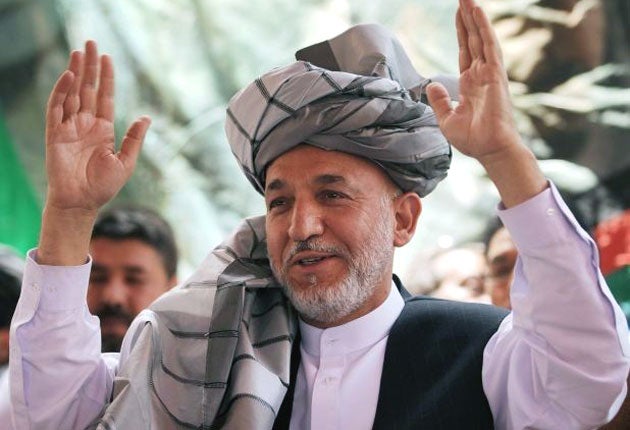
With less than two weeks to go until national elections, the Afghan President, Hamid Karzai, is trying to cut a secret deal with one of his rivals to knock out his leading contender and ensure a decisive victory to avoid the chaos that a tight result might unleash.
Afghanistan's second democratic polls threaten to split the country along sectarian lines. That would risk undermining US and British-led peace efforts which are already under pressure from a resurgent Taliban.
Mr Karzai and his main challenger, Abdullah Abdullah, hail from different ethnic groups and different regions. If neither wins outright in round one on 20 August, officials fear Afghanistan could be engulfed by violence reminiscent of the civil war of the 1990s.
"The whole country is armed. Everybody has weapons. You have to keep everyone happy," an Afghan analyst said. Mr Abdullah's campaign staff have threatened to hold demonstrations should Mr Karzai win, insisting that he could only do so fraudulently.
Mr Abdullah's supporters, who are largely Tajik, have warned of Iranian-style protests, but "with Kalashnikovs", should the President win a second term. Although Mr Karzai, a Pashtun, is still the favourite, his supporters fear that a third candidate, Ashraf Ghani, could split the Pashtun vote, depriving the President of the 51 per cent share he needs to win, and opening the door to Mr Abdullah.
Yesterday, details emerged of how the President was trying to join forces with Mr Ghani to unite the Pashtun vote and knock Mr Abdullah out of the race. Officials said the President had offered Mr Ghani a job as chief executive – a new post described as similar to prime minister. "If Ghani agrees to the terms, Karzai will dump his team and move forward, with Karzai as President and Ghani as chief executive," a campaign official told The Independent last night.
Richard Holbrooke, the US special envoy to Afghanistan and Pakistan, and Karl Eikenberry, the US ambassador, are understood to have discussed the proposal with Mr Ghani late last month. "It makes sense," a policy analyst with close links to the US administration said. "Holbrooke likes Ghani, and he has come round to the fact that Karzai will probably win."
The idea of a chief executive was hatched in Washington as a way of handing the responsibility of running the government to a skilled technocrat. Mr Ghani has an impressive pedigree as a former university professor and finance minister. Two years ago, he was a contender to head the World Bank. What he lacks – and what might make the deal attractive to him – is the grassroots support that Mr Karzai and Mr Abdullah enjoy.
Sources close to the President's inner circle confirmed that they had made an offer to Mr Ghani two weeks ago and the President's brother, Qayum Karzai, had made the first approach.
"For Karzai it's logical," said a businessman with friends in the President's team. "He doesn't want to divide the Pashtun vote, and if it goes to a second round he's going to lose."
US embassy officials have denied any involvement in back-room deals. Foreign diplomats are desperate to avoid being seen to be influencing the election but the international community is equally keen to avoid bloodshed when the results are announced.
Last night, Mr Ghani's staff said he was campaigning as usual and had no plans to pull out of the race. They said the Mr Karzai's offer was proof of their own candidate's strength.
The President, who has been in power since US-led troops overthrew the Taliban regime in 2001, has been criticised for his lack of control outside of the capital, the slow pace of development and endemic government corruption, but many people admire him for weaving friends and enemies together. "He has always played a game with the Northern Alliance, the Hazaras and the warlords," said the Afghan analyst. "Giving people positions and promises, he was very clever keeping everyone together."
During this election campaign, Mr Karzai has made deals with tribal leaders and local strongmen, promising them positions and patronage in exchange for the votes they control. International officials believe as many as 20 cabinet positions have already been pledged. It is unclear what would happen to these deals if Mr Ghani came on board. However, some observers believe the deal could signal the emergence of a unity government. "Everyone realises that winner takes all won't work," said one.
Violence, already at its worst since the Taliban were ousted after the September 11 attacks, has increased in the run-up to the poll. Yesterday brought news of a bomb attack on a family heading to a wedding in Garmsir, in Helmand province. Five people were reported killed. In a separate attack, in Naad Ali, five policemen died when a bomb exploded near their vehicle.
In western Afghanistan, a roadside bomb killed four US Marines, bringing the death toll of Western troops for the first week of August to at least 15.
Join our commenting forum
Join thought-provoking conversations, follow other Independent readers and see their replies
Comments