Spectre of unrest looms after Afghan polls marred by fraud
Allegations of intimidation, ballot-box stuffing and miscounting threaten the country's fragile democracy. Kim Sengupta reports from Nad-e-Ali, Helmand
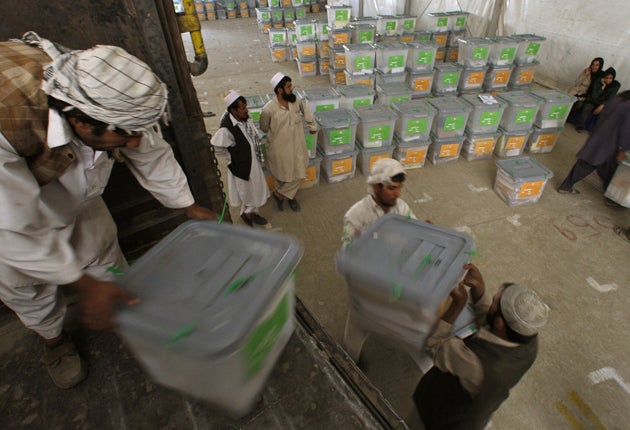
Reports of widespread and systematic fraud and intimidation continued to emerge amid delays in the counting of votes in the Afghan elections, raising the spectre of turbulence when the results are announced.
Allegations of ballot-rigging were particularly prevalent in the southern Pashtun belt. The region, which holds the key to the contest, also suffered from drastically low turnout due to Taliban violence and threats. There were accounts of the insurgents' retribution against voters, including fingers being chopped off.
Afghanistan's Free and Fair Election Foundation, the country's biggest monitoring body for the polls, detailed instances of false tallying of votes, coercion of voters and multiple and under-age voting. European Union observers insisted that despite problems the polls had been generally free and fair. But The Independent on Sunday, which visited polling stations on the Helmand frontline, where observers were not present because it was deemed too dangerous, witnessed apparent examples of fraud.
In Nad-e-Ali, the most populous area of Helmand, one polling station showed a tally of 44 at lunchtime, which remained the same when the polls closed at 5pm. At a second, the lunchtime figure was 30; it rose to 50.
At a third station the 1pm figure of 414, which felt extraordinarily high, had jumped to 1,213 three hours later despite empty streets in which shops and businesses stayed shut because of Taliban mortar and rocket attacks. Election officials were seen counting piles of ballot papers without checking the vote and then declaring that they had been cast for Hamid Karzai. The men, many of them wearing "Vote Karzai" badges and caps, appeared unabashed when challenged, declaring that there had been a sudden outpouring of public zeal to take part in the democratic process. Senior Afghan officials dismissed the polling at the station as "corrupt".
Wali Mohammed, the regional head of the NDS, the National Intelligence Service, stated that the figures were "unbelievable, simply not possible, we have nothing like that number of people staying at Nad-e-Ali at present". A senior Afghan army officer pointed out that his men, keeping a security watch, had hardly seen any civilians heading towards the polling station, let alone hundreds. A senior police officer shrugged: "This is Afghanistan."
Nad-e-Ali has become totemic in the run-up to the elections. A series of operations by British and Afghan government troops have retaken land from the Taliban with the aim of bringing the population into a security envelope to take part in the polls.
Officially the district has around 50,000 registered voters although 12,000 of them are currently in areas such as Marjah, which remains in Taliban hands. Only a fraction voted yesterday, none of them women, although some may have travelled to the provincial capital, Lashkar Gar. A failure to hire female election staff meant that it was never going to be possible for women to exercise their voting rights in this deeply conservative society.
Most of those who voted were young, although not many as young as Naqivullah Ali. "I was 15 when I woke up this morning," he grinned, "but now I am 18 [the legal age for voting in Afghanistan]. I have voted for Karzai because ..." He continued after being prompted by an older man: "He has done a lot for us, and because we need stability in this country and he is the right man."
The preliminary election results will come early this week against a backdrop of similar claims, not just against Mr Karzai's supporters but also against those of his closest rival, the former foreign minister Abdullah Abdullah. Backers of another candidate, Ashraf Ghani, accused Abdullah operatives of bullying people at polling stations to vote for their man.
One of the other 31 contenders, a deputy speaker of the parliament's lower house, Mirwais Yasini, told the BBC he believes both main camps practised widespread fraud. Mr Yasini has posted 31 complaints with Afghanistan's Independent Election Commission.
A very low turnout would shape public reaction to the result. Mr Karzai needs 50 per cent of the poll for an outright victory; failure to get that would lead to an attritional second round run-off with Dr Abdullah in October. If he was to claim victory despite having so few at the polls in the Pashtun south (as few as 5 per cent of those registered voted in many areas of his constituency), there would be accusations that the ballot boxes were stuffed. Dr Abdullah's supporters have warned that there will be disturbances of the type that followed the disputed Iranian elections if Mr Karzai claims outright victory in the first round.
At the same time, an Abdullah victory would be likely to lead to Karzai supporters claiming that the Pashtun community, who make up 42 per cent of the population, had been disenfranchised. The prospect of the Pashtuns being left "outside the tent" is also a source of worry for the West in the battle against the Taliban, as it may give the insurgents more scope to recruit from the Pashtuns.
Dr Abdullah is of mixed Pashtun and Tajik parentage and has made a point during the campaign of visiting the southern city of Kandahar, his birthplace. But his formative adult years were spent fighting in the ranks of the Northern Alliance alongside its charismatic leader, Ahmed Shah Masood, who was murdered by al-Qa'ida on behalf of the Taliban. Dr Abdullah would be unacceptable to most Pashtuns.
Mr Karzai has himself raised the spectre of ethnic violence and a return to civil war in relation to the elections. This is seen by many, however, as an attempt to get the US and UK to pressure Dr Abdullah to come to an accommodation by taking a post in a Karzai government, and to pull out of a second round.
Western officials denied that any pressure is being put on Dr Abdullah to curtail the election process in the interest of stability, although one senior diplomat said it would be preferable to have a "consensus" between the candidates over the country's long-term future. However, another Western official warned: "The situation is extremely volatile and signs of large-scale fraud in the election could well lead to consequences beyond the control of the international community."
t Two voters who had dipped their index fingers in purple ink – a fraud-prevention measure – were attacked in Kandahar province shortly after they left a polling station on Thursday, said Ahmad Nader Nadery, the head of the Free and Fair Election Foundation of Afghanistan. Kandahar is the Taliban's spiritual birthplace.
Join our commenting forum
Join thought-provoking conversations, follow other Independent readers and see their replies
Comments