Sri Lanka: A child is summarily executed
Footage of atrocity committed at the end of the government's war with the Tamil Tigers is revealed
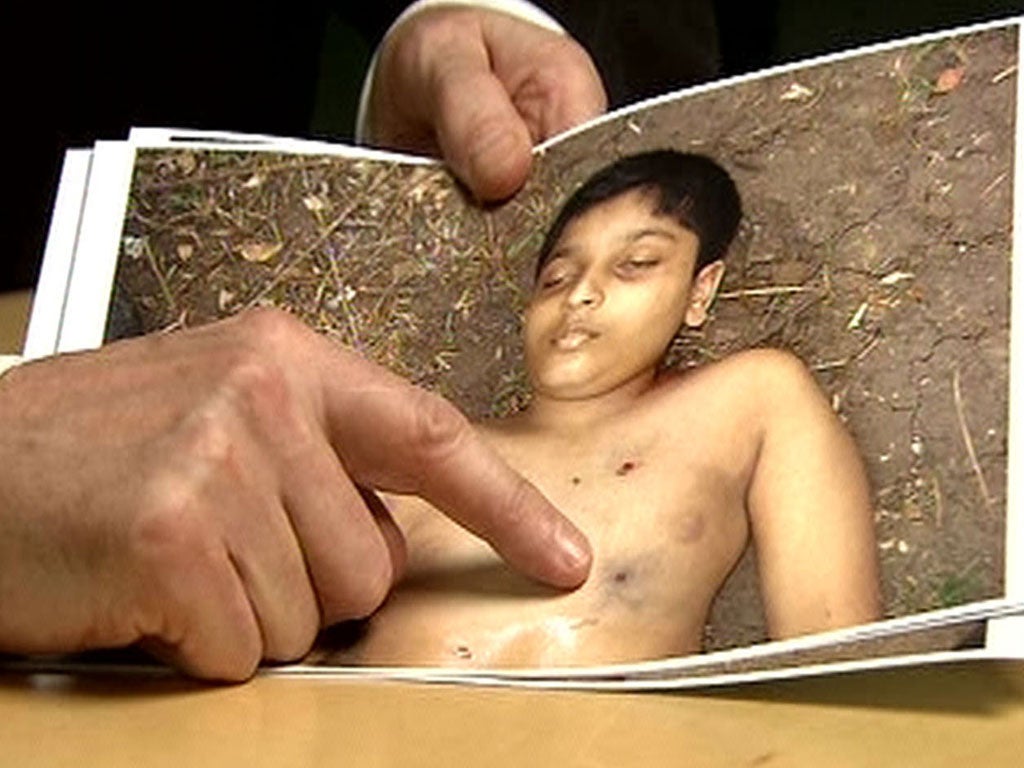
It is a chilling piece of footage that represents yet another blow for the beleaguered Sri Lankan government in its attempts to head off a critical resolution at the United Nations Human Rights Council in Geneva this week.
The short clip dates from the final hours of the bloody 26-year civil war between the Sri Lankan government and the secessionist rebels of the Tamil Tigers, the LTTE.
A 12-year-old boy lies on the ground. He is stripped to the waist and has five neat bullet holes in his chest. His name is Balachandran Prabakaran and he is the son of the LTTE leader, Velupillai Prabhakaran. He has been executed in cold blood. Beside him lie the bodies of five men, believed to be his bodyguards. There are strips of cloth on the ground indicating that they were tied and blindfolded before they were shot – further evidence suggesting that the Sri Lankan government forces had a systematic policy of executing many surrendering or captured LTTE fighters and leading figures, even if they were children.
The footage – dating from 18 May 2009 and which seems to have been shot as a grotesque "trophy video" by Sri Lankan forces – will be broadcast for the first time on Wednesday night in a Channel 4 film, Sri Lanka's Killing Fields: War Crimes Unpunished – a sequel to the controversial investigation broadcast last year which accused both the LTTE and the Sri Lankan government of war crimes and crimes against humanity.
Last year, a special panel of experts appointed by the UN Secretary-General, Ban Ki-moon, suggested that as many as 40,000 civilians died in the last few weeks of the war – the vast majority as a result of government shelling, much of which was targeted on so called "No Fire Zones" set up by the government itself. But as international concern grew over the emerging evidence of appalling crimes against civilians, the Sri Lankan government, headed by President Mahinda Rajapaksa, and his powerful brother, the Defence Minister, Gotabaya Rajapaksa, launched a counter-offensive. At its heart was a special inquiry appointed by the President, the Lessons Learnt and Reconciliation Commission (LLRC).
This, they insisted, would answer the international criticisms. When the LLRC finally reported last December, it did make important concessions – not least an admission that considerable numbers of civilians had died (a fact denied by the government until then). But it specifically denied that civilians had been targeted and rejected allegations of war crimes by the government. It thus failed entirely to deal with the evidence of blame pointing to the political and military leadership.
But still the criticisms have grown – and are likely to increase, following the new revelations in the Channel 4 film. In one incident, legally significant because it is well documented, two international UN workers leading the last UN overland food convoy became trapped near a temporary hospital in a village primary school in Uddiyakattu, in the first of the government's No Fire Zones.
With the help of other civilians they began to dig bunkers to provide some protection from incoming shellfire. As was standard practice, one of the UN workers, an Australian called Peter Mackay, took precise GPS co-ordinates of the site, and these were supplied to the government. But if that had any effect, it was certainly not the desired one. Over the next couple of days the camp was subjected to a massive, sustained barrage of incoming shellfire, much of it falling directly on or near to the UN bunker. Dozens were killed – and many more horrifically injured. It was all photographed by the UN workers.
In a sense, it was just one relatively small incident in the ongoing carnage of the war, but it is potentially significant because it provides specific evidence linking the Sri Lankan government's chain of command to knowledge of targeted attacks on civilians – attacks that appear to constitute war crimes.
As the barrage continued, the UN workers took turns to stand clear of the bunker where they could get line of sight to make frantic sat-phone calls to the Australian High Commi-ssion and other UN officials in the Sri Lankan capital, Colombo, pleading with them to get the government forces to stop the shelling. They were told these requests were passed on directly to both the then Sri Lankan army chief, General Sarath Fonseka, and the Defence Minister.
Shortly after these phone calls, the shelling shifted slightly away from the UN bunkers. But it continued to rain down on the No Fire Zone. In a sworn statement about the incident, Mr Mackay describes how the shelling was re-targeted: "Now the closest shells landed 100 metres from us, indicating that they could control the fire when they wanted to."
That is likely to be significant in any future legal proceedings over command responsibility for war crimes because it amounts to specific evidence suggesting the Defence Minister and army chief had now at least a direct knowledge of the shelling of the No Fire Zone, and that while shelling was then ordered away from the actual UN bunkers, it continued to rain down on the No Fire Zone. It also represents evidence that the attacks killing civilians were accurately targeted.
Other new evidence – some of it emerging from a massive trawl of confidential diplomatic cables sent between the US embassy in Colombo and the US State Department in Washington – reveals just how calculated was another of the most awful features of this war: the deliberate denial of adequate humanitarian supplies of food and medicine to civilians trapped in those grotesquely misnamed No Fire Zones.
To justify this policy, the government systematically underestimated the number of civilians trapped in the zones. At the end of April 2009, for example, President Rajapaksa told CNN that there "there are only about 5,000 ... even 10,000" civilians left in the zones. In fact, according to UN figures, there were more than 125,000 still trapped. The President himself had endorsed the inaccurate figures that were being used to justify what almost certainly constitutes a war crime – a crime that left thousands of civilians catastrophically short of food and water – and allowed hundreds to die unnecessarily in makeshift hospitals because of desperate shortages of supplies including blood and anaesthetics.
The government's LLRC report did acknowledge that humanitarian supplies were short in the No Fire Zones – but again exonerated the government of charges that the policy was deliberate. Amnesty International's Asia director, Sam Zafiri, is in no doubt that the operation was deliberate – and illegal: "International law bans medieval sieges – you can't subject a population to hunger, famine or plague as a means of military victory."
But it is the video evidence depicting the systematic and cold-blooded execution of bound, naked prisoners – and which also suggests sexual assault of naked female fighters – that continues to haunt the government. The new evidence of the death of 12-year-old Balachandran Prabhakaran will increase that pressure. In addition to the footage of the boy's dead body lying beside his slaughtered bodyguards, Channel 4 has obtained a series of high-resolution stills of the scene. These have been analysed by a respected forensic pathologist, Professor Derrick Pounder, to assess the cause of death. It is possible, he suggests, that the boy may have been made to watch the execution of his bound and blindfolded guards before the gun was turned on him.
Professor Pounder believes he has identified the first of the shots to be fired at the boy: "There is a speckling from propellant tattooing, indicating that the distance of the muzzle of the weapon to this boy's chest was two to three feet or less. He could have reached out with his hand and touched the gun that killed him."
The problem for the Sri Lankan government is that this murder is not isolated. If it was, they could perhaps dismiss it as the act of rogue soldiers.
Yesterday, the High Commission of Sri Lanka rejected what it calls the "malicious allegations" in the Channel 4 film. It said it had chosen to focus on: "A number of highly spurious and uncorroborated allegations and seek– entirely falsely – to implicate members of the Sri Lanka government and senior military figures." The High Commission added that the film had, "chosen to ignore the many positive post-conflict developments now taking place in the country."
Callum Macrae's film 'Sri Lanka's Killing Fields: War Crimes Unpunished' will be shown on Channel 4 this Wednesday at 10.55pm
Join our commenting forum
Join thought-provoking conversations, follow other Independent readers and see their replies
Comments
Bookmark popover
Removed from bookmarks