Sri Lankan army accused of making parts for landmines
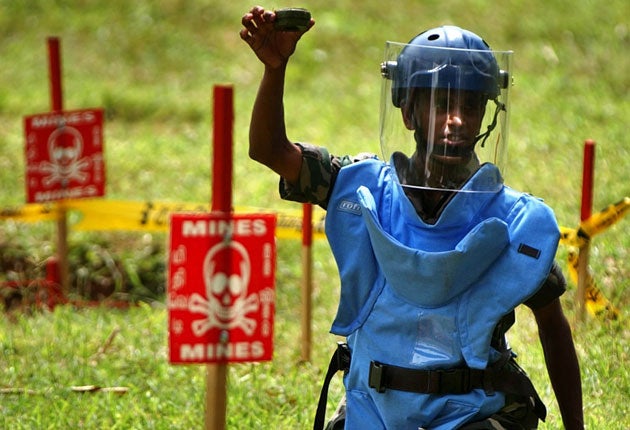
Activists have accused the Sri Lankan military of manufacturing components for landmines while the government was involved in an internationally-sponsored ceasefire with Tamil rebels and receiving millions of pounds in aid for de-mining projects.
The Tamil activists claim to have obtained classified documents they say show the Sri Lankan military sought tenders from several suppliers in Colombo and bought parts to produce remote-control detonators for Claymore anti-personnel mines. The documents, which have been seen by The Independent but which cannot be independently verified, have been dismissed by the military as fake. According to experts, the use of Claymore mines detonated by remote control would not be in breach of the comprehensive Ottawa Treaty of 1997. However, the activists claim that given Sri Lanka has always denied it manufactured parts for anti-personnel mines, the purported revelations about the detonators demand investigation.
The Reverend SJ Emmanuel, president of the Global Tamil Forum (GTF), which said it obtained the documents from a senior Sri Lankan military source, asked that a panel established by the UN examines whether both the army and Tamil rebels manufactured mines. "How much more evidence do we have to produce for the international community to act upon?" he asked.
The documents date from summer 2006, when the Sri Lankan authorities were involved in a Norwegian-brokered ceasefire with the Tigers of Tamil Eelam (LTTE). One of them says: "Project D2 is a remote control device which is designed to detonate Clamor [sic] mine using a T7G and R7G transmitter receiver modules." Others detail a list of 42 items required to manufacture the devices. Another document appears to be an invoice from a supplier in Colombo for a series of items, many matching those on the previous Project D2 list. The invoice, made out to the Sri Lanka Signal Corp and dated August 8, 2006, was for a total of 398,393 Sri Lankan rupees (around £2,200).
At the time, Sri Lanka was receiving considerable sums to fund projects for clearing hundreds of thousands of mines, the legacy of a decades-long conflict with the LTTE, which had launched a brutal war to secure a separate Tamil homeland. In 2004, Sri Lanka received around £15m for de-mining projects. Even now, more than 18 months after the Sri Lankan army defeated the remnants of the LTTE, many Tamils are still unable to return to their villages as they wait for them to be de-mined.
While Sri Lanka is not a party to the Ottawa Treaty, the authorities have publicly supported its humanitarian aims and since 1996 voted in favour of all resolutions at the UN General Assembly that call for a ban on the use, stockpiling or production of anti-personnel mines. The army claimed to have stopped using such weapons in 2001. Despite this, there have been repeated allegations that covert units within the Sri Lankan army continued to use them. In March 2008, K Sivanesan, a Tamil MP was killed by a Claymore – an attack his party blamed on the army, though this was denied.
Last night, a spokesman for the army, General Udaya Madawala, dismissed the GTF's allegation. He said Sri Lanka had not manufactured any such devices and that between 2002 and 2008 the authorities were focused on de-mining. Asked whether the documents might be fake, he said: "Absolutely. They've done this sort of stuff before."
Join our commenting forum
Join thought-provoking conversations, follow other Independent readers and see their replies
Comments