Taliban brutality returns as coalition forces prepare for withdrawal
Fears for future of Afghanistan as hardliners stone couple to death for being in love
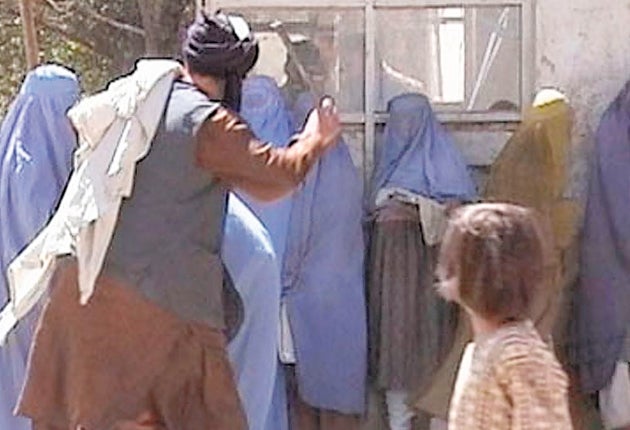
The announcement came on loudspeakers, ordering people to gather at the village bazaar to see Taliban justice being meted out. Then the condemned appeared, a young woman struggling in her bonds, weeping and begging for mercy, her male companion silent, seemingly resigned to his fate.
The first stone was thrown by a Taliban fighter and then the crowd followed suit. The woman fell after the first hail of blows to her head and witnesses in the crowd of around 150 reported that she must have died soon afterwards. The man, covered in blood and severely injured, survived the stoning. One of the Taliban shot the prone body three times, leaving with the warning that this will be the fate of those involved in "un-Islamic" activities.
Sadiqa, 20 and Qayum, 28, had been engaged by their families to other partners for marriage. They fell in love and, knowing the repercussions if they remained in the community, fled. For five days they had hidden at the home of a friend, but returned after being promised that they would not be harmed.
A village elder, Pir Mohammed, said "The jirga [council] sent the message that they would be alright if the man paid compensation. But the Taliban were waiting and they seized them."
The stoning took place at Mullah Quli, near Kunduz, in northern Afghanistan, an area regarded until recently as quite safe but which has passed under insurgent control. It comes as the latest in a series of public murders and mutilations by the Taliban, seen as a sign of their increasing confidence and determination to re-establish the old order, as politicians in the West clamour for troops to be pulled out and the Afghan President, Hamid Karzai, tries to cut a deal with Islamist militants and cling to power.
It is a minimum demand of the Taliban that any peace agreement should include the introduction of their version of sharia law, and each brutal punishment has been publicised to show that their jurisdiction is spreading. Mullah Omar, former head of the Taliban regime, has exhorted jihadists from his haven in Pakistan to step up attacks on government officials and women who "stray" from the path of Islam. Attacks on foreign aid workers have also risen, the most lethal assault resulting in the deaths of 10 members of a medical aid group in Badakhshan. The body of one of the doctors, 36-year-old Karen Woo, was repatriated to Britain yesterday. But it is Afghans who overwhelmingly remain targets of the insurgents.
Last week 35-year-old Bibi Sanubar, a pregnant widow, was lashed 200 times in front of a crowd before a Taliban commander shot her in the head. She had also been accused of adultery, tried and convicted after being kept imprisoned for three days. Her male partner was not punished and continues to live in the area.
Mullah Daoud, a Taliban commander, declared: "There were three of us mullahs who passed this verdict and I was one of them. We gave this decision so that in future no one should have these illegal affairs. We whipped her in front of all the local people, to show them an example. Then we shot her."
The "trial", without any attempt by officials to save Bibi Sanubar, took place at Qadis, in Badghis province in the west, another region which had hitherto seen little militant presence.
The oppression of females restarted soon after "liberation" in 2001. Initially the campaign targeted women who had taken up high-profile jobs. Parliamentarians, schoolteachers, civil servants, security officials and women journalists were selected for attacks by the jihadists.
The attacks have succeeded in eliminating or silencing many of the women who received little or no protection from the Western countries and the Karzai government – the very people who had encouraged them to enter public life. Latterly it has been ordinary people, especially in rural areas, who have been the victims as the vengeful Taliban returned to impose the old order.
A glimpse of the atrocities taking place came recently on the front cover of Time magazine with a picture of a 19-year-old woman with her nose and ears cut off. Bibi Aisha had suffered years of cruelty and abuse at the hands of her in-laws and she fled, pursued by her husband, who caught her and carried out the mutilation. The Taliban chief in the area praised the husband for his actions.
There are many other signs of rising insurgent power and influence over community behaviour across the country. Jalalabad, one of the first cities to throw off the trappings of fundamentalism when the Taliban fell nine years ago, has seen a series of bombings of music shops – Islamists consider secular music to be heresy – and barbers have been ordered not to trim beards.
In Mazhar-i-Sharif the recent decapitation of six drugged security guards is now believed to have Taliban links. But it is women who feel most under threat. Wazhma Forgh, a female rights activist and a former director for Afghanistan of Global Rights, recently met a group of 50 women who said they were facing daily intimidation, beatings in the street for alleged "immodesty" and being ordered to stay in their homes. One woman was forced to give birth out in a courtyard after a Taliban guard barred her from a hospital because she was not accompanied by a suitable male member from her family.
The stoning of Sadiqa and Qayum points to a future full of foreboding, said Amr Nasruddin, a human rights activist. "It is not just that they are carrying out these crimes, but they are doing it regularly and proudly describing what they are doing," he said. "It shows they know that they will not be punished. There is no law to punish them; in many places they have become the law. That is the tragedy of Afghanistan."
Reign of terror
Kunduz
Man and woman stoned to death by the Taliban for having an affair in Kunduz, in the north, last Sunday.
Badghis
Bibi Sanubar, 35, a pregnant widow lashed 200 times and then shot dead by a Taliban commander in public on 8 August in Badghis province.
Uruzgan
Bibi Aisha, a 19-year-old bride, had nose and ears cut off by her husband, a Taliban fighter, after she fled his abusive family. The mutilation took place in Oruzgan province.
Mazhar-i-Sharif
Six bank guards drugged and beheaded by robbers linked to Taliban in Mazhar-i-Sharif on 1 August.
Jalalabad
Music shops burned down in Jalalabad in the west of the country throughout the summer.
Join our commenting forum
Join thought-provoking conversations, follow other Independent readers and see their replies
Comments
Bookmark popover
Removed from bookmarks