Taliban fightback forces US Marines to do longer tour
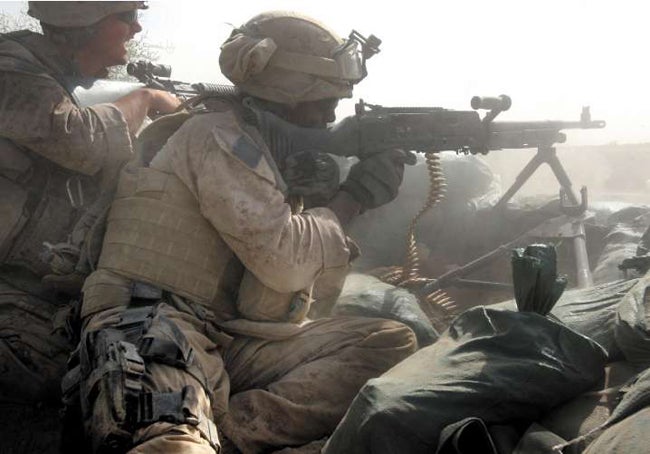
The Pentagon has extended the tour of duty of 2,200 US Marines fighting alongside British forces in southern Afghanistan, amid fears that a resurgent Taliban will force the postponement of next year's crucial presidential election in the country.
The 24th Marine Expeditionary Unit, whose firepower is credited with significantly easing the pressure on British troops in Helmand province, was due to pull out at the end of September, but will now leave a month later. A Pentagon spokesman, Geoff Morrell, said commanders of Nato's 60,000 troops in Afghanistan "asked for 30 more days to milk the fighting season to the bitter end, and cement the gains they have made in the south".
Although Mr Morrell described the extension as "a slight addition to this tour and nothing else", it came after months of denials that the Marines would be told to stay longer. Asked about the possibility in early May, the US Defence Secretary, Robert Gates, said he would "be loath to do that", and that "no one has suggested even the possibility of extending that rotation". His answer appeared to reflect the sensitivity of extra US troop deployments just months before Americans are due to elect a new President. But in the past week, US commanders have warned in stronger terms than before that the Afghan mission risks failure because of a lack of forces on the ground.
For the first time since the Iraq invasion in 2003, the chairman of the joint chiefs of staff, the top US military post, said explicitly last week that Washington could not send enough troops to Afghanistan because of commitments in Iraq. "I don't have troops I can reach for ... to send into Afghanistan until I have a reduced requirement in Iraq," Admiral Michael Mullen said on Wednesday. "Afghanistan ... remains an economy-of-force campaign, which by definition means we need more forces there."
He was echoing General Dan McNeill, who said a few days earlier on completing his term as Nato commander in Afghanistan that it was an "under-resourced war".
Last month was the bloodiest for British forces and their allies in Afghanistan since the 2001 invasion to overthrow the Taliban and oust al-Qa'ida. In June, 45 Nato soldiers, 13 of them British, died on active service, compared with 31 in Iraq.
It was the second consecutive month in which coalition losses were higher in Afghanistan than in Iraq, even though Iraq has three times the number of foreign troops. Attacks on foreign troops in Afghanistan between January and May were 40 per cent higher than in the same period last year, according to the Pentagon.
Though British losses peaked last month, only three were in firefights. Apart from one accidental death, the rest were caused by explosions: one suicide bombing and a succession of roadside bombs and mines. This reflects the Taliban's change of tactics since the heavy clashes of two years ago, when British troops first arrived in Helmand. But it also signals a lack of progress by Nato, since the attacks are taking place in areas where repeated attempts have been made to drive the militants out.
"The Taliban and their supporters have ... grown more effective and more aggressive in recent weeks, as the casualty figures clearly demonstrate," Admiral Mullen said. The insurgency was "a very complex problem", linked to the drugs trade, economic decline and the porous border with Pakistan, which has seen an upsurge in militancy.
Yesterday Pakistan's government suspended a week-long military operation against the militants to allow tribal elders to mediate, but the region has seen a succession of such attempts to negotiate, interspersed with crackdowns. Both tactics have simply allowed extremists to gain a tighter grip on Pakistan's tribal areas, in turn adding to the pressure on Nato forces in Afghanistan.
A recent Pentagon study saw the potential for "two distinct insurgencies" in Afghanistan, one in the eastern provinces bordering Pakistan and one in the south around Kandahar, with common goals – which included "the expulsion of all foreign military forces from Afghanistan, the elimination of external government influence in their respective areas, and the imposition of a religiously conservative, Pashtun-led government".
The short-term aim of the insurgents, said Christopher Langton, an Afghanistan expert at the International Institute of Strategic Studies (IISS) in London, was to make it impossible for the presidential election due by mid-2009 to be held in large areas of the country, forcing President Hamid Karzai to negotiate with them or postpone the poll. "If they succeed, it would raise a question over the whole democracy project in Afghanistan," he said.
Mr Langton said that since last month's mass jailbreak in Kandahar, when hundreds of militants escaped, "it has no longer been possible to claim that the Taliban has been contained. It has freedom of movement around Afghanistan, even though Nato has sent more troops. We want to curb the Taliban and ensure that the election takes place, but we don't have enough forces."
Last week President George Bush admitted that June has been a "tough month" in Afghanistan, adding: "We're going to increase troops by 2009." But Admiral Mullen did not see additional forces arriving until next year, and then only if they could be spared from Iraq.
The Marines were sent to Helmand after the US despaired of persuading other Nato members to send additional forces into combat. Britain has increased its contingent to around 8,500 from the original 6,600, and could send more if some can be withdrawn from Iraq.
Ahmed Rashid, an expert on Afghanistan and the region, told the IISS last week: "We are in the midst of a major new Taliban offensive ... They see a lame-duck President in Washington, they see a policy hiatus until well after the presidential election. So they have set out to rattle the US."
Join our commenting forum
Join thought-provoking conversations, follow other Independent readers and see their replies
Comments