Taliban's high command in secret talks to end war in Afghanistan
Insurgents could be brought back into government, while ceasefire will not hinge on Nato withdrawal
Secret high-level negotiations between the Afghan government and the Taliban leadership aimed at ending the war have begun, diplomatic sources have revealed. Meetings which included delegates of the Quetta Shura, the Taliban's Pakistan-based governing body which is overseen by Mullah Mohammed Omar, are believed to have taken place in Dubai. The Taliban high command had previously rejected any political negotiations until Western forces had left Afghanistan.
Talks have also taken place in Kabul with "indirect representatives" of the insurgency. It remains unclear whether this is a parallel process to the one taking part in the United Arab Emirates. According to reports, Pakistani officials, led by the former foreign minister, Aftab Ahmed Shirpao, were present at meetings at the Serena Hotel in the Afghan capital.
The Dubai discussions are said to have centred on the conditions under which the Taliban would agree to call a ceasefire. They have dropped the demand that Western forces are fully withdrawn from Afghan soil before any peace talks can open but are insisting on an agreed timetable for the exit of Nato troops. The extreme Islamist movement ran Afghanistan between 1996 and the US-led invasion in 2001 and was notorious for its hardline interpretation of Islam, banning such things as music and education for girls. The movement was branded a terrorist organisation by the US after being toppled.
According to diplomats, representatives of the Taliban could initially be brought back into governance at local levels as part of a reconciliation process. It is also claimed that a deal may involve Mullah Omar, the one-eyed religious leader who fled Afghanistan on a motorbike shortly after the 2001 invasion. Some of his lieutenants could also be given immunity from future prosecution and go into exile in Saudi Arabia under a deal. Human rights and women's groups have long feared a political settlement which would allow the Taliban back into power and potentially water down rights guaranteed under the constitution.
Military setbacks are thought to have influenced renewed US backing for the idea of negotiating an end to the conflict. The White House yesterday said that Barack Obama "supports" attempts to negotiate with the Taliban, but stressed its members must pledge to respect Afghan law and lay down their arms. Robert Gibbs, the White House spokesman, said that the US was not directly involved in the talks. Clandestine meetings are however believed to have taken place between senior Taliban members and CIA officials, according to Pakistani officials.
Pakistan, which has been working to promote itself as an irreplaceable interlocutor with the Taliban, remains extremely wary of the Dubai process.
News of meetings in the UAE comes at a particularly fraught time in relations between Pakistan and the West.
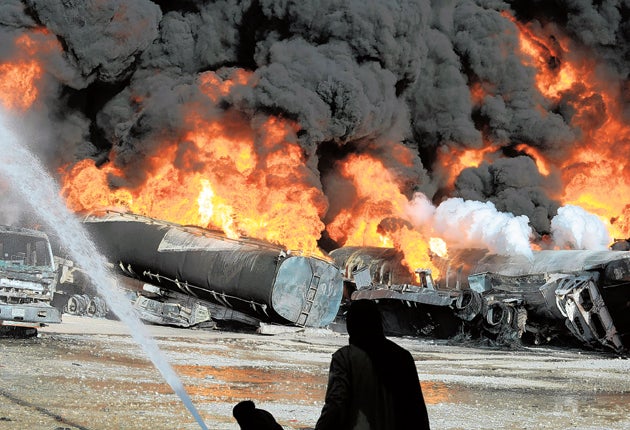
On 30 September, three Pakistani soldiers were killed by missiles fired from Nato helicopters in what appeared to have been an accident. The US yesterday apologised for the attack, that led to the Pakistani authorities last week shutting down the Khyber Pass, which is used by Nato supply convoys heading into Afghanistan. The closure has left hundreds of trucks bottlenecked at the one remaining route into Afghanistan from Pakistan. Since the border closure, Nato convoys have been struck seven times by militants. The most recent attacks came yesterday when gunmen set fire to at least 55 fuel tankers and killed a driver. The first attack was on more than two dozen fuel tankers at a parking lot on the outskirts of Quetta, in Baluchistan province, followed by another attack yesterday evening in Khyber Pakhtunkhwa province last night.
An indication of the determination of the Pakistani authorities to take a central role in talks to ensure a pro-Islamabad government in Afghanistan came earlier this year when Pakistani troops and US agents captured Abdul Ghani Baradar, the Taliban's operational commander. His capture was reported to have been fortuitous but it has since emerged that the Pakistanis had been monitoring his whereabouts and decided to detain him because he had brokered secret peace talks with the Afghan government. The most recent talks do not include the Haqqani network, which operates inside Afghanistan but is based in Pakistan and has strong links to the Pakistani spy agency the ISI. The group has been systematically targeted in American cross-border air attacks recently even though Pakistani officials have been pressing the Karzai government to open dialogue with the network.
Last week General David Petraeus, the US commander of Nato forces in Afghanistan, said senior Taliban leaders had "sought to reach out" to the top level of the Karzai government. The General, who is due to give an assessment of the conflict to President Obama in December, effectively laying out an exit timetable, added: "This is how you end these kinds of insurgencies."
Steffan de Mistura, the head of the UN mission to Afghanistan, said both sides in the conflict have realised that a negotiated settlement is the only way to end the violence. "There is no military solution, we all know it. The Taliban know it too. [The only format] is political dialogue, reconciliation, deal."
The Afghan government held a "peace jirga" in the capital, Kabul, in July, and last week formed an official government reconciliation team, the High Peace Council. The latest talks have their origins in a fruitless set of initial contacts hosted by the Saudi government in the kingdom more than a year ago and attended by Mr Karzai's older brother Qayum Karzai. These were followed, according to diplomatic sources, by talks between Mullah Baradar and Ahmed Wali Karzai, another brother, in Dubai last January. Separate talks were held between Engineer Ibrahim, then the deputy chief of the Afghan intelligence service, and another Taliban leader, Tayyib Agha.
Thomas Ruttig, co-director of the Afghanistan Analysts Network, yesterday advised caution. "It's more talks about talks and there's also messaging involved so it's spreading the good news without much of a basis... It's messaging for the countries that have troops here. They have to the beautify [the situation]. Paint it in a rosier colour.
"I'm not convinced there really is a strategy of talks with the Taliban. There is a willingness, but it is probably [also] a lot of lip service as there was lip service in the framework of the counter-insurgency strategy of protecting the population. A lot of special forces are doing other things."
Prospects for peace: Can a deal with the insurgents be done?
The Taliban has long insisted that no peace deal is possible until all foreign forces have left Afghan soil, an impossible concession for Nato, which knows full well that President Hamid Karzai's government and it fledgling security forces would swiftly fall without its support. Yet preliminary discussions in Dubai suggest that Taliban leaders may be willing to drop this deal-breaker under certain conditions.
There is speculation a deal may be possible if:
* Western forces agree to leave Afghanistan on an agreed timeline. In return the Taliban would call a ceasefire ahead of their departure.
* Taliban representatives take local government jobs as part of a reconciliation process. To an extent this is already happening, with some MPs and senators sympathising with the militants if not actually backing them.
* Mullah Mohammad Omar and his lieutenants on the Quetta Shura, or Taliban governing council, receive immunity from prosecution and go into exile, probably in Saudi Arabia. Other Taliban prisoners are to be released. The Saudi government, however, will only allow the exile clause if the movement disavows all links with Osama bin Laden and al-Qa'ida, a condition the Americans will also insist on.
But there are a number of sticking points with no obvious resolution. Among them are:
* The insurgents are extremely decentralised and special forces raids, taking place at record intensity, exacerbate this by killing new leaders as they emerge. What one band of insurgents accepts may be intolerable for another.
* There is also the question of large, nominally pro-government constituencies resisting or sabotaging a peace deal. Many Afghans from ethnic groups unaffiliated with the predominantly Pashtun Taliban see overtures to insurgents as a betrayal.
Julius Cavendish
Join our commenting forum
Join thought-provoking conversations, follow other Independent readers and see their replies
Comments
Bookmark popover
Removed from bookmarks