Technology revolution is key to fight for democracy, says Aung San Suu Kyi
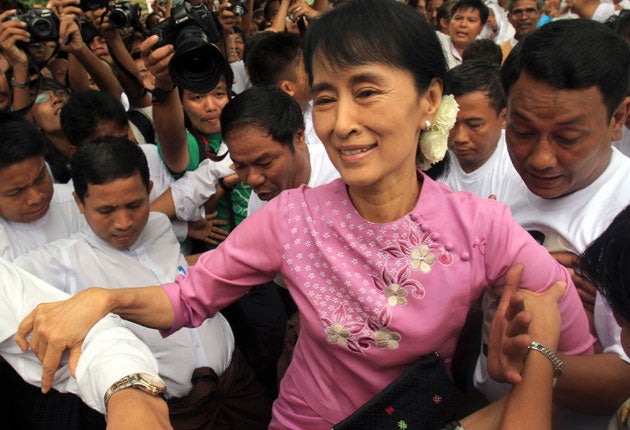
The Nobel peace laureate and human rights campaigner Aung San Suu Kyi spoke yesterday in a BBC lecture of the vital role played by communications technology in modern democratic uprisings and said she was not morally opposed to the use of violence in exceptional circumstances.
The Burmese opposition leader and general secretary of the National League for Democracy (NLD) has recorded two speeches for the annual BBC Reith Lectures, which were smuggled out of Burma last week.
In the first, which will be broadcast on Radio 4 next Tuesday, Ms Suu Kyi compared the 23-year struggle to win democracy in Burma to the fast-moving revolutions in Tunisia and Egypt and said that the widespread availability of internet-based technology in the Arab world had been a crucial factor in the success of those movements.
The lecture was broadcast yesterday to an invited audience at Broadcasting House in London. Afterwards, speaking from a secret location in Rangoon, Ms Suu Kyi told presenter Sue Lawley that, just as Nelson Mandela had altered his position on political protest, "it's possible" she might change her longstanding commitment to non-violence.
"I have said in the lectures I do not hold to non-violence for moral reasons but practical and political reasons," she said. She said Mahatma Gandhi, the "father of non-violence", had "said that between cowardice and violence he would choose violence any time".
Ms Suu Kyi, who was 66 last Sunday, the first birthday she has celebrated as a free woman in nearly a decade following her release from house arrest last November, said the Burmese people wished to emulate the success of Arab democratic movements.
"The similarities between Tunisia and Burma are the similarities that bind people all over the world who yearn for freedom," she said. But two key differences had ensured that "the outcomes of the two revolutions have been so different", she added.
"The first dissimilarity is that while the Tunisian army did not fire on their people, the Burmese army did. The second, and in the long run probably the more important one, was that the Tunisian revolution enjoyed the benefits of the communications revolution and this not only enabled them to better organise and co-ordinate their movements, it kept the attention of the whole world firmly focused on them. Not just every single death but every single [person] wounded can be made known to the world within minutes."
Speaking from a simple room decorated with a single vase of flowers and wearing an orange-coloured blouse, she said that "in Libya, in Syria and in Yemen now, the revolutionaries keep the world informed of the atrocities of those in power" and that "communications means contact".
During the Q&A, she said the Burmese uprising of 1988 might have been successful if the world had seen what was happening. "The communications revolution made a lot of difference [in Tunisia]," she said, noting that although the Burma uprising was "much worse" in terms of violent repression, it had gone unreported.
"The shooting and the lack of images throughout the whole world had a lot to do with the way which our revolution has been going on for such a long time," Ms Suu Kyi said.
In Tunisia and Burma, young people had played a pivotal role in the uprisings, she said, applauding the influence of "young rappers" in Burma. "For those who believe in freedom, young rappers represent a future unbowed by... oppression and injustice."
During the live session, Aung San Suu Kyi was in the company of the BBC World Affairs Editor John Simpson. She said that in making her broadcasts she was "exercising my right to freedom of communication".
She spoke on the nature of being a dissident and talked with fondness of her colleagues in the NLD headquarters. "Their weapons are their faith, their armour is their passion," she said. Dissidents had chosen their path, she said, but "it's not a decision made lightly – we do not enjoy suffering, we are not masochists".
In a passionate address she quoted Czech dissident Vaclav Havel, the English poet William Henley and the Russian poet Irina Ratushinskaya, finishing with lines from Rudyard Kipling's The Fairies' Siege. In the second lecture, which will be broadcast on 5 July, Aung San Suu Kyi will speak of the forces aligned against her National League for Democracy.
Join our commenting forum
Join thought-provoking conversations, follow other Independent readers and see their replies
Comments
Bookmark popover
Removed from bookmarks