The Big Question: Is the dream of independence for Tibet now a lost cause?
Why are we asking this now?
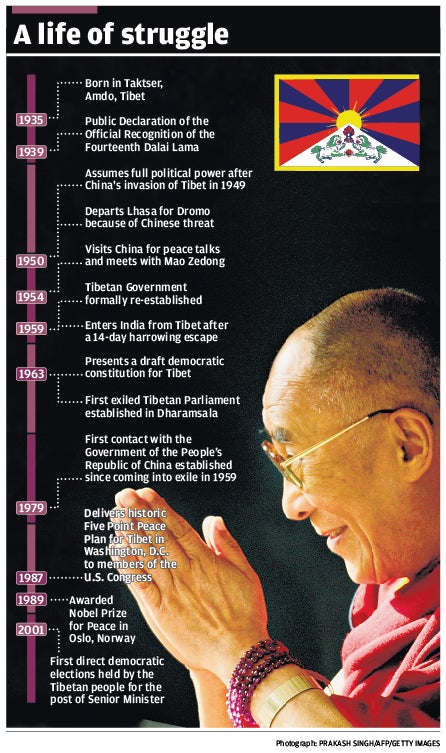
Over the weekend, his Holiness the Dalai Lama, the spiritual leader of Tibet's Buddhists and the man who has been at the centre of efforts to highlight the Tibetan cause for decades, explained that he "had given up" his struggle. "I have been sincerely pursuing the middle-way approach in dealing with China for a long time now, but there hasn't been any positive response from the Chinese side," the 73-year-old told an audience at Dharamsala, the Indian Himalayan town that is the headquarters of the so-called Tibetan government-in-exile. "As far as I'm concerned, I have given up."
Does that mean the Dalai Lama is retiring?
Karma Choephel, the speaker of the parliament in-exile, told reporters that the Dalai Lama used to say that he was semi-retired and that now he believed he was was almost completely retired. However, a senior aide to the Nobel laureate last night dismissed speculation that he would start taking a back seat in Tibet's affairs. "Because of the lack of response from the Chinese we have to be realistic. There is no hope," said Tenzin Taklha. "His holiness does not want to become a hindrance to the Tibetan issue, and therefore has sent a letter to the parliament regarding what options he has."
Is there a possibility that he may continue his work?
Talk of retirement may be a little misleading. Last year, Tenzin Gyatso, who is the 14th Dalai Lama, made clear that he wished to reduce some of his political duties and have the elected Tibetan parliament-in-exile take a more active role. However, when a crisis broke out this spring – as the Chinese authorities cracked down aggressively on a number of uprisings across Tibet – the Dalai Lama placed himself at the centre of efforts urging restraint from both sides. He even offered to personally travel to Beijing to negotiate with the Chinese leadership over the issue. One position from which he cannot retire is his role as a living god. Having been anointed the 14th Dalai Lama when he was just two years old, he will retain that position until death.
How have the Chinese authorities responded to the Dalai Lama?
In short, pretty badly. Either directly or else via their proxies, Beijing has routinely dismissed and demonised the Tibetan spiritual leader and his supporters. In the spring, during the worst crisis in Tibet for two decades, the head of Tibet's hardline Communist Party, Zhang Qingli, said of the Nobel laureate: "The Dalai is a wolf in monk's robes, a devil with a human face but the heart of a beast. We are now engaged in a fierce blood-and-fire battle with the Dalai clique, a life-and-death battle between us and the enemy." At the time, the Dalai Lama insisted that the uprisings that broke out across the Tibetan plateau had not been orchestrated or organised from Dharamsala. He urged a peaceful solution to the problem.
What impact would the Dalai Lama's retirement have on the movement for Tibetan independence?
In regard to the high-profile campaign to gather support around the world, if the 73-year-old decided to stand down it would be a huge blow. Since he fled to India 1959, the Dalai Lama has worked to spread the word of his homeland's fate, courting both politicians and Hollywood celebrities such as Richard Gere and Steven Seagal. Charming, ebullient yet convincing, he has been more responsible than anyone for gaining supporters to the cause. On the other hand, not all Tibetans support his tactics. For many years the Dalai Lama has promoted a "third way" in regard to Tibet, calling for meaningful autonomy rather than full independence and arguing that he wants to protect Tibet's people and culture. Even during the spring crisis earlier this year, he refused to give his backing to calls for a boycott of the Beijing Olympics.
What has been the response of young Tibetans to the retirement?
Many younger Tibetans say thatwhile they respect the Dalai Lamaand venerate him as a living god, his tactics are wrong. Groups such as the Tibetan Youth Congress have demanded full independence forTibet and led a far more outspoken campaign to achieve it. The group's president, Tsewang Rigzin, said yesterday: "I think the statement by his Holiness is an eye-opener for the Tibetan people. "We are not against the middle-way approach of his Holiness, the fact is that China is not sincere and has never been sincere in talking about the middle way."
Who might fill the sandals of his Holiness?
The Dalai Lama has said he wishes the elected Tibetan government-in-exile to take on some of the work he currently does. However, some observers believe that an unofficial, transitional political successor might be Ogyen Trinley Dorje, who is the Karmapa, or spiritual head of the Kagyu order of Tibetan Buddhism. The 17th Karmapa – who is froma different school of Tibetan Buddhism to the Dalai Lama andwho cannot inherit his title – is just 23 years old. His escape as a teenage boy to India from Tibet via Nepal – he arrived in 2000 – has become the stuff of legend. Earlier this year, the young man made his first visit to the United States, triggering much talk that officials might be preparing him for a bigger role. At the time, even the Dalai Lama himself said: "There are now spiritual leaders who are young, energetic and well educated. "They can assume the role of spiritual leadership, as the political role is played by a democratically elected government."
What difference would any of this make to China?
Perhaps very little whatsoever. At the time of the crisis this spring, China reacted swiftly, aggressively and with seeming little regard for public opinion. Travel to Tibet was suspended and the ban then remained in place until the Olympic Torch had been run through the region. As soon as the demonstrations had been put down, journalists were flown in for special tours by the Chinese authorities. An unknown number of people were killed and hundreds were arrested. China insists that Tibet has officially been part of the Chinese nation since the mid-13th century and that it should continue to be ruled from Beijing. China is anxious about encouraging separatist movements in other parts of the country, such as in the Muslim-majority Xinjiang province. As a result, it has refused to discuss any loosening of its control over Tibet, which it invaded in 1950.
What will happen next?
The Dalai Lama has already called a special meeting of Tibetan exiles for next month in Dharamsala to discuss both the spring crisis and the future of the movement. This will undoubtedly be surrounded by speculation that he could use the event to stand down. The conclave, which is due to begin on November 17, is apparently only the third such meeting of its kind in the past 60 years. The Dalai Lama is expected to address the six-day meeting of delegates from non-government organisations, politicians, monks and intellectuals and lay out his views about the way forward.
Is the Tibetan independence movement now likely to fail?
Yes...
*The Dalai Lama appears to be running out of patience and without him the movement would lose an irreplaceable campaigner
*The Chinese show no intention of offering any kind of autonomy to Tibet
*The rest of the world is unwilling to upset China
No...
*There is a new generation of highly motivated activists who are ready to continue the struggle and who back a more direct approach
*Across the world, the Tibetan cause wins new supporters every day
*Should China move towards democracy, Tibet's fortunes might look very much brighter
Join our commenting forum
Join thought-provoking conversations, follow other Independent readers and see their replies
Comments