The Big Question: Who are the Naxalites and will they topple the Indian government?
Why are we asking this now?
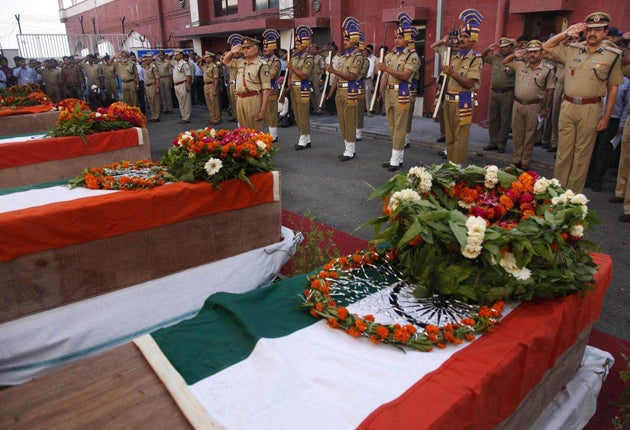
Earlier this week, at least 76 Indian paramilitaries on a four-day patrol were killed in a co-ordinated ambush by hundreds of insurgents in dense jungle in the central state of Chhattisgarh. It was the deadliest single strike against government forces in a bloody insurgency that has stretched for more than four decades and in which at least 6,000 people have lost their lives. The authorities appeared deeply shocked by the ambush, in which the rebels used a combination of automatic weapons and landmines. A further 50 troops were injured in the incident, which experts said showed an intelligence failure by government forces. "This shows the true nature of the [rebels] and their brutality and the savagery they are capable of," said India's home minister, Palaniappan Chidambaram.
Who are the insurgents and where are they operating?
The rebels are often called the Maoists, or Naxalites, and are the latest incarnation of armed left-wing rebels who first emerged during a peasants' uprising in the West Bengal village of Naxalbari in 1967. The most recent grouping, known formally as the Communist Party of India (Maoist) (CPI-M), was created in 2004 by the merger of two left-wing groups. Precisely how many fighters are involved and the level of co-ordination between rebels in different states is unclear, but it is estimated that 16 of India's 28 states – mostly in the east and the centre – are "infected" to a greater or lesser degree. There may be as many as 120,000 militiamen and full-time fighters in total and India's Prime Minister, Manmohan Singh, has described them as the single biggest threat to the country's security.
What is the government doing in response?
In recent years, operations against the Maoists using police and paramilitary forces have steadily increased. The government has also funded local armed resistance movements, known as Salwa Judum or Peace March, to confront the rebels.
Last year, Mr Chidambaram announced the government was launching Operation Green Hunt, a new drive. There has been a rush to provide funding and training for new police and paramilitary recruits and an effort to forge better co-operation among the authorities in those states affected by insurgents. The patrol that was ambushed in the Dantewada district of Chhattisgarh was part of this operation. The government has claimed it will take three years to crush the rebels. Not everyone agrees. KPS Gill, the former director general of police in Punjab who is considered an anti-insurgency expert, told reporters: "The anti-Naxal strategy is a flop. Someone picked up the strategy from some book and forced it down the throats of the paramilitary forces."
What do the rebels want?
Theoretically, the leadership of the movement says they are committed to a "protracted armed struggle" in order to seize power from the state. Yet the Maoists also stress that they are fighting to protect the rights of India's most oppressed communities, the adivasis or tribal people, and dalits, or untouchables, whose land and resources have often been taken by Indian and international corporations. While some of the rebel leaders were originally educated urbanites, their rank-and-file fighters are made up overwhelmingly of tribal people and other marginalised people. The government routinely claims that the rebels are opposed to development and progress, yet GN Saibaba, an activist and professor at Delhi University, said: "The government has no other explanation to offer for why there is an uprising. It is not true that the Maoists are against development but the questions they ask is 'whose development' and 'what sort of development'."
Is poverty an issue?
Activists, among them the Booker Prize-winning author Arundhati Roy, point out that support for the Maoists is strongest in impoverished, remote areas where government services are at a minimum. Activists say reports commissioned by the government itself – both by the central planning committee and the rural affairs commission – have highlighted lack of services and poverty as a root cause.
Even many of those involved in the fight against the rebels have noted this. Bahukutumbi Raman, a former head of the counter-terrorism division of India's external intelligence agency Research and Analysis Wing, said this week: "There are two Indias. The dazzling India which we see every day on our TV channels, in the spins of our political leaders and in the writings of our so-called strategic analysts. But there is another India which we rarely see or write about. This is the India of grinding poverty, a victim of social exploitation of the worst kind, where the inhabitants – mainly tribals – are treated like chattels and domestic animals by the upper caste political leaders, landlords and forest contractors... It is this India coming out from under the carpet, which is flocking to the banners of the Maoist ideologues."
How widespread is support for the rebels?
Activists point out that military operations in tribal areas routinely kill or injure innocent villagers who are then more likely to be recruited as cadres. "If I was a person who is being dispossessed, whose wife has been raped, who is being pushed off their land and who is being faced with this police force, I would say that I am justified in taking up arms," said Roy. "If that is the only way I have to defend myself."
Yet while some politicians and activists have raised their voices against the military operation, most of the Indian media is often largely unquestioning of the government's claims. At the same time, activists claim the authorities have launched a smear campaign against them, labelling anyone who speaks out as a "Maoist sympathiser". Several have been locked up, among them Dr Binayak Sen, a pediatrician and civil rights activist from Chhattisgarh who was detained for two years. His detention was widely condemned by organisations such as Amnesty International.
Why can't the two sides talk?
Earlier this year, Maoists in West Bengal offered a ceasefire ahead of possible talks. Mr Chidambaram responded by asking the rebels to fax him their ceasefire offer and read out his personal fax number – something that soon ensured his fax machine was clogged with faxes from disgruntled members of the public. The government has previously said it would only hold talks if there was a complete ceasefire, which has not been forthcoming. In the aftermath of this week's attack there is more pressure on the government to escalate its military operations, rather than to push for talks. "The government must launch a fight-to-the-finish offensive to root out the menace," said Rajiv Pratap Rudy, a spokesman for the opposition Bharatiya Janata Party. Indeed, Mr Chidambaram, who yesterday toured the site of ambush, said that the government remained ready to meet with militants who "abjured violence", but added: "To talk of talks now is to mock the sacrifice of these 76."
Will the Maoists be defeated?
Yes...
* Government and industry believe rebels stand in the way of development
* Disputes among India's leftist groups means some natural
sympathisers are actually rivals
* India watched on as Sri Lankan forces defeated the Tamil Tigers recently
No...
* The rebels cover a vast area. India is one of the world's least heavily policed nations
* Maoists' cause will only end when India addresses massive problem of poverty
* The wishes of India's tribal people are very often at odds with those of the government and industry
Join our commenting forum
Join thought-provoking conversations, follow other Independent readers and see their replies
Comments
Bookmark popover
Removed from bookmarks