Twenty years after Soviet humiliation, Russia seeks a return to Afghanistan
Foreign Minister offers help with reconstruction in bid to quell unrest on doorstep. By Mary Dejevsky in Moscow
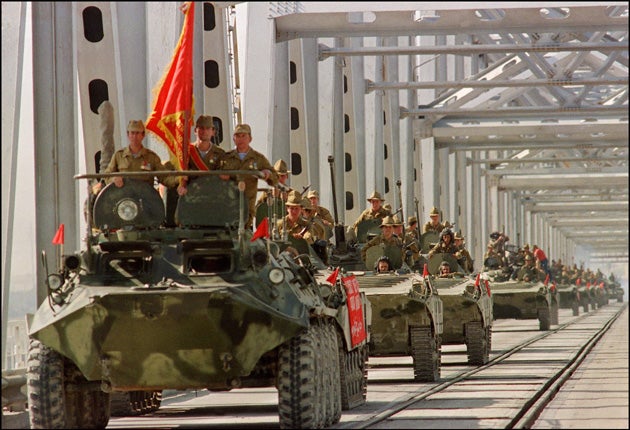
Russia is positioning itself for active reinvolvement in Afghanistan, the country's Foreign Minister indicated yesterday. Sergei Lavrov said his government wanted to offer Washington and Nato all the help it can to stabilise the war-wrecked country, short of sending troops.
In the most explicit statement yet of Moscow's desire to boost its influence in the former Cold War battleground, two decades after the humiliating withdrawal of its troops from Kabul, Mr Lavrov said: "We do not want to take any leading role but we want to help those who are already there, because we know how hard it is from our own sad experience. We want to help stabilise the situation. We would do anything short of military involvement".
Among the proposals Moscow has in mind, he said, is for Russian engineers to renovate some 140 infrastructure projects, including power stations, built during the Soviet occupation, assistance in repairing the key Salang tunnel, and provision of helicopters.
Speaking yesterday, Mr Lavrov said that Russia's desire to co-operate stemmed in part from its own "bitter experience" in the country, which cost more than 13,000 Soviet lives and was finally ended by Mikhail Gorbachev, who described the Soviet Union's 10-year occupation as "a bleeding wound".
But Russia has two other reasons for becoming more actively engaged with Afghanistan now. The first is its own national security. Once the US and Nato troops depart, Russia could face more lawlessness on its already troubled and exposed southern frontier. As Mr Lavrov pointed out, terrorism, drug trafficking and general lawlessness emanating from Afghanistan present problems for Russia, too.
The second is the general reorientation of Russian foreign policy. Two years after the war in Georgia, Russia is making a determined effort to show a friendlier and more co-operative face to the world. The signs have been multiplying for some time: the participation of foreign delegations at the May Victory Day parade in Moscow, the response to the death of the Polish President in the air crash near Katyn, and the muted reaction to the expulsion of Russian spies from the US in July.
Mr Lavrov's answers yesterday were distinguished by a whole new vocabulary, starting with the Russian for "soft power", and continuing with "pragmatism", "team work", "co-ordination" and "co-operation" – but always "on an equal footing".
In principle, Russia's first two reconstruction offers appear to have been accepted by the Americans, while the helicopters, to which the Russians would contribute one-seventh of the cost, are still under discussion. As in Iraq, a shortage of helicopters has been a continual complaint of Nato forces. Russia also permits the transit of Nato supplies for Afghanistan across Russian territory, upgrading a series of piecemeal agreements concluded with individual European countries. It has also recently concluded an agreement allowing Nato planes through Russian airspace, the official said.
While voicing the Russian desire to co-operate on Afghanistan and its sympathy with Nato allies and their difficulties, Mr Lavrov also had some criticism of the way reconstruction operations are drawn up and organised. He had the impression, he said, that the US "jealously guarded" its primacy in the decision-making and suggested that "broader perspectives" might be beneficial.
He also queried the usefulness of big donor conferences, such as those held in London and most recently in Kabul. With more than 70 delegates, he said, the concluding document had pretty much to be agreed beforehand, limiting discussion. "I don't want to criticise the big conferences that have been held in London and Kabul ... but a co-ordinated approach would be useful."
Join our commenting forum
Join thought-provoking conversations, follow other Independent readers and see their replies
Comments