UK forces in Afghanistan in worst ever winter campaign
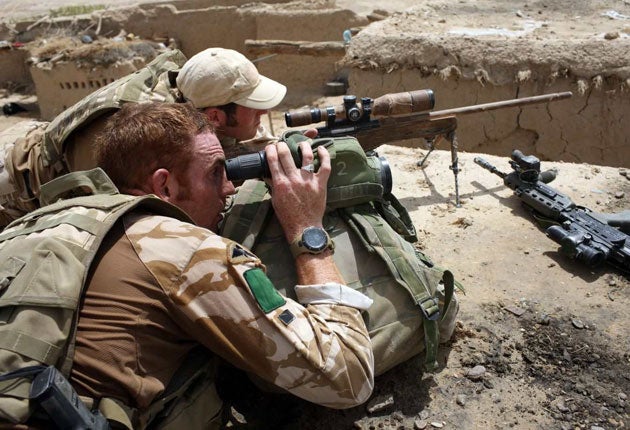
British troops are fighting their deadliest winter campaign to date in Afghanistan as the Prime Minister continues to resist calls to send reinforcements. Traditionally the onslaught from the Taliban has quietened over the icy winter. Less than three months ago Foreign Secretary David Miliband spoke of the “winter lull” offering a chance to plan the next phase of a campaign aimed at supporting Afghan governance. But the hiatus has failed to materialise this year and the fighting has been relentless.
The most recent soldier to die was killed in an explosion while on patrol in Helmand province yesterday. A Royal Marine operating with the 45 Commando unit, was killed in the Kajaki area. An MoD statement said the soldier, who has not been named, “was taking part in a routine reassurance patrol when the explosion occured. He received immediate medical attention but sadly died of his wounds.” The Marine has not been named but his family has been informed.
The death follows that of Serjeant Christopher Reed, of the 6th Battalion, The Rifles, a 25-year-old “talented, committed” non-commissioned officer killed in Garmsir on New Year’s Day, the 138th British serviceman to die in the country since 2001.
In the first two-and-a-half months in Helmand, 3 Commando Brigade has suffered 17 deaths. By contrast, the previous 2006 and 2007 winter tours cost 10 and 12 men respectively over a six month period. Fatalities have been matched by injuries. In the first half of December there were 58 wounded servicemen or women admitted to the field hospital in comparison with a total of 43 in January last year.
The death rate has already surpassed the equivalent period of most of the customarily-tougher summer tours, only matched so far by the toll wreaked on 16 Air Assault Brigade this year.
British commanders in Helmand insist the heavy losses are due to the fact that the Royal Marines and attached army units have been “taking the fight to the Taliban” in a previously untouched insurgent stronghold.
Experts, however, believe the surge has more to do with a build up of locally-based militants, increasingly sophisticated terrorist tactics and a pre-emptive strike to disrupt this year’s elections. Despite Afghanistan’s unforgiving winters, the insurgents now operate on a year-round basis.
“Casualties can be attributed to the unusually high presence of Taliban in certain areas. Also to the reaction of the international forces, particularly the British, who seem determined, quite rightly, to disrupt the Taliban presence,” explained Colonel Christopher Langton, a senior analyst with the International Institute for Strategic Studies. “It is hard to gauge numbers but it is certainly a firm impression, not just by me, that there is a larger presence. The numbers may not be bigger but it could be the fact that they are more active.” This, he added, was probably due to locals continuing to take up arms in the winter.
British commanders have long realised that they face a multi-tiered enemy of hardline Taliban emanating from Pakistan bolstered by locally-recruited fighters amongst the impoverished community. The battle to win the “hearts and minds” of “reconcilable” militants has always been foremost.
“The insurgency is fragmented, to simply refer to them as ‘Taliban’ is no longer sufficient. It is a complex patchwork of different actors, all with a vested interest,” said Paul Burton, Director of Policy Research at The International Council on Security and Development, formerly the Senlis Council.
These would include locals desperate to feed their families or coerced by the insurgents, criminals or drug barons trying to protect their revenues, as well as ideological fighters.
Col Langton agreed that the spike in violence could be due to factions fighting to protect interests in the face of a determined Helmand Governor Gulab Mangal, who has taken a hard line against corruption and the poppy trade. Last autumn Col Langton predicted a greater militant presence this winter “with the knowledge that this year is a critical year for both sides. They need to be in position to provide maximum disruption during the election period. They have to be in the area to start full-scale operations and carry on a relatively high level of activity leading up to that period.”
David Livingstone, Chatham House international security expert, said the increasing sophistication of insurgent tactics meant they were deliberately pre-empting an anticipated spring offensive by NATO forces.
However the British military in Helmand says the spike in fatalities could be explained by the fact that they had targeted the previously impenetrable Taliban stronghold of Nad-e-Ali. Operation Sond Chara (Pashto for “Red Dagger” after the commando patch) had successfully targeted the Taliban in their safe haven, dominating 180sq km in treacherous weather.
“We are taking the fight to the enemy and prodding and poking in areas he doesn’t want to be prodded and poked,” said Commander Paula Rowe, spokeswoman for the task force in Helmand said. “We do not underestimate that there are more challenges to come. This is the start, not the end, for 3 Commando operations. We are driving the tempo.”
Of the 18 British deaths this tour, five lost their lives in Sond Chara. By contrast 11 died in explosions with roadside and suicide bombs an expanding tactic that has taken a bloody toll on soldiers and civilians for the past year.
Mr Burton said: “Sticking an IED [improvised explosive device] by the side of the road in freezing conditions only takes two or three men in a small detail,” said Mr Burton. “It is showing a tragic trend in the country.”
Successive senior officers in Helmand have indicated a need for more troops to boost the current number of 7,300. Most notably the outgoing commander this summer, Brigadier Mark Carleton-Smith, said the size of the force in Helmand had to rise by 50 per cent, while adding that the solution could not be entirely military.
In December Gordon Brown announced that 300 more troops would be sent with the deployment of 19 Light Brigade this summer. But despite this year’s Iraq withdrawal, he has resisted calls for greater numbers. Thousands of the anticipated influx of US troops are expected to be sent to Helmand.
Mr Burton said: “They [the Taliban] are agile in a way that is costing more lives. The military paint a positive scene – that they are on the run. That may be the case, but with such a hard winter one can only really look at the situation deteriorating, unfortunately.”
Join our commenting forum
Join thought-provoking conversations, follow other Independent readers and see their replies
Comments