US 'wants to guard Pakistan's nuclear arsenal'
Concern that weapons could fall into enemy hands prompted drastic plan, claims 'New Yorker' report
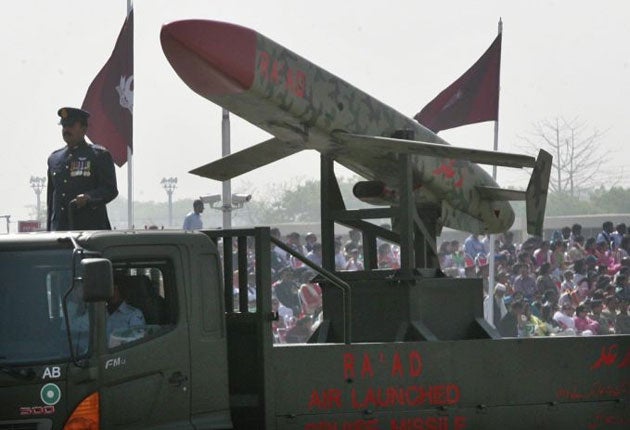
Pakistan's military has angrily insisted that its nuclear weapons arsenal is safely protected and denounced claims that it is secretly negotiating with the United States to allow teams of American specialists to provide added security in the event of a crisis.
In a rare public statement, General Tariq Majid, chairman of Pakistan's Joint Chiefs of Staff Committee, said claims that it was discussing "understandings" with the US that could even see the specialists spirit sophisticated nuclear triggers out of the country to prevent them falling into the wrong hands were "absurd and plain mischievous". "There is absolutely no question of sharing or allowing any foreign individual, entity or state, any access to sensitive information about our nuclear assets," he added.
His comments came after the publication of an article in The New Yorker by the respected investigative reporter Seymour Hersh which claimed that deepening concern within the Obama administration about the situation inside Pakistan had persuaded Washington that more needed to be done to protect the stockpile of a country that it considers an important regional ally.
The article also claimed that the threat could come from Islamist elements within the military or intelligence establishment as well as militants. It quotes a former US intelligence official as saying: "The Pakistanis gave us a virtual look at the number of warheads, some of their locations, and their command-and-control system ... We got their security plans, so we could augment them in case of a breach of security."
This is not the first time that concerns have been raised about the security of Pakistan's arsenal, estimated to contain between 80 and 100 warheads, as the country continues to be rocked with militant violence. Earlier this year it was claimed that facilities connected with the nuclear programme had been attacked on three occasions in the past two years, leading Pakistan to insist that there was no danger to its weapons.
Professor Shaun Gregory, director of the Pakistan Security Research Unit at the University of Bradford, whose report earlier this year was dismissed by Islamabad, said there were two main threats: from militants carrying out increasingly sophisticated attacks and seemingly armed with inside information, and from the "collusion" of those inside the military with militant Islamist sympathies. "If you look at the military there is no doubt that it is shot through with Islamist sympathisers and has increasingly moved away from the West as it has been asked to turn its guns on its own people," he added.
Pakistan has long bristled at suggestions that its nuclear arsenal, guarded by a half-million-strong army and a three-layer National Command Authority security system, could slip into the hands of Taliban militants. Government officials point to statements from senior American and British counterparts as proof that the Islamic world's only nuclear deterrent is not imperilled.
But the question is a nagging one, and returned last month after militants subjected the Pakistani army hq in Rawalpindi to a 22-hour siege. While the US Secretary of State, Hillary Clinton, said that the attack was evidence that militants "are increasingly threatening the authority of the state," she insisted: "We have confidence in the Pakistani government and military's control over its nuclear weapons." Mrs Clinton's "confidence" may owe something to the fact that since the attacks of September 2001 the US has done much to help Pakistan secure its arsenal. Two years ago it was reported that Washington had spent $100m to boost security and improve the vetting of those working with nuclear weapons. Such efforts may have been hampered by legal restraints in aiding a country that has not signed the Nuclear Non-Proliferation Treaty, but there was also concern about sharing too much sensitive technology – including the so-called "permissive action links" or Pals, a system used to prevent a device from detonating without proper codes.
The New Yorker report, which has also been denied by Anne Patterson, the US ambassador in Islamabad, claimed that this summer a highly classified military and civil emergency response team was put on alert after getting a report that a Pakistan nuclear component had gone missing. The team, Hersh claimed, was scrambled from Andrews Air Force Base, outside Washington, and apparently dispatched to Pakistan. By the time it was revealed that the report was false the team had already reached Dubai.
A Pentagon spokesman in Washington confirmed that the US was providing some training and equipment to Pakistan to improve its nuclear security but denied any intention to seize its nuclear arsenal. And analysts said it was all but inconceivable that Islamabad would acquiesce. One Western expert on Pakistan's nuclear arsenal, who asked not to be identified, said: "The Pakistanis would not share this nuclear information with the US. And to believe you can send in a couple of helicopters full of snake-eaters [special forces troops] and get the weapons simply does not work."
The Islamic bomb: Pakistan's pride
* Zulfikar Ali Bhutto was determined to deny rival India a nuclear monopoly. In 1965, the future prime minister said: "If India builds the bomb, we will eat grass or leaves, even go hungry." In 1972 he gave the go-ahead to a nuclear programme. Today, Pakistan is estimated to have 80 to 100 weapons.
* Bhutto was toppled in 1977, but the dictator who hanged him followed the same nuclear compulsions. During General Muhammad Zia-ul-Haq's rule, Dr A Q Khan, the "father" of Pakistan's bomb, boasted to a senior Indian journalist that Pakistan was "a screwdriver's turn away from developing an Islamic bomb".
* Strenuous US efforts to halt the programme failed in the 1990s. When in 1998 India staged tests, Pakistan responded in kind. Prime Minister Nawaz Sharif's popularity briefly soared, but severe sanctions ensued.
* In 2004, Dr Khan tearfully confessed that he had sold nuclear secrets to Iran, Libya and North Korea. He was dismissed but later pardoned; the US was barred from interrogating him. Today he is no longer under house arrest, but his movements remain restricted.
Omar Waraich
Join our commenting forum
Join thought-provoking conversations, follow other Independent readers and see their replies
Comments