'We feared that our baby would cry, giving away our position'
Escape from the Tigers leads to safety – in razor-wire encircled 'transition' camps
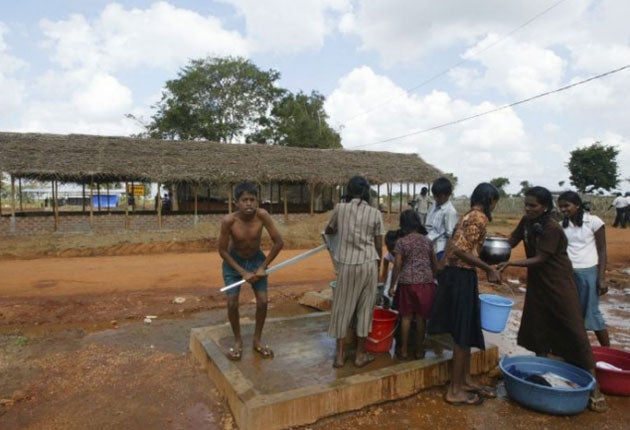
It was barely two miles across the no man's land that separated the rebel positions from the territory held by the government troops, yet it took Prabakhar and his family a full four days to make the journey. With just a bagful of belongings, they lived off biscuits and river water and stayed awake through the night. Prabakhar and his wife were terrified their five month old baby would cry and give away their position to rebel soldiers.
Now they are safe. Since January, Prabakhar, Ratikala and their two children, have been living in a government refugee camp in the north of Sri Lanka, some of the countless thousands of civilians forced from their homes by the conflict. They have no idea how long they will be forced to stay here before they can return home. "I don't know. It's up to the government," said the 30-year-old science teacher.
Prabakhar and his family are fortunate. They are among 8,500 residents of a showcase "transition" camp shown to journalists to prove that the government is doing every thing it can to help the civilians. The wood and metal-sheet houses are quite sturdy, there are schools and a hospital and the camp is clean.
A short drive away, the situation is markedly different; in a clutch of "transit camps" on a shadeless plain, more than 17,000 people try to escape the sun under tarpaulin huts. People complain about a lack of water and the sanitation facilities are utterly inadequate. One woman, Kirria, whose father was killed and whose husband was wounded in the fighting, said: "The food has no taste, there is not enough water." All the camps are surrounded by razor wire and people are not allowed to leave.
Sri Lanka is grappling with mounting problem of IDPs – internally displaced persons – driven from their homes as the conflict between government troops and the rebel forces of the Liberation Tigers of Tamil Eelam. With the last of the rebels – along with up to 150,000 civilians – surrounded in a strip of land in the north east, many hundreds of refugees are being taken to the camps every day. The total now stands at around 70,000. Despite the military operation to crush the rebels having been launched as far back as January 2008, the senior military commander in the Manik Farm region said they had been surprised by the numbers. "We never thought we would get so many," said Lt Col Indunil De Silva.
Many of these refugees have stories similar to Prabakhar's and tell how they were driven from their homes in the north as the conflict got ever closer. Some said that the Tigers had tried to prevent them from leaving. Aid groups have accused the Tigers of using civilians as a shield and say that some civilians were shot when they tried to leave.
Prabakhar, originally from Trincomalee, spoke without a military-provided translator and without the supervision of soldiers. His two room hut was simple; there were no beds, and refugees have to sleep on the floor, but it was well ventilated and the metal roof had been covered with coconut palm in a rather ineffective attempt to ward off the sun. He – along with many others – said they could use more water but that the food supplies were sufficient. His wife has planted flowers in the path of dirt in front of their hut.
Yet the most troubling issue for Prabakhar and the others is just how long they will have to stay here. The government said it must thoroughly process all refugees to ensure they are not Tigers and to send mine clearance teams to their villages before they can return. The government admits they could be here a year. Some aid organisations fear it could be much longer.
"I would like to be a normal person again. I would live to leave tomorrow," said Sandran, from a village near Kilinochchi, the one-time Tiger capital. "If I have to stay for a year, I think I will be sick. There are so many problems here – the water and the sanitation. And the food is not to our taste. All our belongings are gone. We have only the things we arrived in."
Another man, 31-year-old Nanthapalan, said he too would like to leave. "If the government says we can go then we will go. If we have to stay here for a year there will be many problems."
Piancy Charles, the civilian administrator of the camps, said she believed the refugees would have to stay at most a year. "We are doing everything we can to make these people value-added citizens," she said, explaining the vocational training and other things being offered at the camp.
Join our commenting forum
Join thought-provoking conversations, follow other Independent readers and see their replies
Comments
Bookmark popover
Removed from bookmarks