Who wants to be a coconut millionaire?
The Indian state of Kerala is famous as the land of coconuts. But climbing trees has been the only way to pick them. Until now...
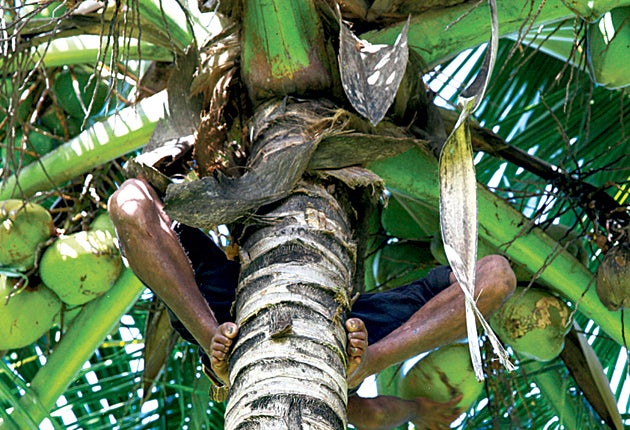
When he was a child, C Satheesh got used to his father slipping from the family home every morning at dawn to go and pick coconuts.
It was tough, arduous work. With a lunghi wrapped around his waist, a loop of fibre rope twisted around his ankles and a sharp knife tucked out of sight, his father would clamber high into the trees and start chopping at thecoconuts. Some days he would climb 50 trees for less than 150 rupees (£2). And it was unforgiving on the body; his joints ached, his back constantly hurt. A fall could have been fatal.
So last year, when the state government of Kerala announced a special competition, Mr Satheesh, 28, a computer engineering graduate who runs his own software company, immediately took notice.
The contest was to devise a machine that could ascend a coconut tree and harvest the nuts, thereby doing away with the need for human climbers.
Today, Mr Satheesh's machine, designed with the benefit of practical advice from his father, will be one of eight shortlisted entrants to be tested in a two-day trial overseen by government officials. The organisers received more than 450 entries, and even at this stage people can bring their machines to the finals to compete. Three winners, whose machines are judged to have most effectively scaled the tree and completed the task, will each receive 1m rupees (£14,000).
"The economy of Kerala is very agrarian and many people depend on agriculture and the coconut. It's one of the most important products we have, and every part of the tree is used," said D K Singh, a senior official with the Kerala state government's office in Delhi.
"But nowadays, the younger generation does not want to climb trees. So the government planned to develop a mechanical device."
India grows 15 billion coconuts a year. The Coconut Development Board, in the port city of Kochi, claims that the average Indian family uses 30 coconuts a month. They are eaten, their liquid is drunk, their flesh is used to make shampoo and oil. In Kerala, coconut is also distilled into a fiery toddy, while the fibre is used for matting. The nuts are worth more than £11bn to the nation's economy.
But for all of India's progress in introducing modern agricultural methods – at least in certain parts of the country – during the "green revolution" of the late 1960s, the growing and harvesting of coconuts today is little changed from how it has been for generations. Even now, every coconut is picked by hand.
Traditionally, the harvesting of Kerala's coconuts was a task for members of the lower caste thiyya clan. But in Kerala, which enjoys literacy rates of more than 90 per cent and where educational opportunities are more than in most Indian states, a younger generation has grown up less inclined to climb trees. The result is an estimated 15 per cent shortfall in the number of climbers required to harvest the state's annual crop.
By any measure, climbing for coconuts is hard work. Not only does a climber have to scale the tree and reach out among the fronds and cut the coconut, but they also have to instinctively learn which nuts are ripe enough to be harvested.
"It affects your ligaments, it pulls at you. You have to try and ignore the pain if you want to feed your family," said Mr Satheesh's father, K Chandran, whose father and grandfather before him also worked as coconut harvesters. "I would start work at 6am, work for two hours, stop, work for another two hours at midday, rest, and then do another two hours in the evening. It is too hard on the body just to keep going; you have to take a break." Speaking from his home near the village of Palakkad, he added: "After three or four years, you start to feel much older."
Inspired by the challenge of building a machine that could end the need for the toil of climbers such as his father, Mr Satheesh set his ingenuity to work. The result is a robot that "climbs the tree like a human being", with hooks instead of hands and feet. His 4ft-long contraption is made of aluminium and steel and employs a mechanical arm to cut the coconut. "The machine is alright. But there are still some fixes that need to be done to it," he said. "When it is cutting the coconut, it takes a long time. So there needs to be some changes."
T Prakasan, who like most Keralans uses his given name and an initial, also devised a battery-operated robot to climb the tree and pick the nut. Another of the eight who received a small amount of money from the state authorities to come up with a prototype, 57-year-old Mr Prakasan spent 12 months coming up with his design, working at his home near Calicut.
"It's a hobby. I've made toys, lights, birds and other gadgets," said the retired tax official, whose home is set in an acre of coconut trees. "My family was not so interested in my hobby before, but this time they are."
Not everyone due to take part in the finals, being held in the city of Thiruvananthapuram, opted for a robot. Another entrant, G Babu, who works at a technical college, spent 16 months working on his machine, which uses ropes and a rotating knife. He would have liked to have used more costly materials, but was limited by his means. Moreover, he said he believed the winning entry should be affordable so that it could be bought and used by ordinary people. He said he had tested his device on the trees in front of his home and that it had worked successfully at up to 13 metres.
"You have to stand and operate my design. As you pull on the rope it goes up," said Mr Babu, who said his favourite use of coconut was as an ingredient in a chutney, combined with chili and coriander. "It's not too sophisticated, it's rather simple. But it has a success rate of 90 per cent."
Not all those competing in the contest are amateurs. Staff at the MS Ramaiah School of Advanced Studies in Bangalore are among those who received money to develop a prototype. Jairam Madan said four members of the institute's research and development team had been working on their device since they read about the challenge in a newspaper.
"Ours is not fully remote-controlled. It still has cables," said Mr Madan. "One of the hardest things was working out the amount of friction on the trunk of the tree. There are two elements to the design, the climber and the robotic arm to cut the coconut. We have made several trials."
In the days before the contest, Mr Satheesh has been busy fine-tuning his design, determined to try to win, determined to ensure that Kerala can continue to enjoy the benefits of the coconut without the need for human harvesters. He added: "I developed this to stop people [such as] my father from climbing."
Join our commenting forum
Join thought-provoking conversations, follow other Independent readers and see their replies
Comments