Why Burma's dictatorship is desperately hunting for a white elephant
Sighting of rare albino animal – a symbol of power in Asia – has generals scouring jungle
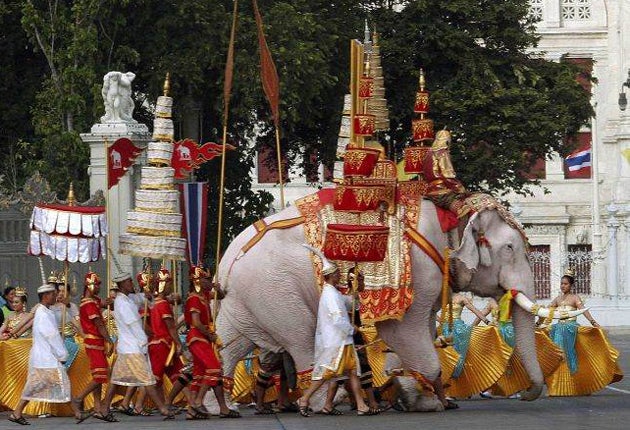
For centuries, white elephants have been revered as a symbol of power and good fortune in south-east Asia. Their discovery is a sign that the nation will prosper, and its rulers are wise and just. Small wonder, then, that when one of these rare creatures was spotted near Burma's western coast earlier this year, the country's ruling generals sent in a special army unit to capture it.
Never mind the international condemnation of Burma's military dictatorship, suspected war crimes or shocking levels of poverty. If a white elephant is found, so the superstition goes, then all will be well.
In the forested hills behind Ngwe Saung beach, elephants are used to haul timber. It was one of their handlers who spotted the rare albino among a herd of wild elephants in January. He reported the sighting to the head of the timber company, the military was informed and the news was quickly sent up the chain of command. According to soldiers in Ngwe Saung, Senior General Than Shwe – the country's head – himself dispatched a company of some 50 soldiers, with an entourage of elephant handlers and veterinarians armed with tranquilliser darts.
Soe Tin, a local farmer, knew what this meant for him. The first sighting of the elephant in 2008 brought a swarm of soldiers to the area. The military commandeered the local workforce of banana farmers and charcoal sellers to assist in an unsuccessful three-month search. When the hunt resumed in January, Soe Tin was recruited again. "The village authorities demanded one person from each household," the 41-year-old said. "We were forced to work without pay."
The soldiers demanded that all the villages near the beach provided them with unpaid labour – a practice that is common in Burma. The men left their homes and their farms to act as guides and porters. "The soldiers ordered us around. I just did what they said. I didn't dare speak up," the farmer said.
The legend of the white elephant originates in tales of the birth of Buddha: a white elephant reputedly appeared before his mother and presented her with a sacred lotus flower. The ancient Burmese kings believed that white elephants were found only during the reign of good kings and that the possession of one would help a country prosper. Conversely, the death of one of these creatures could spell disaster. The demise of King Thibaw's favourite white elephant – who lived in extravagant surroundings, adorned with diamonds and fed from a gold trough – was soon followed by the monarch's ousting by British colonisers in 1885.
Burma's modern-day rulers revere the white elephant just as their royal predecessors did. In 2001, the capture of a white elephant in the jungles of Arakan state was hailed in the media as "an omen for the emergence of a prosperous, peaceful and modern state". The "royal elephant" was brought to Rangoon and presented to General Khin Nyunt – then first secretary of the ruling State Peace and Development Council – who dressed it in full military regalia and kept it at his private temple in a northern suburb of Rangoon. But when Khin Nyunt was purged from his post as Prime Minister in 2004, the elephant fell out of favour.
The junta's leader, Than Shwe, and his army chiefs, now in their newly built capital Naypyidaw, are still waiting for a white elephant of their own. This would be an auspicious year to find one. Burma's first general election in 20 years will be held later in 2010, but Western governments have already dismissed the vote as a sham.
Recently announced election laws forbid the detained opposition leader Aung San Suu Kyi from running for office. Her National League for Democracy, faced with the choice of expelling its leader or boycotting the election, has chosen to boycott it.
Amid the chorus of international criticism, the regime may be hoping that the capture of the elephant will bestow legitimacy on its rule. But the Burmese people, run down by years of political repression and economic mismanagement, may not see it that way.
"Old symbols of the monarchy still hold some sway, and the possession of a white elephant might boost the confidence of some, but I think for most Burmese people today, just a little more spending on health and education would be a much more welcome sign of enlightened government," said the historian and author Thant Myint-U.
In the Ngwe Saung hills, the hunt goes on. Local farmers say they think the herd is protecting the elusive beast – estimated to be around five years old and 5ft tall. Farmers in the area where the creature was spotted say they have been driven off their land. They claim soldiers have cut down hardwood trees and allowed their hunting elephants to trample crops.
The search is causing misery and hardship, said Soe Tin. "No one has any idea where this elephant is," he said. "If there is a white elephant out there, I just hope they catch it very soon."
Additional reporting by Win Myat
White elephants Useless or exalted?
While the white elephant is revered in Burma, the phrase has a rather different connotation in Britain, where it is defined as a "a possession that is useless or troublesome," according to the Oxford English Dictionary. It derives from the practice of the kings of Siam, the former name for Thailand, to give rare albino elephants to ambitious courtiers. So great was the honour and so prestigious the gift, that they would have no choice but to look after the animal. However, the unwilling owner would soon be ruined by the enormous cost of looking after it, with its insatiable demand for bananas and sugar cane. The mystique of the animal continues in Thailand through the honours system and the Most Exalted Order of the White Elephant, established in 1861 by King Rama IV.
Join our commenting forum
Join thought-provoking conversations, follow other Independent readers and see their replies
Comments
Bookmark popover
Removed from bookmarks