Zardari 'must relinquish powers of Musharraf'
Pakistan President accused of dragging his feet on constitutional change
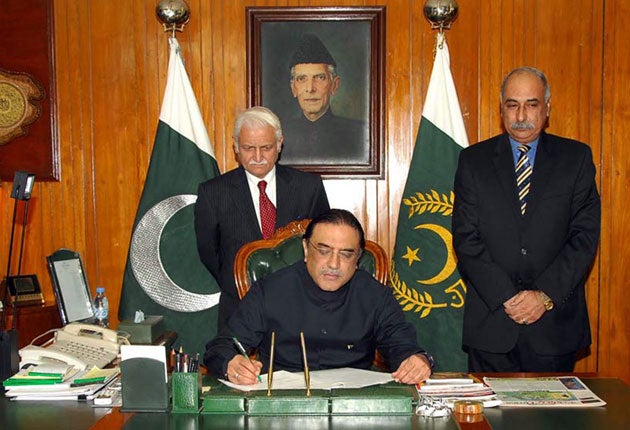
Pakistan's beleaguered President, Asif Ali Zardari, should immediately relinquish many of his powers, a prominent opposition politician said yesterday in the latest twist to a long-brewing crisis.
Shahbaz Sharif, the brother of former prime minister Nawaz Sharif and Chief Minister of Punjab, Pakistan's largest province, called on Mr Zardari to renounce, without delay, his powers to fire an elected government and appoint military chiefs.
Mr Zardari announced last week that he was transferring command of the body that oversees the country's nuclear arsenal to the Prime Minister, Yousaf Gilani, in what was widely seen as an attempt to ease some of the mounting pressure. While the move may have been largely symbolic – as it is the army that controls Pakistan's warheads – Mr Zardari also promised to surrender other key powers, referred to as the 17th Amendment, by the end of the year.
But Mr Sharif, whose brother, Nawaz, heads the main opposition party, the Pakistan Muslim League-N (PML-N), said Mr Zardari had made similar promises in the past and that he should act now. "I would ask the President to immediately abolish the 17th Amendment," Mr Sharif told reporters in Lahore, the provincial capital. "The nation would appreciate this act."
Mr Zardari, who heads the Pakistan People's Party (PPP), inherited far-reaching presidential powers from his predecessor, Pervez Musharraf, who resigned last year. When he assumed the position, Mr Zardari said those powers would be transferred to the Prime Minister, in accordance with the country's original constitution. For several months, Mr Zardari and Nawaz Sharif suggested they could put aside their differences and work together as allies in a newly democratic Pakistan.
But Mr Zardari has repeatedly been accused of dragging his feet and refusing to meet his promises, firstly over an undertaking to restore the country's former chief justice, who was fired by Mr Musharraf, and secondly on the implementation of a series of constitutional changes that would see many of the presidential powers assumed by the Prime Minister.
Mr Zardari's vulnerability and the ongoing sense of turmoil within Pakistan have been exacerbated by the expiry of an amnesty protecting him and several allies from prosecution over long-standing corruption allegations. The agreement was brokered by Mr Musharraf in the autumn of 2007 apparently as part of a power-sharing deal with Mr Zardari's late wife, Benazir Bhutto, and its demise has raised the prospect of legal challenges to his rule. However, he is exempt from prosecution as long as he is President .
The uncertainty comes ahead of US President Barack Obama's announcement this week of his new strategy for confronting the Taliban in neighbouring Afghanistan. Amid growing concern about cross-border raids by Taliban militants based inside Pakistan, there is an awareness within the US that a any new plan must include both countries. While under President George Bush, the US strove to build a close relationship with Pakistan's military, it has more recently thrown its weight behind supporting democracy in the country.
Yet for Mr Zardari, that relationship cuts both ways. Fifteen months after he took office and struggling in opinion polls, Pakistan's President finds himself condemned for what his critics say is an overly deferential and dependent relationship with the US, something that has deeply antagonised the powerful military.
Much now will depend on the actions of the PML-N and Nawaz Sharif, who would love to assume a third turn at the helm of the country. Analysts say that while Mr Sharif is happy to apply pressure on Mr Zardari, he will stop short of anything "unconstitutional" that could threaten civilian rule.
Join our commenting forum
Join thought-provoking conversations, follow other Independent readers and see their replies
Comments
Bookmark popover
Removed from bookmarks