Climbers may be barred from Uluru
News in pictures
News in pictures
On Facebook
From the blogs

Tyrannosaur and Drive: The difference between loneliness and being alone

The prospect of loneliness is probably one of the biggest fears that humans have to contend with. Mo...

The Woman in Black: From page, to stage, to film

Director James Watkins and screenwriter Jane Goldman discuss how they kept up the constant high leve...

The future of academic publishing

These are the most uncertain times in living memory for academic publishing. After decades of bumpin...

Books with soundtracks: no, really, this one works…

Books with soundtracks. The idea is so glaringly obvious, and so obviously feeble, that I hesitate t...

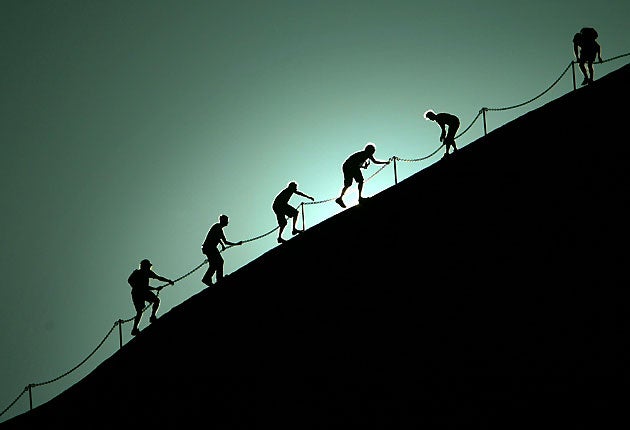
An Australian government proposal to stop people from climbing the famed Uluru, in deference to the wishes of indigenous people, sparked debate today with lawmakers opposing the plan.

A draft management plan for the Uluru-Kata Tjuta National Park called for a ban on people climbing the 348-metre (1,142 ft) rock, which is sacred to local Aborigine people and visited each year by 350,000 people, half of them from overseas.

The plan for Uluru, formerly known as Ayers Rock, could be implemented within 18 months, but must be approved by national Environment Minister Peter Garrett after a two-month public consultation, a spokesman for Garrett said.

"Kevin Rudd must veto any plans by Peter Garrett to shut down Australia's world-famous Uluru climb," said conservative politician and environment spokesman Greg Hunt.

"Visitors from around Australia and the world would be stopped from completing the majestic and exhilarating journey," Hunt said.

The world heritage-listed rock, famed for its shifting red-ochre colours, is a top tourist drawcard and is climbed by more than 100,000 people each year, despite its central desert location and against the wishes of indigenous people.

"You can't go climb on top of the Vatican, you can't go climb on top of the Buddhist temples and so on and so forth," local elder Vince Forrester from Mutitjulu township told state radio.

Forrester said traditional owners of the rock, which is 9.4kms (5.8 mls) in circumference, have wanted the climb closed since the park was placed in indigenous hands in 1985. The monolith features strongly in indigenous creation myth.

"Obviously you have to respect our religious attachment to the land too, so we're saying please do not climb Uluru. We've said it in all languages," Forrester said.

But outback Northern Territory Tourism Minister Chris Burns said his government did not back the indigenous proposal.

Hunt said the national government should not contemplate the closure of the rock at a time when Australia's tourism industry was under threat from the global financial crisis.

"Big Brother is coming to Uluru to slam the gate closed on an Australian tourism icon, the climb," he said.

But people responding to the state ABC radio website were divided, with some saying it was a "denial of the rights", and others calling for more respect of sacred areas.

"About time. We would be horrified if people were allowed to climb all over our churches or sacred sites," wrote Lilly.

Independent Comment
blog comments powered by Disqus

Day In a Page

Silent revolution at the Baftas as the French take top awards

Silent revolution at the Baftas

The Artist wins in seven categories, with Meryl Streep the other big success story
Whitney Houston: The diva who had – and lost – it all

The diva who had – and lost – it all

Nick Hasted charts the highs and lows of Whitney Houston's life
How Picasso won over (some of) the British

How Picasso won over (some of) the British

Winston Churchill and Evelyn Waugh hated his work, but Picasso provided inspiration for a whole generation of UK artists
Topshop: A Decade Of Design

Topshop: A Decade Of Design

When London Fashion Week starts on Friday, Topshop will celebrate 10 years backing its brightest young stars
John Prescott: 'My wife thought I'd just retire, but I'm not a slippers man'

'My wife thought I'd just retire, but I'm not a slippers man'

At 73, John Prescott isn't mellowing. In fact he's taking a shot at becoming a police commissioner
Jim Gamble: We are losing the race to protect our young

Jim Gamble: We are losing the race to protect our young

Technology and the children who use it won't wait for slow-moving child-protection services and police to catch up
Sarah Sands: A friend is not the one you turn to, but the person who turns to you

Sarah Sands on friendship

A friend is not the one you turn to, but the person who turns to you
Andy Burnham: 'It's a genie out of the bottle moment'

Andy Burnham interview

'It's a genie out of the bottle moment'
Leveson: What we've learnt so far

Leveson: What we've learnt so far

Ingenious hacks, shifty editors and attacks of Sudden Memory Loss Syndrome – Matthew Bell assesses the state of play at the Royal Courts of Justice
Modern lovers: The 'sexual body warriors' and pioneers transforming 21st-century relationships

Modern lovers: The 'sexual body warriors'

Sarah Morrison meets the people redefining love in the 21st century.
'I was angry, so angry': How heartbreak, betrayal and Su Pollard helped Estelle find pop success

Estelle: 'I was angry, so angry'

The singer talks about heartache, betrayal and bouncing back.
Choc tactics: Bill Granger's Valentine's recipes for chocoholics

Bill Granger's Valentine's recipes for chocoholics

Should it be white, milk or plain? Can you make a melt-in-the-mouth pudding without using any?
Male, pale & stale: Could more women on the board help Mothercare – and other ailing firms?

Male, pale & stale

Could more women on the board help Mothercare – and other ailing firms?
Upstairs, downstairs, 2012-style

Upstairs, downstairs, 2012-style

There are now more domestic workers in Britain than in Edwardian times
Boos in Berlin for Jolie's war drama

Boos in Berlin for Jolie's war drama

Hollywood star defends her hard-hitting and controversial story set during the 1990s Bosnian conflict