Frozen out – the rower on a solo polar mission
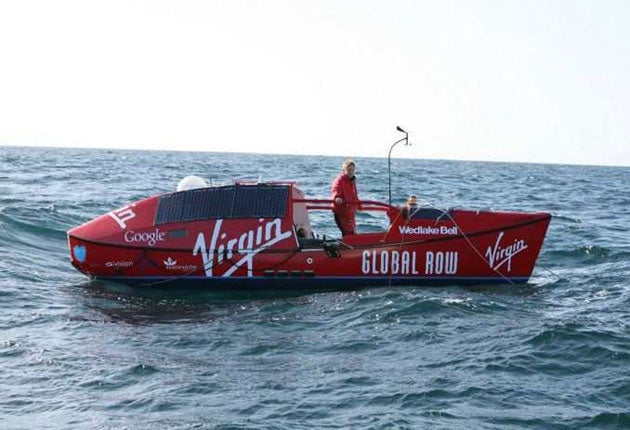
After years of meticulous preparation, Oliver Hicks is ready to launch an attempt to row solo around the world. First, though, the young Englishman must surmount a last-minute obstacle: the bossy paternalism of authorities in Australasia, where he intends to start his expedition.
Mr Hicks, from Suffolk, had planned to set off from New Zealand on his audacious voyage, which will take him across the Pacific Ocean and down into the icy waters of Antarctica. But maritime officials refused to allow him to leave, saying his trip was too perilous, for himself and for those likely to be called on to rescue him.
Following a swift change of itinerary, the 27-year-old decamped to southern Tasmania, where authorities were equally lukewarm. The maritime safety body, Marine and Safety Tasmania, urged him to reconsider his "inherently dangerous" plan yesterday. However, unlike their New Zealand counterparts, who could have detained him, Australian officials cannot prevent him from leaving.
Mr Hicks was lying low yesterday, putting the final touches to his hi-tech boat, the Flying Carrot, in which he hopes to become the first rower to circle the globe. But interference from officialdom – fuelled in part by rescue missions that had to be launched during the Vendée Globe round-the-world yacht race – is unlikely to deter him from setting off before the end of this month.
At the age of 17, he cycled 1,000 miles from Land's End to John O'Groats. At 21, he ran six marathons (150 miles) back to back across the Sahara desert. Four years ago, he became the first person to row solo eastbound across the North Atlantic: a 124-day trip in a second-hand boat.
But none of that compares with what lies ahead now: up to 22 months alone at sea, a diet of dehydrated food, multi-vitamins and the occasional fish, and a 15,000-mile route that takes in the iceberg-strewn Southern Ocean and the "Furious Fifties" – the winds that rage between 50 and 60 degrees south.
The 24ft Flying Carrot is, of course, no ordinary boat. The fibreglass vessel has a self-righting hull, solar panels and a wind generator to power Mr Hicks's communications equipment. It is steered by a computer-controlled autopilot and is equipped with 10 pairs of oars, a sail (for emergencies only), a laptop and two satellite phones. The bow cabin will have an emergency grab-bag containing survival equipment.
Even with all the technological assistance, it will be a gruelling trip. The English adventurer plans to paddle for nine hours a day, covering 30 miles daily for 500 days, braving biting winds and mountainous swells. He will take a break mid-year, pausing for a few months on South Georgia, in the southern Atlantic, to restock his supplies and avoid the worst of the southern hemisphere winter.
That assumes that all goes well, of course, a view not shared by the official body, Maritime New Zealand. Its strategy and communications manager, Lindsay Sturt, told The Sydney Morning Herald: "The risks inherent in Mr Hicks's proposed voyage are substantial and the likelihood of rescue being required is significant."
Mr Hicks – the youngest person to row across an ocean – arrived in Tasmania just before Christmas and put his boat in the water last week, after two weeks in quarantine in Hobart.
According to Hobart's The Mercury, the Flying Carrot will be towed to its launch site at Recherche Bay, near Tasmania's southern tip, by a support vessel, Blizzard, which will escort it out to sea. Then Mr Hicks will be on his own, as he crosses the Pacific to Cape Horn, traverses the hazardous Drake Passage, then heads down into the Southern Ocean.
In his blog, he explained why the voyage appealed to him. It was, he wrote, "extraordinarily difficult; long duration – like the old-fashioned explorers; solo – to raise the bar as high as possible; a first – never been done before; an ocean adventure; exciting, exhilarating, frightening and, at times, mind-numbing".
Wandering spirits: Adventurers in trouble
*Adelir Antonio de Carli
In an attempt to set a record for the longest time spent flying with balloons, the 41-year-old Brazilian priest attached 1,000 helium-filled party balloons to his chair and set off from Paranagua, Brazil, in April 2008. Fr de Carli was trying to fly the 465 miles to Dourados, hoping to raise funds to build a chapel for truckers in his parish. He disappeared after bad weather blew him off course and his body was found three months later off south-eastern Brazil.
*Steve Fossett
An adventurer who made a number of daredevil record attempts, Fossett met his end while preparing to break the land-speed record. He disappeared in September 2007 while flying his single-engine plane, looking – it is believed – for a site to stage the attempt. In 2002 Fossett, 63, a friend of Sir Richard Branson, became the first person to fly solo around the world in a balloon. His remains were found last year near where his plane crashed in California.
*Jean Le Cam
Covering a distance of 26,000 miles and having claimed the lives of three participants, the Vendée Globe is considered the world's most gruelling yacht race and has earned the nickname "the Everest of the Seas". Out of the 30 racers who started this year's event, 18 have dropped out. One of these is Le Cam, who last week became trapped in the hull of his boat in extreme weather. He was stuck there for 16 hours before Vincent Riou, another participant, rescued him.
Join our commenting forum
Join thought-provoking conversations, follow other Independent readers and see their replies
Comments