Pirate radio tries to beat repression in paradise
Fiji's democratic opposition hopes to evade military leader's draconian censorship
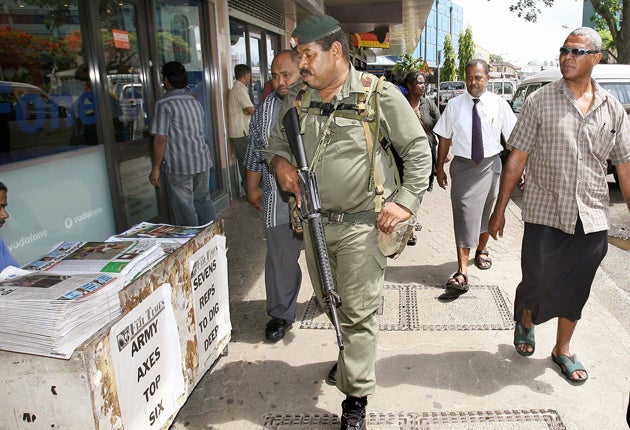
This is a story about repression in what many people would think of as some kind of paradise.
In a move inspired by pirate radio stations of the 1960s, political activists in the South Pacific are planning to position a Dutch-registered merchant vessel in international waters off the coast of Fiji to defy censors in the military dictatorship.
Opponents of the coup leader and self-appointed Prime Minister, Commodore Frank Bainimarama, hope to have the station broadcasting news and interviews by the end of next month in an effort to circumvent draconian media laws imposed on the island state's press, radio and television.
Since taking power in a military coup in December 2006, Fiji's strongman has slowly eaten away at the country's democratic freedoms, installing newsroom censors and cracking down on foreign media ownership. Newspapers and radio stations now have to be 90 per cent locally owned, a stipulation that will almost certainly see the closure of the 140-year-old Fiji Times. The popular title, which has been owned by News Limited since 1987, has been emasculated since the censors moved in to demand the removal of any anti-government stories.
With most of the population too poor to access the internet or satellite television, the majority of Fijians rely on the press and transistor radios for their news. That is why Usaia Waqatairewa of the Fiji Democracy Movement has opted for pirate broadcasting. Now exiled in Australia, he plans to stream live programming to the ship from a Sydney newsroom and rebroadcast the material from an on-board transmitter on the AM waveband. "The basic purpose is to inform the public of what's really happening in Fiji so that they can make an informed decision about whether to support Bainimarama or not," he said.
Fiji has suffered four coups in the past two decades and is now facing an economic crisis that threatens to bring further instability to the 800,000 people who inhabit this sprawling archipelago. To make matters worse, there are increasing concerns about human rights as Commodore Bainimarama continues to crack down on those who oppose his dictatorship. In a rare interview aired by the Australian Broadcasting Corporation last month, the military leader said, "we'll need to shut some people up" before the country can return to democracy. "I don't trust the people," declared the Prime Minister, adding that he was none too happy about politicians or the judiciary, either.
After silencing the powerful Methodist church and the chiefs who are the traditional rulers of this fiercely patriotic nation, Mr Bainimarama sacked many judges.
Suspended from the Commonwealth and excluded from the recent South Pacific Forum annual meeting, Fiji risks becoming a pariah in the region at a time when it desperately needs friends. The Prime Minister also recently expelled Australia's acting high commissioner to Fiji and held his own mini-regional conference to prove he can do without the support of those who disagree with him.
The reforms the commodore talks about strike at the very heart of Fiji's racially divided society. For many years, about half the population was of Indian origin, descendants of indentured labourers who were brought to Fiji by the British in the 19th century to help in the sugar industry. In recent years, faced with eviction from their Fijian-owned farms after their leases expired, thousands of Indians have sought refuge overseas while many of those unable to leave have ended up in squatter camps.
When Mr Bainimarama seized power he promised a fairer society, with legislation designed to protect the interests of the Indian community. But while he may have been well intentioned, his policies are in danger of turning Fiji into an economic basket case. Unemployment, poverty and fear have created a society whose people are often too scared to talk.
Even the phones no longer guarantee confidentiality since the government ordered mobile and landline users to register all their personal details. One local carrier, Vodafone, is also demanding customers provide a left-hand thumb print and PIN, which the user would normally keep secret. The head of the Justice Ministry, Aiyaz Sayed-Khaiyum, claims the compulsory registration of all phones is the result of a spate of bomb threats and bogus calls. Critics suggest it is more to do with the interim government wanting to create a database of callers whose views do not correspond with the regime's.
Telephone paranoia even extends to some tourists. A German businessman who used his satellite phone in a restaurant recently was reported to the police, who promptly raided his hotel room. He left the country in disgust shortly afterwards. So far, such stories have not damaged tourism, which is one of the few Fijian industries still booming.
A devalued local currency and a strong Australian dollar have made Fiji a bargain destination for overseas holidaymakers. In June alone, more than 45,000 Australians ignored the political considerations and headed to the country's upmarket resorts.
Cocooned in luxury, they are unlikely to see any military presence or the squalor in which so many thousands of Fijians are forced to live in the squatter camps around the capital, Suva. But while the tourists are still heading to Fiji, businesses are pulling out. Australia's Commonwealth Bank has sold its Fijian arm, and Qantas is trying to sell its 46 per cent stake in Fiji's national airline, Air Pacific.
Despite these economic warning signals, Mr Bainimarama remains determined to do things his way. The Prime Minister has promised to go to the country in 2014, but, since he has repeatedly postponed his general election plans over the past three and a half years, few believe he will keep his word. And, if an application for a loan of F$1bn (£328m) from the IMF fails, "the country's economic outlook will be shocking", according to Anthony Bergin of the Australian Strategic Policy Unit.
Such a situation will make Usaia Waqatairewa's plans for a pirate radio station all the more crucial in informing Fijians about what is happening. "We are not intending to broadcast propaganda. We just want to report the facts," he says.
Join our commenting forum
Join thought-provoking conversations, follow other Independent readers and see their replies
Comments
Bookmark popover
Removed from bookmarks