The Australian town that kicked the bottle
Drinking fountains replace shop-bought mineral water in environmental initiative
PENNY SPANKIE/AFP/GETTY
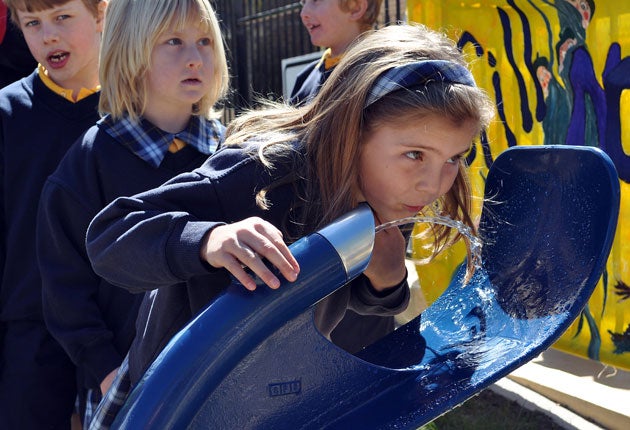
Children drink from a new drinking fountain in Bundanoon on the first day of a bottled-water ban
Plastic bottles were ceremoniously removed from shelves in the sleepy Australian town of Bundanoon at the weekend as a ban on commercially-bottled water – believed to be a world first – came into force.
The ban, which is supported by local shopkeepers, means bottled water can no longer be bought in the town in the Southern Highlands, two hours from Sydney. Instead, reusable bottles have gone on sale, which can be refilled for free at new drinking fountains.
Locals marched through the town on Saturday, led by a lone piper, to celebrate the start of the ban. John Dee, a campaign spokesman, said: "While our politicians grapple with the enormity of dealing with climate change, what Bundanoon shows is that at the very local level we can sometimes do things to bring about real and measurable change."
The ban was triggered by a Sydney drinks company's plan to build a water extraction plant in the town. Huw Kingston, a cafe owner, said townsfolk were horrified by "the idea of them taking water here, trucking it to Sydney and bringing it back in bottles to be sold in shops at 300 times the tap price".
Bottled water is widely viewed as an environmental menace, because of the energy consumed in producing and transporting it, and because most bottles end up in landfill sites. A New South Wales government study found the industry was responsible for releasing 60,000 tonnes of greenhouse gases in 2006.
In recent years, dozens of local authorities in Britain and the US have stopped spending public money on bottled water. But Bundanoon, population 2,000, is believed to be the first community to ban it completely.
Shelf space previously reserved for bottled water in the town's supermarket, off-licence, cafes and newsagent is now occupied by the reusable bottles. Filtered water fountains have been set up in the main street and at the local school; bottles can also be refilled in shops, for a small fee.
Mr Dee said: "We're saying to people, you can save money and save the environment at the same time. The alternative doesn't have a sexy brand, doesn't have pictures of mountain streams on the front of it. It comes out of your tap."
Only two people voted against the ban. One was concerned it would lead to more sugary drinks being consumed. The other was Geoff Parker, director of the Australasian Bottled Water Institute.
View all comments that have been posted about this article.
Offensive or abusive comments will be removed and your IP logged and may be used to prevent further submission. In submitting a comment to the site, you agree to be bound by the Independent Minds Terms of Service.
- Print Article
- Email Article
-
Click here for copyright permissions
Copyright 2009 Independent News and Media Limited


Comments
Bottled water was always an obvious scam. I can't remember the exact wording, but many bottle wrappers carry a warning such as, "For reasons of hygiene, do not refill." Why, what's it going to do to me? Or is it just that you want me to buy another bottle rather than doing the (sensible) thing of filling it up at the tap?
So this is good.
PS: I have been refilling 'single-use' bottles for years to no ill-effect.
A university in Eastern England was last year trying to push the use re-usable water bottles. Indeed, the campus shops were full of university-branded bottles for £3 - pretty reasonable considering the £1 cost of bottled water.
Unfortunately, there was nowhere to fill the things. The few water coolers available quickly sprouted signs banning the filling of bottles to "avoid the risk of transmitting infection".
Well done Aussies, you may only 2000 people in Bundanoon but you have set a shining example of how ordinary people can make a difference. :-)
In the UK the overwhelming majority of bottled water is drunk instead of other soft drinks, not instead of tap. Over 70% of the recent fall in bottled water sales came from people directly switching to other soft drinks instead.
Bottled water has the lowest environmental impact of any drink on the shelf - for example, the carbon footprint of a fizzy drink is 2-3 times greater and a fruit juice or smoothie is 7-8 times greater. In that context, why ban just bottled water? If people just switch over to the other soft drinks the environmental impact goes up, not down.
Hydration needn't come at such a high price, for either the environment or the pocket.
1. Ban all plastic bottles and cans then only sell drinks in glass bottles with a 20p deposit.
2. Ban council snoopers looking through our bins and send them to supermarkets to prosecute overpackaging.
3. Ban packaging of all natural products with a protective coat/skin ie potatoes, bananas and other fruit and vegetables.
4. Charge deposits on McDonalds plastic trays and drinks cups to stop litter
5. Close the pubs at 10.30pm and all other entertainments as well a TV so everyone goes home to bed and turns off the electricity (no naughty business in bed it's not allowed)
6. Ban floodlit sports
7. Ban cars
8. Ban enjoying yourself
9. Ban Christmas excess
10. Ban attention seeking scientists, politicians etc from talking about climate change ever again. These were the same people who forecast Y2K disasters, aircraft falling out the sky, nuclear power stations explodiong etc That made these alledged experts very rich and now they have another gravy train.