This isn't about climate change – but it may be the face of the future
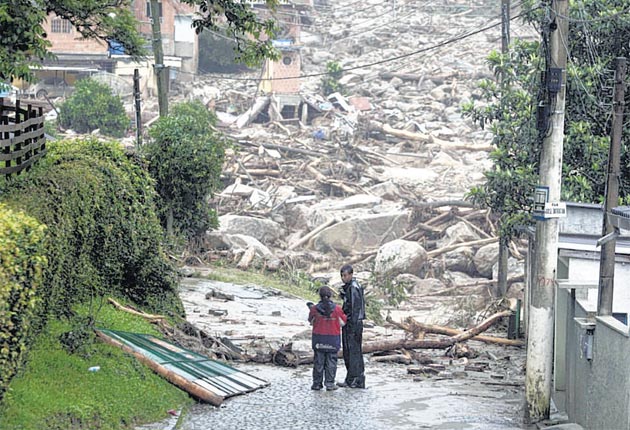
Rain in Brazil, rain in Australia and rain in Sri Lanka. Rain is the factor that links all three large-scale disasters unfolding before our eyes in these very different regions of the world.
To try to make sense of what is going on around us, it is understandable to draw comparisons. The images of flooded homes and stranded people from as far apart as Rio de Janeiro and Brisbane underscore the human anguish shared by all those caught up by these devastating natural disasters.
Heavy torrential rain falling on vulnerable people is the one incontrovertible connection linking all three tragedies. But there are other questions relating to whether these events are part of a longer-term climatic pattern, or whether any of the impacts could have been prevented by better urban planning.
Since 1975, disasters of all kinds have claimed the lives of more than 2.2 million people. Storms, floods, droughts and other weather-related phenomena were responsible for two thirds of these deaths, according to the UN's International Strategy for Disaster Reduction, which has warned that climate change is likely to increase the frequency and severity of these events.
A report by Oxfam in April 2009 found that in a typical year some 250 million people are affected by natural disasters and the vast majority – 98 per cent – suffered from weather-related catastrophes such as droughts and floods. Oxfam has calculated that by 2015 this number could grow by 50 per cent, to an average of more than 375 million people affected by climate-related disasters each year.
Scientists have emphasised that none of the three extreme weather events occurring now can be linked directly to global warming. Two of them, the floods in Australia and Sri Lanka, may be connected with a naturally occurring climatic phenomenon in the Pacific Ocean, called La Niña, whereas the landslides in Brazil are the result of heavy, localised downpours falling on badly constructed homes built precariously on steep hillsides.
It is almost certain that La Niña is behind the Queensland floods. La Niña, which means "little girl", is a change in the Pacific Ocean where a body of relatively cold water wells up over the equatorial region, causing a corresponding build-up of warm water in the western regions near Indonesia and Australia.
This warm water usually dissipates to the east in non-La Niña years. This year, however, is the strongest La Niña since 1974, and the warm water around Australia and Indonesia, with nowhere to escape, has generated heavy rain clouds that have burst over Queensland.
In 1974, when Queensland also suffered heavy flooding, La Niña was stronger then than at any time on record. Sri Lanka remained dry that time, but this time there is evidence that some of the warm moist air has blown further west, just nudging Sri Lanka into torrential downpours, according to Adam Scaife, head of long-range forecasting at the Met Office.
"Rainfall is expected to increase in a warmer world but in this case it's linked with the La Niña cycle. It's a natural cycle and we don't expect it to change in the future. This is not a climate-change issue, it's La Niña, and it's happened before and will happen again," Dr Scaife said.
Equally, the rain around Rio is associated with a typical weather system in the South Atlantic. Here the issue has centred on the lack of urban planning.
Urban planning has also played a pivotal role in making Brisbane vulnerable. After 1974, authorities said the newly built Wivenhoue Dam would save Brisbane from severe flooding but what they didn't take into account was that the city and its surroundings would change dramatically over the next 35 years.
Rapid urban development, a growth in the population and the dubious practice of building on flood plains have all raised the flooding risk in areas once considered flood-free. The building of houses, roads, drains and other infrastructure has changed the way water flows through river catchments, said Professor Chris Eves of the Queensland University of Technology.
Bad urban planning even in a nation such as Australia can increase the risk of flooding by taking away natural defences that let rainwater seep away safely. "It's created the potential to flood areas that were safe in 1974, and we're seeing that now," Professor Eves said.
John Magrath of Oxfam said that it should be no surprise that more people in the coming years will be affected by floods and other natural disasters, and not just because in a globally warmer world we are likely to experience more extreme weather.
"We're seeing more people affected because there are just more people and they tend to be more crowded together in unstable places," Mr Magrath said.
"We're seeing more extreme weather and it doesn't take much for that trend to become truly extreme and to cause disasters rather then just disruption," he said.
A world of disasters
2.2m People killed by natural disasters since 1975
50% Predicted increase in number of people affected by natural disasters between 2009 and 2015
375m People expected to be affected by climate-related disasters each year by 2015
Join our commenting forum
Join thought-provoking conversations, follow other Independent readers and see their replies
Comments