World's largest parrot pulled back from the brink
Once facing extinction, the 9lb ground-nesting bird has been rescued by breeding scheme
Adam Sherwin
Adam Sherwin is a News reporter who specialises in entertainment, broadcasting, music and popular culture stories.
Wednesday 18 March 2009
Latest in Australasia
Related articles
On Facebook
From the blogs
Sepp Blatter: Penalty shoot-outs must remain, they’re football’s great leveller
As England supporters, we should scorn at any such deciding factor within football. On so many occas...
Why do some men consider the street as a female meat market?
Pronouncements on sexual inequality in the UK are normally met with an eye roll by my generation. As...
Political corruption reflects the widening chasm between the political class and the electorate
The corruption and hypocrisy which has come to characterise politics and politicians, and in particu...
Despite its popularity, the death penalty would allow the state to kill innocent people
The University of Michigan law school and Northwestern University have just compiled a database of o...
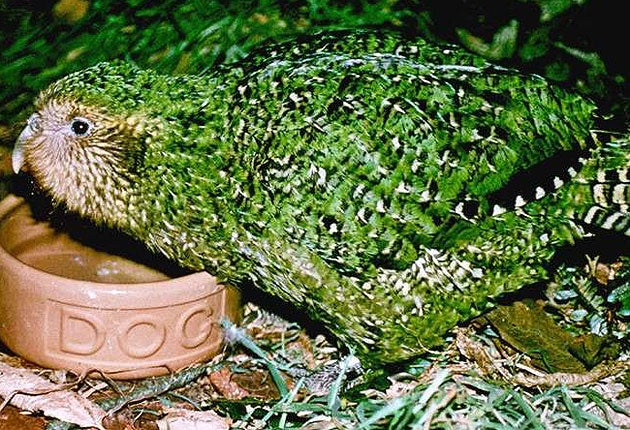
Scientists in New Zealand have rescued the world’s largest parrot from the brink of extinction. The population of the flightless kakapo has surpassed 100 birds for the first time in decades.
The milestone was reached this month after six chicks hatched on Codfish Island, one of two predator-free islands where kakapo numbers are being restored. There are now 105 birds, more than twice the number in 1999.
The ground-nesting kakapo, which weighs up to 9lb, was once widespread in the forests of New Zealand. But Maoris hunted it for its meat and bright green plumage, and European settlers brought cats, dogs, rats and ferrets into a formerly predator-free environment. A docile bird, the kakapo was prone to freeze on the spot when frightened.
One early explorer, Charles Douglas, wrote in 1899: "They could be caught in the moonlight by simply shaking the tree or bush until they tumbled to the ground … like shaking down apples."
By 1995, there were only 51 individuals left, and the future of the species seemed precarious. But in recent years, the kakapo’s fortunes have been restored. This summer, a total of 14 chicks have hatched on Codfish Island, off southern New Zealand, and all are thriving. Deirdre Vercoe, manager of the Department of Conservation’s kakapo recovery programme, linked the large number of chicks with a bumper crop of the adults’ favourite food: the fruit of the rimu tree. Kakapo are slow breeders, but perk up when they spot large quantities of the seeds. During lean times, conservationists have tried to fool kakapo into believing there was abundant food available.
"We’ve scattered freeze-dried seeds around their nests, even hung them from trees, but they seem to know when it’s the real thing," Ms Vercoe said.
New Zealand’s Conservation Minister, Tim Groser, warned of a "long road ahead" before the kakapo’s future was secure. Every chick is precious, and scientists have used many ways to give young birds the best chance of survival. In the past, adults were fitted with radio transmitters, and infra-red spy cameras were positioned in underground nests, enabling the kakapo to be monitored by volunteers in tents.
Whenever the mother left to forage for food, a bell rang, which was the signal for a volunteer to lower an electric blanket into the nest, using an extendable ski pole, so the eggs could be kept warm. If a predator appeared, the nest-minder would press a panic button, setting off a bang and a puff of smoke to scare it away.
- 1 Mark Zuckerberg saved $111m by selling Facebook shares before stock slumped
- 2 Brazil rocked by abortion for 9-year-old rape victim
- 3 Greece: Out of cash, out of hope
- 4 Society: The only way is Finland
- 5 News in pictures
- 6 Cameron knew Hunt would back BSkyB bid
- 7 In pictures: The bewildering face of China
- 8 Catcalls, whistles, groping: the everyday picture of sexual harassment in London
- 9 Ten adverts that shocked the world
- 10 '60 stone' Welsh teenager remains in hospital
- 1 Mark Zuckerberg saved $111m by selling Facebook shares before stock slumped
- 2 Brazil rocked by abortion for 9-year-old rape victim
- 3 Society: The only way is Finland
- 4 Catcalls, whistles, groping: the everyday picture of sexual harassment in London
- 5 Feeding a hungry world – or meddling with laws of nature?
- 6 Owen Jones: If socialists really did run the show, working people would benefit
- 7 'Hello mum, this is going to be hard for you to read ...'
- 8 African monkey meat that could be behind the next HIV
- 9 French in uproar over oral sex anti-smoking posters
- 10 Coke reveals its secret: It may need to carry a cancer warning
Experience the Heineken Hub
Get free wi-fi and exclusive i content while you enjoy a tasty pint of Heineken at participating pubs.
Can you imagine a career in teaching?
Be inspired to teach - let real teachers show you how rewarding the job can be.
Playing a game-changing role during the Games
Cisco is providing the solutions for London 2012's complex IT needs.
Enter the latest Independent competitions
Win anything from gadgets to five-star holidays on our competitions and offers page.
Business videos from commercial thought leaders
Watch the best in the business world give their insights into the world of business.
Career Services
Day In a Page
For men only: A pilgrimage to Mount Athos
48 Hours In: Faro
Feeding a hungry world – or meddling with laws of nature?
Monkey meat that could be behind the next HIV
Catcalls, whistles, groping: just another day for a young woman
Move over Brangelina, this night belongs to Kingston Bagpuize


Comments