1,500 dead as Georgia conflict escalates
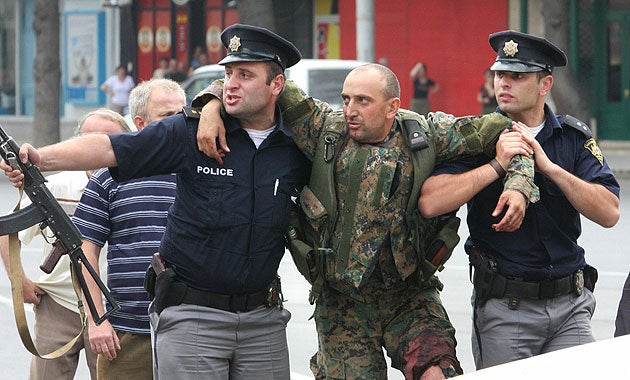
Russia sent hundreds of tanks and troops into the separatist province of South Ossetia and bombed Georgian towns today in a major escalation of the conflict that has left scores of civilians dead and wounded.
Georgia, a staunch Western ally, had launched an offensive yesterday to retake control of breakaway South Ossetia.
Russia, which has close ties to the province and posts peacekeepers there, responded by sending in armed convoys and combat aircraft.
Russian Foreign Minister Sergey Lavrov told reporters in Moscow today that some 1,500 people have been killed, with the death toll rising.
The figure could not be independently confirmed, but witnesses who fled the fighting estimated that hundreds of civilians had died. They said most of South Ossetia's provincial capital, Tskhinvali, was in ruins, with bodies lying everywhere.
Russian General Vladimir Boldyrev said in televised comments that Russian troops had driven Georgian forces out of the Tskhinvali. Witnesses confirmed that there was no sign of Georgian soldiers on the streets.
Georgia's President Mikhail Saakashvili proposed a ceasefire today. As part of his proposal, Georgian troops were pulled out of Tskhinvali and had been ordered to stop responding to Russian shelling, said Alexander Lomaia, secretary of his Security Council.
Russia did not immediately respond to Saakashvili's proposal. Russian President Dmitry Medvedev had said earlier that Moscow sent troops into South Ossetia to force Georgia into a ceasefire.
Lomaia said there had been direct fighting between Russian and Georgian soldiers on the streets of Tskhinvali. He estimated that Russia sent 2,500 troops into Georgia. The Russian army has not said how many of its troops were deployed.
Russian military aircraft also bombed the Georgian town of Gori today, leaving several apartment buildings in ruins, some still on fire, and scores of dead bodies and bloodied civilians. The elderly, women and children were among the victims.
"Georgia is facing Russia's military aggression," Saakashvili said, noting that Russian forces were attacking areas outside South Ossetia. "Georgian authorities support a ceasefire and separation of the warring parties."
The fighting threatens to ignite a wider war between Russia and Georgia. Georgia, a former Soviet republic with ambitions of joining Nato, has asked the international community to help end what it called Russian aggression.
It will probably also increase tensions between Moscow and Washington, which Lavrov said should bear part of the blame for arming and training Georgian soldiers.
Moscow has said it needed to protect its peacekeepers and civilians in South Ossetia, most of whom have been given Russian passports. Ethnic Ossetians live in the breakaway Georgian province and in the neighbouring Russian province of North Ossetia.
When striking Gori, Russian planes appeared to have targeted a military base in Gori's outskirts that sustained hits. They also apparently hit nearby living quarters.
Overnight, Russian warplanes bombed the Vaziani military base on the outskirts of the Georgian capital and near the Baku-Tbilisi-Ceyhan oil pipeline, Georgian Interior Ministry spokesman Shota Utiashvili said.
He added that two other military bases were hit, and that warplanes bombed the Black Sea port city of Poti, which has a sizable oil shipment facility.
Lavrov said Georgia brought the airstrikes upon itself by bombing civilians and Russian peacekeepers. He warned that the small Caucasus country should expect more attacks.
"Whatever side is used to bomb civilians and the positions of peacekeepers, this side is not safe and they should know this," Lavrov said.
Asked whether Russia could bomb the Georgian capital, Tbilisi, Lavrov answered: "I don't think the bombing is coming from Tbilisi, but whatever part of Georgia is used for this aggression is not safe."
Georgia, meanwhile, said it had shot down 10 Russian planes, including four brought down today.
The first Russian confirmation came from Russian Colonel General Anatoly Nogovitsyn, Deputy Chief of the General Staff, who said two Russian planes were downed. He did not say where or when.
Russian military commanders said 15 peacekeepers have been killed and about 150 wounded.
It was unclear what might persuade either side to stop shooting. Both claim the battle started after the other side violated a ceasefire that had been declared just hours earlier after a week of sporadic clashes.
US President George Bush urged an immediate halt to the fighting, which he said endangered peace throughout the volatile region.
White House spokesman Gordon Johndroe said Bush had spoken very recently with Medvedev and Saakashvili.
Washington's top Caucasus envoy, Deputy Assistant Secretary of State Matthew Bryza, was heading to the region.
Diplomats also called for another emergency session of the UN Security Council, its second since early yesterday morning seeking to prevent an all-out war.
It is the worst outbreak of hostilities since the province won de facto independence in a war against Georgia that ended in 1992. Russian troops went in as peacekeepers but Georgia alleges they now back the separatists.
Russia, which has granted citizenship to most of the region's residents, appeared to lay much of the responsibility for ending the fighting on Washington.
Georgia, which borders the Black Sea between Turkey and Russia, was ruled by Moscow for most of the two centuries preceding the breakup of the Soviet Union. Georgia has angered Russia by seeking Nato membership - a bid Moscow regards as part of a Western effort to weaken its influence in the region.
Saakashvili, a U.S.-educated lawyer, long pledged to restore Tbilisi's rule over South Ossetia and another breakaway province, Abkhazia.
Both regions have run their own affairs without international recognition since splitting from Georgia in the early 1990s and have built up ties with Moscow.
Georgia had about 2,000 troops in Iraq but Saakashvili called them home in the face of the South Ossetia fighting. The Georgian commander of the brigade in Iraq said they would leave as soon as possible.
Join our commenting forum
Join thought-provoking conversations, follow other Independent readers and see their replies
Comments
Bookmark popover
Removed from bookmarks