After five centuries, women finally step inside the Spanish Riding School
Sojurner Morell was named after a women's rights campaigner. And, at 17, she has landed a blow of her own for equality after being accepted into Vienna's famed equestrian centre. Tony Paterson met her
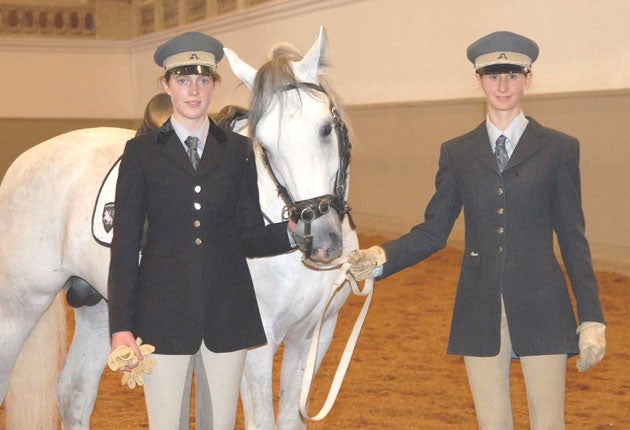
Dressed up in the skintight breeches, knee-high leather boots, frock coat and 19th-century commissionaire-style cap worn by pupils at the world's oldest riding school, Sojurner Morell, a 17-year-old British horsewoman, looks decidedly butch.
Yet there are ancient and firmly entrenched reasons for the teenager's masculine appearance. She and her 21-year-old Austrian colleague, Hannah Zeitlhofer have secured a sudden reputation for breaking one of Austria's last and most enduring taboos. They have become the first women to be accepted to Vienna's elite, internationally renowned and hitherto male-dominated Spanish Riding School – a 481-year-old institution as famous and peculiar to this Alpine nation as Mozart.
But being the first women to enter one of the last men-only bastions in Europe has exacted its inevitable sartorial price: "I guess they haven't got round to designing a uniform for women yet," admitted Sojurner. "Let's face it, it hasn't exactly been an issue at the school for about four hundred years."
Sojurner, whose name derives from the black 19th-century American abolitionist and women's rights campaigner Sojurner Truth, doesn't come across as a militant feminist activist. She was besotted with horses as a child. She vividly remembers riding around on the back of ponies in the paddock behind the family home in Saratoga Springs, New York, aged two. Her father comes from Birmingham but the family moved to America when she was a child.
"When you grow up with horses, you get to know about the Spanish Riding School almost automatically," she said. "I can't even remember how or when I first heard of it but for me it was always an ideal, the ultimate goal for anyone who loves horses."
She first visited the Riding School two years ago while on a tour of Europe with her mother. She was so taken by the place and its elaborate displays of dressage performed by the schools' legendary Lipizzaner horses, that she sent a letter of application in September last year just to try her luck.
She was delighted when she received a reply inviting her to attend an interview. She had to compete against eight other candidates by demonstrating her riding skills to a board of examiners and she was astounded when she learnt the result. Only four candidates were accepted and she, along with Ms Zeitlhofer, who recently obtained a degree in equestrian science, were among them and women to boot.
Horse riding is an activity in which women have been involved for centuries. Dressage, showjumping competitions and even village gymkhanas would be unthinkable with no female riders. Without them Black Beauty would doubtless never have been written. It seems extraordinary, therefore, that an institution like the Spanish Riding School has sustained a ban on women for so long.
The cliches about the Teutonic world lagging behind the Anglo-Saxons sometimes ring true. Laws guaranteeing women equal rights only came into force in Germany in 1957 and it took until 1972 for the Swiss to give women the vote.
Austria can hardly claim the status of most emancipated nation in the world either; Vienna's Philharmonic Orchestra only hired a full-time female musician in 1997, after being subjected to massive public pressure to do so. And when it comes to horses, the nation is radically out of step with the English-speaking world. Austria is famous for its horsemeat sausages.
Vienna's Spanish Riding School embodied such conservatism for centuries. Founded back in 1527, its roots are in the military traditions dating as far back as Xenophon in ancient Greece and the horsemanship of the post-medieval age. Then, knights attempted to retain a battlefield role by shedding armour and learning to outwit their opponents through manoeuvrability and riding skill.
The school is described as Spanish because of the Spanish horses that Austria's ruling Hapsburg family imported in the 16th century. The horses gave rise to the famous Lipizzaner breed, a symbol of the country's prowess during the Austro-Hungarian empire. The school specialises in training Lipizzaner stallions. It takes 15 years to become one of its chief riders and the skills required are easily as demanding as those needed to master a Stradivarious violin or helm an America's Cup-winning yacht.
The school is a magnet for tourists who flock to see its displays of classical dressage in the early 18th-century, pillared Winter Riding School building. Uniformed riders, clad in bicorne hats, period uniforms and immaculately polished boots salute in front of a portrait of the Austrian emperor, Charles VI, before performing on their white Lipizzaner stallions.
It has taken a female manager to break the school's male exclusivity. Early last year Elisabeth Gürtler, a Viennese society hostess and owner of the Sacher hotel next door, was appointed general director. An experienced businesswoman, she took over when the school was facing bankruptcy. Last January it had to cancel a tour to the US to cut spending. Part of Ms Gürtler's remit has been to modernise the school and "make it more open". She sees the decision to admit women as an entirely natural process. "Both men and women have to earn their keep and prove themselves nowadays, nobody is against this," she says. Nobody ever ruled that women should never be admitted, "it just sort of ended up that way".
For Ms Morell and Ms Zeitlhofer, being the only women in the Riding School's entourage of 21 riders has not been as problematic as expected. Their main difficulty is trying to mount a horse when its stirrups are set high. Both say their upper arms have not yet developed sufficient muscle to enable them to always complete the process alone. "We sometimes have to ask our male colleagues for a lift up," says Ms Zeitlhofer, "That can be pretty annoying, because then everyone looks at you."
As first-year pupils or élèves, as the school calls them, both women are paid €700 (£610) a month and work a demanding eight-hour day that begins at 6 m. Riding lessons follow and students have to learn how to maintain perfect posture and lead with the reins. The rest of the working day is spent mucking out stables and grooming the horses. Both women say they encounter absolutely no resentment from the male riders and most are "totally nice". Andreas Hausberger, 43, a chief rider, says he is thrilled to have women at the school: "Thank God we are not living in the Middle Ages any more."
Yet the school has still to sort out the dress issues. The difficulties for women presented by the masculine uniform of frock coat and peaked cap are nothing compared to those presented by the uniform worn by its troupe of still exclusively male chief riders. Their parade dress is a coffee-coloured riding coat buttoned up to the neck, knee-high boots and an 18th-century Captain Hornblower-style bicorne hat. "There are a couple of questions about that," admitted Ms Gürtler, "But we have a few years to think about it."
Join our commenting forum
Join thought-provoking conversations, follow other Independent readers and see their replies
Comments
Bookmark popover
Removed from bookmarks