Basque separatist group Eta calls off 50-year campaign of violence
But lack of clarity brings only muted response from Spanish political figures
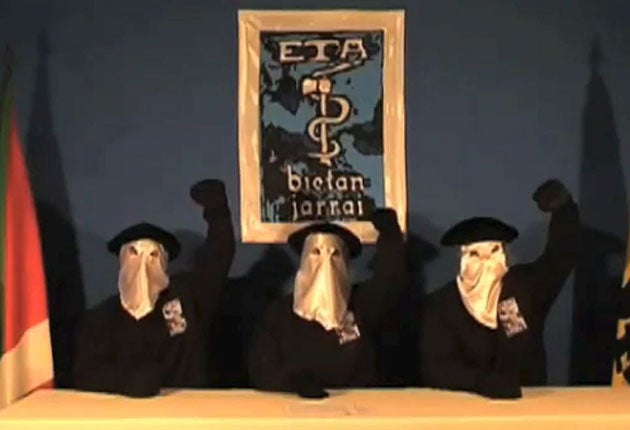
Three hooded figures flanked by flags, filmed for a grainy video released to the BBC, announced yesterday that the Basque separatist group Eta was calling off the armed campaign it has waged for more than half a century.
Their statement defended Eta's actions but suggested that the group might now be ready to turn to the political process to pursue its aim of an independent Basque state. "Eta confirms its commitment to finding a democratic solution to the conflict," one of the hooded figures, a woman, said. "In its commitment to a democratic process to decide freely and democratically our future, through dialogue and negotiations, Eta is prepared today as yesterday to agree to the minimum democratic conditions necessary to put in motion a democratic process, if the Spanish government is willing."
The announcement raises hopes of an eventual peaceful settlement inspired by the power-sharing resolution achieved in Northern Ireland. But the lack of clarity about Eta's ceasefire meant there was only a muted welcome from Spain's wider poltitical arena. On two previous occasions Eta has announced it was calling off its campaign only to abandon the decision. There have been up to 10 declarations of "temporary" ceasefire since 1981 alone. The Basque regional government interior minister said the statement was "insufficient".
The Spanish government's initial reaction was to urge caution. Madrid has refused to relaunch a process of dialogue with Eta, suspended after the Madrid airport bombings in 2006, until the armed group gives up its weapons and renounces violence. Close observers of the conflict, which dates back to 1960 and has claimed 829 lives, pointed out that Eta is weak on both the political and military front. It has in effect been decapitated by the arrests of its leaders. Stronger collaboration between the French and Spanish police has led to 13 arrests of Eta members in the year so far, at a time when amongst the radical Basque left, support is growing steadily for more peaceful methods.
"Semantically, it's a very clever statement that gives away very little of what they're really thinking," Pablo Muñoz, director of four newspapers, three TV channels and a radio station in the Basque country, and a political analyst of the conflict for the past 30 years, said. "Nowhere does it say whether this ceasefire can be verified, by international observers, for example. Nor do Eta promise anywhere that they will not interfere in the democratic process, which is another a key tenet of the [George] Mitchell mediation protocol for ending armed conflicts."
"That means it's going to be very difficult for the national government, or the Basque one, to give this kind of statement a big thumbs-up. That said, when an organisation such as Eta say they're stopping killing, first and foremost it's magnificently good news for everybody who's been threatened by them."
Mr Muñoz said the latest arrests, coupled with growing pressure both internationally and from the broader radical left in the Basque country for a peaceful resolution to the conflict, have all had their effect.
"The Brussels Declaration (a statement made this spring in the European Parliament by 20 international figures, including Desmond Tutu, John Hume and South African human rights lawyer Brian Currin urging Eta to lay down their arms) "was important," Mr Muñoz said. "At the same time, for over a year within the more extreme political groups, there's been a growing grassroots insistence that Eta stop killing."
Mr Muñoz did not rule out that Eta's latest manouvre could be a way of helping their political wing, at present declared illegal, re-enter mainstream Basque politics. "Eta's always been part of a broader national liberation movement which is currently clandestine, and obviously they want to end that situation, too."
The Madrid-based political parties all dismissed the statement as "clearly insufficent". Tomas Gomez, the Socialist Party general secretary, said: "We have to treat it with considerable caution. Eta have shown their true colours on countless occasions." Gaspar Llamazares, the spokesman of the United Left front added: "They've fallen short. What we want is a definitive end to any armed action."
The ceasefire comes at a point when support for nationalism as a whole is on the ebb in the Basque region which already has considerable levels of autonomy. Two years ago, for the first time in their history, the nationalists were ousted from the Basque local government by the Socialist Party, with support from the right-wing Partido Popular.
At the same time, low-level outbreaks of rioting in favour of independence in the old quarters of Bilbao and San Sebastian, which have never stopped completely throughout Spain's 35 years of democracy, are becoming increasingly infrequent.
"Just walking the streets you see fewer slogans on walls daubed in favour of Eta, and the number of burnt-out cashpoints and rubbish bins has dropped," said one journalist from San Sebastian, who refused to be named. "Eta is becoming an economic group that simply uses political statements as a means of extortion. At the same time, the non-nationalist political forces of the Basque country are more united than they ever were and they're becoming less and less frightened to speak out in public. That's hugely important, and it could bring an end to the violence, too."
A history of broken pledges
*1959: Euzkadi Ta Askatasuna (Fatherland and Freedom) or Eta is founded by Basque students in response to dictator Francisco Franco's oppression
*1973: Prime Minister Admiral Luis Carrero Blanco assassinated
*1980: Eta escalates bombing, killing 118 people in the year
*1987: 21 people killed in an Eta bomb attack at a supermarket in Barcelona
*1998: Eta declares its first "indefinite" ceasefire
*2000: Eta detonates car bombs in Madrid and Vittoria.
*2001: Politicians and the Spanish establishment are targeted. Among those killed are Judge Jose Maria Lidon and politicians Manuel Jimenez Abad and Froilan Elexpe. A single car bomb in Madrid injures almost 100 people. The EU declares Eta a terrorist organisation
*2004: French police arrest Mikel Albizu, one of Eta's most influential figures
*2006: Eta declares a new permanent ceasefire, but a deadly bomb attack at Madrid airport, pictured, in which two are killed prompts the Spanish government to announce the peace process as "broken, liquidated and finished"
*2007: Eta announces formal end to ceasefire. Leadership of Batasuna, Eta's political wing arrested
*2008: Eta's most senior commander, Javier Lopez Pena, and its military chief Garikoitz Aspiazu Rubina, alias Txeroki, arrested in separate operations in France
*2009: French police capture two senior figures in Eta's military leadership, Jurdan Martitegi, and Aitzol Irionda
*February 2010: Senior Eta commander Ibon Gogeascotxea is arrested in France
*March, 2010: A Spanish judge accuses Eta of collaborating with the Colombian rebel army FARC.
Join our commenting forum
Join thought-provoking conversations, follow other Independent readers and see their replies
Comments
Bookmark popover
Removed from bookmarks