Bertie Ahern: The teflon Taoiseach who came unstuck
Bertie Ahern was untouched by the sort of scandal that has traditionally dogged Irish politics. But his mysterious financial affairs caught up with him when his secretary was forced into the spotlight. By David McKittrick
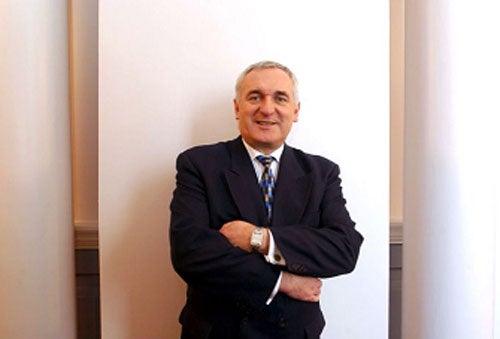
For over a decade he dominated Dublin politics as deal-maker supreme, negotiator par excellence, master of his once fractious party, skilful manager of the Celtic Tiger and peacemaker in Northern Ireland.
There was much achievement, and indeed glory, in the career of Bertie Ahern. But yesterday that career came to an abrupt end amid allegations of tawdry, venal behaviour.
Ahern's announcement that he will resign within weeks came after many months of revelations and accusations centring on up to a dozen mini-scandals and unsatisfactorily explained financial transactions. An official tribunal looking into his affairs has found no smoking gun, but in the end the cumulative effect of so many mysteries brought him down. The fact that he will resign just after having had the honour of addressing the US Congress demonstrates the severity of his fall.
His answers to the many questions put to him about his financial affairs were unconvincing and increasingly far-fetched. As a result his credibility took a significant hit, and in recent weeks he was increasingly accused of perjury. The irony is that he was once regarded as the Mister Clean of his Fianna Fail party, which under its previous leader Charles Haughey had a reputation as being deeply corrupt and regarded as "the party of the brown envelope".
For years Ahern was known as the Teflon Taoiseach, since none of the numerous allegations about Fianna Fail ever seemed to cause him personal damage. But that changed. After years of digging, the tribunal's lawyers and investigators unearthed a web of mysterious bank accounts and puzzling payments.
Nothing that has turned up comes close to rivalling the exploits of Haughey, who during a legendarily corrupt career accepted payments of many millions of pounds. Ahern's modest lifestyle provided a huge contrast with Haughey's lavish behaviour.
Ahern had absolutely no taste for ostentation. He made much of his "man of the people" image as a Manchester United supporter, a divorced man who liked women and who spent Friday nights drinking pints of Bass with his mates in north Dublin pubs.
He said once: "I have no big houses or mansions or yachts or studs. All I've got is a mortgage." He carried this off in large part because, unlike Haughey, he seemed not to care about personal enrichment.
He was, he projected, one of the boys – a political workaholic fascinated with power but uninterested in amassing worldly wealth. That persona endured for years, but it eventually vanished under the weight of evidence extracted by the tribunal.
A Fianna Fail underworld came to light. Ahern's former girlfriend, for example, testified that he drove her to a bank in Dublin's O'Connell Street so she could nip in and withdraw £50,000 sterling in cash. There were examples of Ahern squirrelling money away. A businessman involved in a complicated house deal with Ahern told of taking 28 grand in a briefcase and heaping it on his desk. Ahern put the cash into a safe, without counting it – and without offering a receipt.
This was strange behaviour for a government minister: perhaps stranger still was the fact that although he was both an accountant and minister for finance, he did not have a bank account.
One of the final straws came in recent weeks when his former secretary broke down in the witness box of the investigating tribunal. She had earlier supported Ahern's evidence that certain transactions had not involved sterling sums, but was then confronted with bank records which flatly contradicted this.
Amid her tears she said plaintively: "I just want to go home." The widespread suspicion that Ahern had something to hide, and had sent in a former employee to carry the can for him, led to a surge of public feeling against him.
He will, like Tony Blair, hope that history will pay more attention to his performance on Northern Ireland than the recent scandal. He and Blair came to office at the same point in 1997, immediately forming a relationship refreshingly free from the strains which had previously affected Anglo-Irish relations.
This proved one of the keys to the peace process. As time went on, Ahern also struck up working relationships with the Sinn Fein president, Gerry Adams, and the Ulster Unionist leader David Trimble.
But his partnership with Blair was critical, since it was axiomatic of the peace process that if London-Dublin relations were wrong, then nothing else would come right. Crucially, Blair and Ahern agreed that an exit route from the Troubles could be envisaged.
No part of the decade of negotiations aimed at replacing paramilitarism with politics was easy. In fact, Blair's chief of staff Jonathan Powell relates that Ahern himself was at one stage tempted to resort to violence.
According to Powell's account of one negotiating session: "The Irish dug their heels in, and Trimble came across as appallingly rude to Bertie, who came within an ace of hitting him, as he told us after the Unionists had left the room."
But fisticuffs were averted, and the Good Friday Agreement of 1998 was an important milestone. The funeral of Ahern's mother coincided with a crucial moment in the talks, so that he left Dublin before dawn to meet Blair in Belfast, then returned to Dublin for the funeral at noon before travelling back to Belfast.
George Mitchell, the former US senator who chaired the talks, said admiringly of him: "I don't recall ever having seen a person as totally exhausted. I also had never seen a person more determined."
Ahern went on to strike up a relationship with the Rev Ian Paisley, helping pave the way for the historic Paisley-Sinn Fein administration in Belfast.
Ahern came from a staunchly republican family – his father was a member of the 3rd Cork Brigade of the IRA during Ireland's War of Independence – but he was a pragmatist in all things and, in tune with general opinion in the Irish Republic, he left the goal of a united Ireland to the future, and concentrated first on silencing the guns.
Ahern's rise through Fianna Fail's ranks was steady. He joined at the tender age of 14, entering the Irish parliament at 26 and becoming leader of the party at 43.
His workrate was legendary, but he first really made his name as a Minister for Labour whose natural negotiating skills helped solve many industrial disputes.
Although Charles Haughey was one of his political mentors, Ahern earned his Teflon tag by dodging almost all the mud that stuck to his predecessor as Taoiseach.
Once installed as leader, Ahern consolidated his reputation for solid competence. He displayed impressive skills in holding together a series of coalitions, since in the modern era Fianna Fail never managed to achieve an overall majority.
Previous coalitions had perished due to personal and political differences, but Ahern's talent for negotiation and conciliation provided an unexpectedly stable government.
He was fortunate, of course, to be in power during the greatest period of prosperity that the Irish Republic has ever known. But he also had the advantage of being – until recent times – one of the most trusted politicians around.
He was certainly one of the most popular politicians to emerge in Ireland in the last half-century. He is credited with managing the economy well, and won three elections by stressing the feel-good factor.
If he lacked a certain vision, he was given much credit for shrewd management and steady government, and for devoting much time to the peace process. He has seen off a series of opposition leaders who could find no way of bringing him down.
Ahern had said that he would not fight another general election, but he also said lately that he intended to stay in office for some years yet. He is thus departing earlier than he wanted to, and for reasons that he will always regret.
He was once described as the most formidable operator on the Dublin political scene, a man who had the antennae to sense looming crises, the expertise to manage the economy, and the savvy to remain Prime Minister for a decade.
Haughey famously said of him: "He's the man. He's the best, the most skilful, the most devious and the most cunning of them all." Those were all qualities widely ascribed to him, and they stood him in good stead for years.
Yet it all came to an ignominious end amid all the inexplicable bank deposits and briefcases stuffed with cash. Eventually the man regarded as Ireland's most astute politician just ran out of road.
For all the cash in safes and briefcases he eventually became politically overdrawn and had to go. His skills and his cunning took him a long way, but the moral seems that be that, in the end, not even Teflon lasts for ever.
Join our commenting forum
Join thought-provoking conversations, follow other Independent readers and see their replies
Comments