Blair for President? 'Not necessarily a good idea,' says his former adviser
And polls throughout Europe – and 38,000 petition signatories – agree. Jane Merrick reports on the gathering momentum to stop the former PM
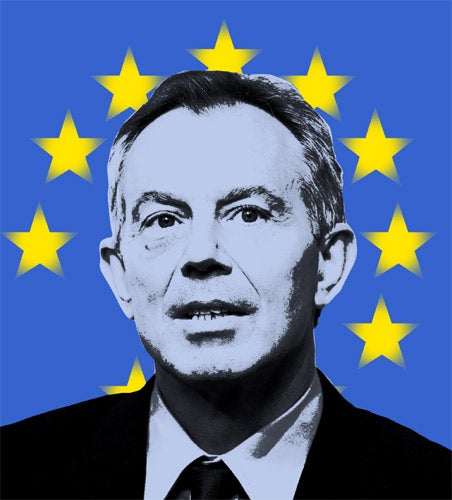
Tony Blair's former chief adviser on the EU has misgivings about the ex-prime minister becoming President of Europe, as the campaign to overturn his bid gathers pace.
Sir Stephen Wall – one of the key architects of the post of EU president – said a high-profile figure such as Mr Blair was "not necessarily a very good idea" and cast doubt on his ability to build consensus among EU leaders. A figure from a smaller state would send a "unifying signal", he added.
The surprise intervention came amid growing signs that a President Blair would not be welcomed by ordinary citizens of Europe, despite their leaders showing support.
Research by The Independent on Sunday suggests a democratic discrepancy between voters and national leaders – who wield the votes for the new president. The findings are supported by a European-wide petition to stop Mr Blair taking the post, which comes with a string of perks. Nearly 38,000 people have signed the petition, yet he remains a favourite with bookmakers and with a growing number of EU leaders.
After the IoS asked readers' opinions last week, hundreds responded – and those saying No to Mr Blair outnumbered Yes by 20 to 1. His role in the Iraq war was the main complaint. As the process for choosing a European Council president draws to a close later this year, Mr Blair is expected to appear before the Chilcot Inquiry into the Iraq war.
Comments from readers and petitioners suggest that Mr Blair appears to have misjudged the public anger that still exists over Iraq. Last night sources close to the former prime minister claimed he remained focused on his job as Middle East envoy and was "really enjoying his new life".
The EU president, a role created by the Lisbon Treaty, will be decided before the end of this year, with only Vaclav Klaus, the Czech president, yet to ratify the charter. Despite voters' opposition, EU leaders appear to be inching towards acclamation of Mr Blair at a meeting in Brussels in December. Yet Sir Stephen, who criticised Mr Blair over Iraq, said in an interview with the journal European Voice that the ex-PM would not be suitable if the post was designed for consensus-building in the 27-nation bloc.
Sir Stephen was the UK's permanent representative to the EU between 1995 and 2000, before working as Mr Blair's European adviser until 2004. During his time at No 10, Sir Stephen helped devise the posts of president and European foreign affairs representative.
Asked about the possibility of a high-profile figure such as Mr Blair as president, Sir Stephen said: "[That] is not necessarily a very good idea."
On whether he thought the first president should be from a smaller member state, he said: "I think that it would help a lot as a signal. As a unifying signal, it should be thought about." He added that the disadvantage of appointing such a personality was that they would be "trampling on what should be done by the high representative".
He said if Mr Blair were appointed "you do have someone who is seen as someone who counts and can articulate his vision". But he added: "The powers are very constrained. If the president of the United States did phone a President Tony Blair to ask for something, then Blair could only respond that he would 'consult 27 governments and see what we can do'."
Some 18,845 Britons have signed the petition. The rest are made up of 2,882 Belgians, 2,777 French, 1,538 Austrians, 1,417 from Spain and 1,409 from Germany. Others are from the Netherlands, Portugal, Greece, Italy and Ireland.
A poll last week found 47 per cent of Britons were opposed to Mr Blair, with 35 per cent in favour. But Gordon Brown has backed him for the job, and leaders in Spain, Italy and Denmark are said to be in favour. France's Nicolas Sarkozy has, so far, been indecisive.
Meanwhile, the Czech president, Vaclav Klaus, in an interview yesterday, suggested he was softening his hardline opposition to signing the treaty. He told the newspaper Lidove Noviny that despite his continued opposition, it was too late to stop it.
Additional reporting by Paul Bignell and Rachel Shields
The alternative front-runners
Jan Peter Balkenende 4/1: Current Dutch PM, a Christian Democrat once described as a 'petit bourgeois Harry Potter'
Jean-Claude Juncker 5/1: Prime Minister of Luxembourg, author of the Maastricht Treaty and therefore creator of the euro
Paavo Lipponen 6/1: Former PM of Finland, a social democrat who supported the Iraq war but is not a toxic figure in Europe
Mary Robinson 8/1: Former president of Ireland and UN human rights chief whose odds at Ladbrokes shortened yesterday
Join our commenting forum
Join thought-provoking conversations, follow other Independent readers and see their replies
Comments