Brain illness could have affected Stalin's actions, secret diaries reveal
Accounts by his inner circle give new insight into dictator's life
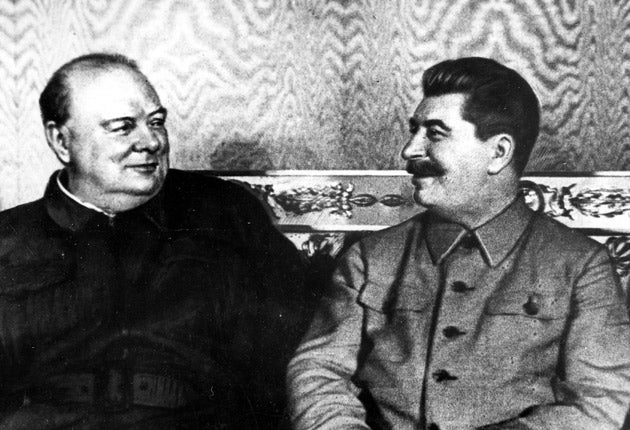
It's one of the great questions of history, and indeed philosophy: what does it take to create a Hitler or a Stalin? What circumstances does it require to produce such evil? Newly released diaries from one of Joseph Stalin's personal doctors suggest that, in Stalin's case, illness could have helped to contribute to the paranoia and ruthlessness of his rule over the Soviet Union.
Alexander Myasnikov was one of the doctors called to Stalin's deathbed when the dictator fell ill in 1953, and, in diaries that have been kept secret up to now, he claims that Stalin suffered from a brain illness that could have impaired his decision-making.
"The major atherosclerosis in the brain, which we found at the autopsy, should raise the question of how much this illness – which had clearly been developing over a number of years – affected Stalin's health, his character and his actions," Dr Myasnikov wrote in his diaries, excerpts of which were published for the first time in the Russian newspaper Moskovsky Komsomolets yesterday. "Stalin may have lost his sense of good and bad, healthy and dangerous, permissible and impermissible, friend and enemy. Character traits can become exaggerated, so that a suspicious person becomes paranoid," the doctor wrote.
In what could be another fascinating insight into the inner world of Stalin, purported excerpts from the secret diaries of Lavrentiy Beria, one of the most unpleasant and bloodthirsty members of Stalin's inner circle, also surfaced this week. The Beria diaries, excerpts of which appeared in Komsomolskaya Pravda, are to be released by a controversial publishing house that has previously published books whitewashing Stalin-era crimes, and there is no independent verification yet that they are genuine. If they are, they would prove invaluable to historians as an insight into the warped mind of Beria as well as into the inner workings of the Soviet hierarchy.
The diaries refer to Stalin by his revolutionary nickname "Koba" and are filled with coarse language and swearing. The entries start in 1938, when Stalin called on Beria to leave his native Georgia and travel to Moscow to work as the deputy to Nikolai Yezhov, head of the feared NKVD secret police and known as "the bloodthirsty dwarf". The NKVD had just conducted the "Great Purge", when hundreds of thousands of Soviet citizens had been shot.
Yezhov himself was shot in 1940 and Beria took over his position as head of the NKVD, becoming one of Stalin's most trusted lieutenants. He was also known as a sexual deviant, frequently trawling the streets of Moscow and picking out women who would be taken back to his mansion and raped.
The alleged diaries occasionally show a softer side to Beria, expressing regret about the life he had ended up leading. "I like nature, and fishing, but when is there time for that now?" he wrote during the height of the Second World War, in 1943.
Beria's diaries, if genuine, also shed new light on events during the Second World War. When in August 1942 Winston Churchill travelled to Moscow to meet Stalin, the allies were suspicious of each other, and Beria claims he advised Stalin that the best way to win concessions from the British Prime Minister would be to get him drunk.
After the visit, Beria wrote: "These are not funny times, but we have all had a laugh. Koba told me that my advice about Churchill came in handy. Churchill agreed, got completely drunk and lost the plot. Koba told us about it and laughed... Afterwards, he said: 'It's good when you know the weaknesses of your enemy in advance.'"
On the evening of 10 May 1945, the day after Soviet troops celebrated victory, Beria notes that Stalin started crying. "Again we spent the evening with Koba... He was even softer, and he even had to brush away a tear."
Stalin died in 1953, and Beria was arrested shortly afterwards and shot, before the Soviet Union began a gradual retreat from the bloody excesses of the Stalin period. "I would suggest that the cruelty and suspicion of Stalin, his fear of enemies... was created to a large extent by atherosclerosis of the cerebral arteries," Dr Myasnikov wrote in his diaries. "The country was being run, in effect, by a sick man."
Striking notes: Extracts from the diaries
Alexander Myasnikov
* "I would suggest that the cruelty and suspicion of Stalin, his fear of enemies... was created to a large extent by atherosclerosis of the cerebral arteries. The country was being run, in effect, by a sick man."
* "Death was expected at any moment. Finally it came, at 9.50pm on 5 March... Party leaders quietly filed into the room, as well as Stalin's daughter, Svetlana, son Vasily and security detail. Everyone stood without moving in ceremonial silence, for a long time. I don't even know how long – maybe half an hour or more."
Lavrenty Beria
* "I remember the picnics Koba [Stalin] and I had in the mid-1930s. He with his big moustache, and me all young and thin, in a shirt with an open collar, chopping wood for the fire. And fresh trout. It was good back then."
* "Today I saw tears in Koba's eyes for the first time. I told him about Stalingrad, about how people are fighting. When I reach that point, I just swear a lot and feel better. But he tries to keep it together, and what about his heart? He couldn't hold it in."
* "[Churchill] got completely drunk and lost the plot. Koba told us about it and laughed... Afterwards, he said: 'It's good when you know the weaknesses of your enemy in advance.'"
Join our commenting forum
Join thought-provoking conversations, follow other Independent readers and see their replies
Comments