'Bribes and bombs' scandal returns to haunt Sarkozy
Families of 11 engineers murdered in Karachi in 2002 point finger of blame at French government
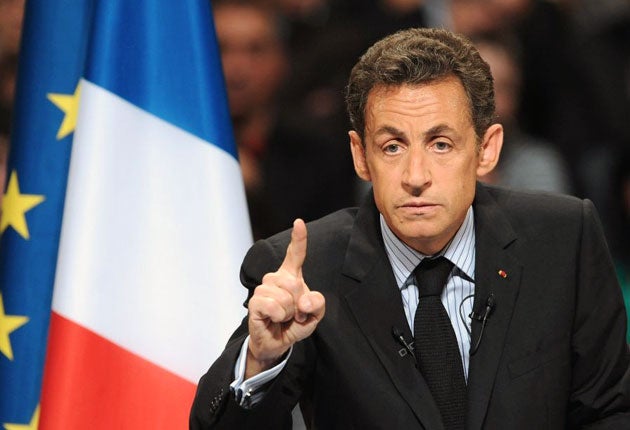
A political scandal is gathering pace over claims that 11 French submarine engineers were murdered in a bomb attack in Karachi seven years ago to punish France for the non-payment of arms contract "commissions" to senior Pakistani officials.
Lawyers for the French victims' families believe the attack, allegedly carried out by Islamist terrorists, was in fact part of a web of financial chicanery and political manoeuvring which may yet severely embarrass senior figures, including the French President Nicolas Sarkozy and his Pakistani counterpart Asif Ali Zardari.
Two French magistrates investigating the bombing of the engineers' bus in May 2002 have ruled out the possibility that it was an attack by al-Qa'ida on Western interests. They have told the victims' families there is "cruel logic" to an alternative explanation. They believe unknown figures in the Pakistani establishment may have fomented the attack in retaliation for the non-payment of part of the €80m (£68m) in sweeteners promised to senior officials when Lahore bought three Agosta 90B submarines from France in 1994.
Documents seized by French police allege that part of these "commissions" – legal under French law at the time – were illegally "kicked back" to help finance the 1995 presidential campaign of the then prime minister, Edouard Balladur. When Jacques Chirac won the election the following spring, it is alleged that he punished his old friend and acolyte for running against him by cancelling the remaining payments to senior Pakistani figures.
M. Chirac's then defence minister, Charles Millon, confirmed in an interview with Paris Match magazine yesterday that, soon after he took office in 1995, he was ordered to block the Pakistani commissions and all other arms payments on which "retro-commissions", or kick-backs to France, were suspected. When the €800m submarine sale was negotiated, M. Sarkozy was the budget minister and M. Balladur's right-hand man. He was also a key figure in the then prime minister's decision to break with M. Chirac that autumn and run for the presidency the following spring. There is no direct evidence linking him with either the legal commissions or the alleged illegal kick-backs but, as budget minister, he would have had to sign documents authorising large, untaxed payments to foreign officials.
According to investigation documents leaked to the Agence France Presse news agency, a large part of the €80m was paid out before M. Chirac intervened and had already been "distributed" by the then Pakistani investment minister, Asif Ali Zardari. Mr Zardari, husband of the late prime minister, Benazir Bhutto, is now President.
The legal implications of the affair are unclear but the political implications could be explosive. If clear evidence emerges to link the submarine commissions to the killing of the 11 French engineers and three Pakistanis, there would at the very least be deep embarrassment for M. Balladur, M. Chirac and for President Sarkozy.
When asked about the suspicions of the two French investigating judges, M. Sarkozy flew into a temper. He said any suggestion that the murders were a Pakistani retaliation for non-payment of French commissions was a "fable". "This is ridiculous. It is grotesque," he added. "Let's have some respect for the grief of the victims. Who could believe a fable like that?"
The answer is that the "fable" is being taken seriously by the victims' families, lawyers and the investigating judges, Marc Trévidic and Yves Jannier. "The al-Qa'ida line of inquiry has been totally abandoned," said Maître Olivier Morice, a lawyer for seven of the families, after meeting the judges in Cherbourg, where the engineers were based. "This is all linked to the payment of commissions... they were blocked by Jacques Chirac to prevent kick-backs to the presidential campaign of Edouard Balladur. This is turning into a [state scandal]."
On 8 May 2002 – just after M. Chirac won a second term as president – a bomb exploded in Karachi beside a bus transporting French shipyard workers who were assembling one of the Agosta submarines. Fourteen people were killed, including 11 French workers. Both Pakistani and French authorities blamed Islamists close to al-Qa'ida, but it appears that US intelligence agents told Paris at the time that the attack was linked to blocked payments on the submarine contract. A self-confessed militant, Asif Zaheer, was convicted in 2003 of playing a part but his conviction was quashed on appeal last month.
The investigating judges are said to believe that M. Chirac's re-election convinced figures in Pakistani they would never receive their missing money – hence the timing of the attack.
In a speech at a remembrance service for the dead shipyard workers in Cherbourg in June 2002, President Chirac said France would not surrender to "blackmail" – a word which caused some puzzlement at the time.
The key figures: 15 years ago and now
Edouard Balladur, 80
THEN Centre-right prime minister in cohabitation with the Socialist president, François Mitterrand. Ran for presidency in 1995 but was knocked out by Chirac in first round.
ROLE It is alleged in documents seized by French police that his campaign – quite possibly without his knowledge – benefited from illegal kickbacks.
NOW Retired.
Jacques Chirac, 76
THEN Mayor of Paris and leader of the centre-right RPR party. Ran for the presidency in 1995 for the third time and won.
ROLE As president, he ordered the cancellation of the Pakistani "commissions", allegedly in pique against M Balladur.
NOW Retired.
Charles Millon, 63
THEN Chirac's defence minister in 1995.
ROLE Admits he cancelled Pakistani commissions on Chirac's orders.
NOW Faded from mainstream politics.
Asif Ali Zardari, 53
THEN Minister in government of his wife, Benazir Bhutto, who was murdered in 2007 after she returned to Pakistan.
ROLE Alleged to have "distributed" part of the commissions paid by France, which were legal under French law.
NOW President of Pakistan.
Join our commenting forum
Join thought-provoking conversations, follow other Independent readers and see their replies
Comments
Bookmark popover
Removed from bookmarks