Bullfighters 'hired Colombian assassins to kill rivals' horses'
Three men on trial after firebomb attack that left six Domecq-dynasty thoroughbreds dead and injured six others
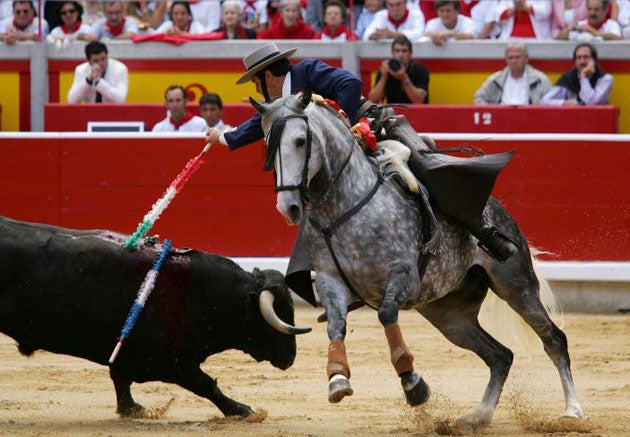
A matador on horseback is one of the most spectacular sights in Spain. The dramatic face-off between man and beast becomes even more theatrical when the bullfighter confronts his prey from the saddle of a high-stepping thoroughbred, and the figure of the mounted matador – the rejoneador – has been immortalised in vivid ringside sketches by Francisco de Goya.
Anything to do with bulls or horses arouses fierce passions in Spain, but neither the taurine nor the equine world have witnessed anything to match the extraordinary crimes now being tried in a Toledo court. Three rejoneadores are accused of hiring Colombian hitmen to firebomb a dozen horses belonging to the aristocratic Domecq dynasty.
A long-established Andalusian horse- and cattle-breeding family, as well as the founders of the renowned sherry empire, the Domecqs are doyens of the gentlemanly art of the rejoneo. The three men on trial are accused of setting fire to 12 of their horses in June 2001. Six died instantly, six took years to recover from serious burns.
The arson attack meant the Domecqs' hugely expensive horses, trained for years to perfect the intricate footwork and elaborate curvetting movements of rejoneo, were unable to take part in 60 mounted bullfights during the 2001 season, resulting in enormous financial losses for the owners and the bullfighters who would have ridden them.
But to complicate the intrigue, the Domecq horses – considered among the finest in Spain – were not the intended target.
The accused – Jose Miguel Callejon Martin, 30, then a promising young competitor; his father, Jose Antonio Callejon Amoros, and Manuel Buendía – allegedly contracted three Colombian hired assassins, or sicarios, to destroy horses belonging to another rejoneador – Sergio Galan, an up-and-coming rival.
By a bizarre twist of fate, the Colombians – who vanished after the act and whose whereabouts remain unknown – attacked the wrong horses. On the day of the crime, Sergio Galan and the Domecq brothers, Luis and Antonio, had all taken part in a horseback bullfight at Las Ventas bullring in Madrid. When each party set off for home with their horses in trailers, the Colombian hitmen chose the wrong lorry by mistake and followed the Domecq convoy, instead of that of Galan.
On their way home to the family estate in Jerez, the Domecqs stopped for dinner at a roadside inn at Ocana near Toledo. According to prosectors, the sicarios, seizing their chance, allegedly pushed two petrol bombs through the vents in the horseboxes, which exploded with immediate and deadly effect. Alerted by the explosions, the lorry driver and stable lads jumped from their dinner table and rushed outside to see the horse-box trailer in flames in the car park. Only six horses were saved. Police described the crime as unprecedented in the history of Spanish horseback bullfighting. Prosecutors say they have tapped telephone conversations incriminating the Callejons – both father and son – in a plot to hire the hitmen. Additional evidence proves their involvement in the crime, police say.
The Colombians chose a 17-year-old to throw the firebomb – apparently to protect themselves since Spanish law is considered lenient to minors who commit violent crimes. But the young man burnt his hand, and had to be taken to hospital to have the wound treated. His presence in hospital was the first tip-off in a case whose details were eventually pieced together by detectives.
The Domecq family has apparently requested a sentence of three years' jail for the culprits, plus compensation for the loss of the six horses and through not being able to take part in the 2001 competition season, according to local media reports.
"We are grieved at the memory of such a sad episode for our family ... but are filled with the hope that at last justice will be done. We hope there will be a conviction," the Domecq brothers said on the eve of the trial. The lawyer for the Callejons insists his clients are innocent. "They did not burn the horses," he said. Proceedings have now been adjourned until next April to allow for further investigation.
Rejoneo as a spectacle dates from the Middle Ages, possibly earlier. Aristocrats on horseback – caballero in Spanish means both "horseman" and "gentleman" – turned the task of herding cattle on their estates with a lance into an art form and a military skill. They were helped by men on foot, who used capes to lure bulls away from a fallen rider and subdue them with a sword. As the centuries passed, the plebeians on foot developed their distinctive bullfighting style, and fanbase.
Far from dazzling in a sequinned suit of lights, the matador on horseback wears a functional short, tight jacket and trousers in muted colours, typical of Spanish country riding garb. The clientele for the two kinds of bullfight also differs, because the skills are different. Bullfight aficionados watch how the matador confronts the bull, judging his bravery and that of the bull. Spectators of corridas de rejoneo – less frequent but usually packed events – assess the rider's command of his horse, his elegance in the saddle and the horse's skilful footwork.
Sergio Galan – the 28-year-old who was supposed to have been the target of the original plot – has become a star on the mounted bullfight circuit in the intervening seven years, winning prizes and cutting ears in the smartest bullrings, according to Spain's bullfighting magazine 6toros6. Jose Miguel Callejon, whose alleged spoiling operation against his fast-developing rival so spectacularly misfired, has also consolidated his name, albeit at a lower level. But if the Domecqs' court action succeeds, it is doubtful whether Callejon can hold his position in this courteous world of ancient chivalries.
Join our commenting forum
Join thought-provoking conversations, follow other Independent readers and see their replies
Comments