Calls for demolition of 'Nazi' pavilion in Venice
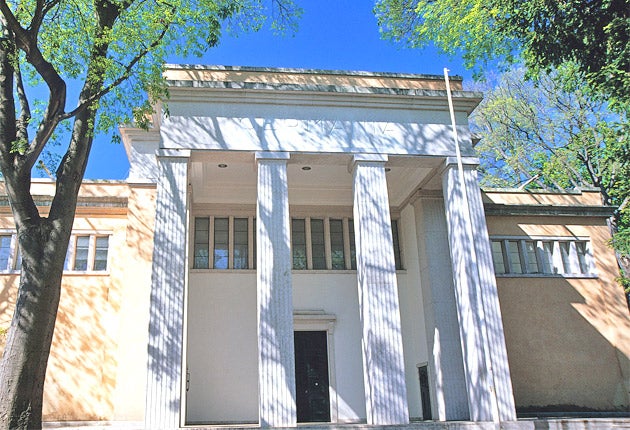
Hitler and Mussolini once exchanged fascist salutes in its entrance hall and four years later the monumental, grey-pillared building in Venice's Giardini park was turned into a Nazi shrine displaying busts of the two dictators alongside muscle-bound Aryans sculpted by the Third Reich artist, Arno Breker.
Nowadays the German Pavilion – which is used for German art and architecture exhibits during the prestigious Venice Biennale – remains a prime example of Nazi design.
The removal of swastikas and the Nazi eagle have been the only significant changes made to its grim and forbidding exterior since 1945.
But with the architecture Biennale set to open on 29 August, an angry dispute has erupted over demands that the pavilion be razed to the ground because it is an unpalatable reminder of past tyranny and an embarrassment to today's democratic Germany.
The call for the pavilion's demolition has come from the German architect, Arno Sighard Schmid, the influential president of the Federal Chamber of German Architects. "The pavilion is neither suitable for art, nor architecture," he declared in a recent interview. "It has no connection with the Venetian skyline," he added, insisting that the structure be torn down.
Mr Schmid's calls have since been echoed by a number of leading German architects and artists. Werner Schaub, the chairman of Germany's creative artist's association, wants the pavilion to be rebuilt. "One does not have to hang on to everything just because it's old," he said, arguing that the building was problematic because of its Nazi history and its internal design, which made it difficult to use as a place to exhibit art. "It would be good to knock it down and start again," he said.
German Biennale artists have also thrown their weight behind the demolition campaign. "It is one of the nastiest clichés about Germany around," an artist, Tino Sehgal, told Germany's 3Sat television channel. "It creates an image of Germany that has nothing to do with the reality of today."
The pavilion's opponents argue that the building is pure Nazi propaganda. They point out that the original, designed and built in 1909 with Ionic columns to resemble a Greek temple, was hastily revamped in 64 days in 1938 by the German architect, Ernst Haiger.
The pavilion was given a more imposing roof and its delicate Ionic columns were replaced by heavy, square Teutonic pillars, to conform with the architectural ideology of the Nazis.
But the pro-demolition camp faces a wide range of critics, including the German ministry of public buildings, the controversial performance artist Christoph Schlingensief, and Susanne Gaensheimer, the curator of next year's Venice art Biennale, which alternates with the architecture event.
Ms Gaensheimer, who is also the director of Frankfurt's Museum for Modern Art, claims that demolishing the building would be futile. "You can't change history by demolishing architecture. But we can use architecture to preserve our consciousness of history," she said. "Fantastic works of art have been shown in the German pavilion and that is what represents this country," she added.
Some German artists have managed to use the pavilion's Nazi past with imaginative effect during past Biennale events. In 1993, Hans Haacke was allowed to smash up the floor of the entrance hall where Hitler and Mussolini met in 1934. He left the debris lying on the ground and called the exhibit "Failed Hope". Four years ago a group of German architects built a bright red staircase on to the side of the building, giving visitors access to the roof and a stunning panoramic view of Venice.
In an attempt to continue the innovative tradition, Dr Gaensheimer has invited Mr Schlingensief, the enfant terrible of German performance art, to come up with an artistic concept for the pavilion for the 2011 Biennale.
Mr Schlingensief has won attention for provocative action art, such as his "Foreigners Out" stunt in Vienna in 2000, when he filled a Big Brother-style container with would-be asylum seekers and asked the public to select which of the unfortunate foreigners should be deported.
Mr Schlingensief has dismissed the calls for the demolition of the pavilion as "idiotic".
Join our commenting forum
Join thought-provoking conversations, follow other Independent readers and see their replies
Comments
Bookmark popover
Removed from bookmarks