Cameron told: give up on Litvinenko extradition
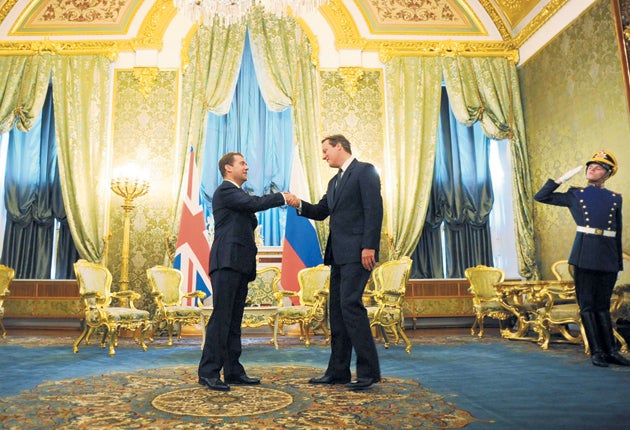
David Cameron has signalled Britain's readiness to rebuild a political relationship with Moscow despite a public vow by President Medvedev that Russia would never extradite the key suspect in the Alexander Litvinenko murder case.
Speaking after the meetings William Hague, the Foreign Secretary, said there had been a "patient, steady improvement" in UK-Russian ties as a result of the visit. He added he believed Britain now had a "working relationship at the very top of government".
At a joint press conference with President Medvedev in the Kremlin, Mr Cameron hinted for the first time that the deportation of the former KGB agent Andrei Lugovoi need no longer be an impediment to closer ties.
"We can't pretend [difficulties] don't exist – we must continue to have frank discussions about them. At the same time it is right to rebuild an effective relationship on those things which are vital to the wellbeing of people in Russian and Britain."
Mr Cameron ruled out reopening contacts between the British and Russian security services, though he said co-operation between the Serious and Organised Crime Agency and Russian police could be extended.
Mr Medvedev held out no prospect of Russia ever extraditing Mr Lugovoi to Britain and gave a tough response to UK criticisms about corruption in the Russian legal system. "We all have to learn to reflect our legal frameworks," he said.
"I would like to remind you that Article 65 of the Russian constitution directly says that a Russian citizen cannot be extradited to a foreign state. That will never happen – no matter what the circumstances... This is not possible. Please remember this."
Asked about corruption he added: "Corruption exists everywhere. I open the secret to you that it exists in Great Britain as well but we are prepared to co-operate and invest in the UK."
Differences also emerged over Syria, where Britain is pushing Russia to agree to a tough package of sanction against the Assad regime. However, President Medvedev offered little hope of an early resolution and expressed anger that Nato had over-stepped the meaning of resolution 1973 on intervention in Libya.
"We believe you should adopt a resolution which is tough and balanced," said Mr Medvedev. "But it should not lead to the automatic imposition of sanctions.
"What is important for me is any resolution on Syria will not turn into resolution 1973 [on Libya]. Not in a sense of its content but in terms of its implementation in practice."
But despite some tough rhetoric British officials were pleased by the rapport between the two men during nearly an hour of one-to-one talks and will hope that it is Mr Medvedev, rather than Mr Putin, who becomes the agreed candidate for presidential elections due to take place next year.
Mr Hague said Mr Cameron had an "excellent working relationship" with President Medvedev. In contrast he said the Prime Minister had had a "businesslike meeting" with Mr Putin.
Asked which areas the two countries could work together on, Mr Cameron, who had just watched officials sign more than £200m worth of trade deals said: "We are mature and sensible countries and we should try to build a relationship which is in our interests. We both need to see investment in trade and jobs. We both want to see progress and stability in the Middle East. We both want to deal with nuclear proliferation. [Our] bilateral relationship needs to be progressed."
Prime suspect in ex-spy's Murder speaks out
* The main suspect in ex-spy Alexander Litvinenko's murder is a member of the Russian parliament.
Andrei Lugovoi, a former KGB bodyguard, has always denied any role in Mr Litvinenko's death, and has suggested that British intelligence was the most likely culprit.
British authorities believe that Mr Lugovoi poisoned Mr Litvinenko with polonium over tea in a London hotel in 2006. He has not left Russia since the allegations were made, as there is an Interpol warrant out for him, but inside Russia he is safe, with the Kremlin repeatedly insisting that the Russian constitution bans the extradition of Russian citizens from the country.
He found extra protection when he was made an MP for the Liberal Democratic party, which is run by the far-right nationalist demagogue Vladimir Zhirinovsky, and sits on the parliament's Security Committee.
Mr Lugovoi told ITV News yesterday: "I am extremely satisfied that the President stressed he has his own position on this case and would stick to it. I am upset it has been an obstacle for British Russian relations."
Shaun Walker, in Moscow
Join our commenting forum
Join thought-provoking conversations, follow other Independent readers and see their replies
Comments
Bookmark popover
Removed from bookmarks