Can he fix it? Sarkozy's carbon-tax plan derided by environmentalists
'Green' law balancing levies with tax breaks proves more whimper than bang
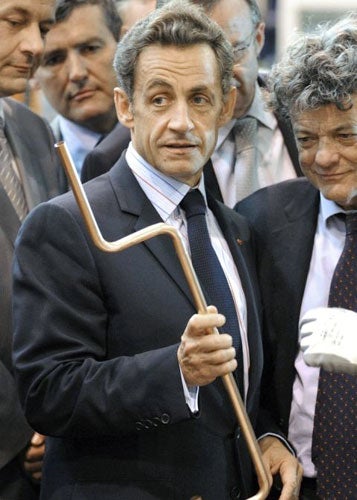
A "carbon" tax on transport, homes and factories, intended to make France a "green" model for other large economies, was unveiled yesterday by President Nicolas Sarkozy.
But the convoluted proposals, including mechanisms to refund most of the new energy levies through tax breaks and "green cheques", were condemned by critics as half-hearted and a bureaucratic nightmare.
President Sarkozy insisted, however, that the carbon tax or "climate contribution" would put France on track to fulfill its promise to reduce its carbon dioxide emissions to a quarter of their present levels in the next 40 years. In theory, the taxes will grow steeper in the years ahead but the proposals are already contested by two-thirds of French voters and by many politicians on the left and within the President's own centre-right party.
Mr Sarkozy wants, in the first stage, to impose a tax of €17 (£15) per tonne of carbon dioxide on all forms of energy, except electricity.
This will increase heating fuel and petrol pump prices by around four centimes a litre and also place a modest charge on gas bills. Electricity has been exempted because 80 per cent of French supplies are nuclear-generated and carbon-free. After a tumultuous row within his own party, and public differences with his Prime Minister, François Fillon, Mr Sarkozy promised that tax-payers and businesses would be fully compensated for the new levies through cuts in their income and pay-roll taxes. Poor people who paid no income tax would receive a "green" cheque. People living in rural areas, who need to use their cars, would qualify for higher tax breaks than city-dwellers.
In a speech at a heat-pump factory near Lyons, televised to the nation, the President said: "Every centime taken from families will be returned to families... The aim of this ecological fiscal policy is not to fill the state's coffers but to encourage the French people and companies to change their behaviour.
"The gravest challenge that we face is climate change," he went on. "Every one of our compatriots must feel concerned."
In other words, while families and businesses that change their energy consumption patterns for the better would pay less tax, those which fail to do so would face no fiscal penalty.
Green politicians and climate campaigners said yesterday that the tax was a step in the right direction but half-hearted and set too low to make a real impact on the use of energy. They had been campaigning for a tax of at least €30 for every tonne of carbon dioxide.
In theory, almost the whole of the French political establishment is committed to the principle of a "carbon tax". France's favourite TV ecologist, Nicolas Hulot, extracted a promise from all leading candidates during the 2007 presidential election that they would introduce the idea, if elected. Carbon taxes were also approved by an environmental conference, uniting politicians of all parties, pressure groups, unions and industry, in October 2007, a few months after President Sarkozy was elected.
Although Sweden already has a similar tax, France would be the first large industrial economy to introduce a systematic, environmental levy of this kind. In recent weeks, however, the consensus supporting a carbon tax has evaporated.
The former Socialist presidential candidate Ségolène Royal abandoned her campaign promise and said the tax would be unfair to poorer people. Politicians within Mr Sarkozy's party, the Union pour un Mouvement Populaire (UMP), complained that the tax would place a disastrous brake on France's recovery from recession.
President Sarkozy, who had himself seemed to waver from introducing the policy just a few days ago, attempted to respond to all these criticisms yesterday. It remains uncertain, however, whether he can force the proposals through the two houses of the French parliament in time to be included, on schedule, in next year's state budget.
Green schemes or white elephants? How governments are tackling climate change
UK Ed Miliband's Low Carbon Transition Plan calls for 40 per cent of energy needs to be met by "clean" renewable technology by 2020. A 2050 goal had been set at 80 per cent, but the Government admitted this week that the aviation industry's continued growth could mean other sectors could need to meet a 90 per cent target.
AUSTRALIA Kevin Rudd's government was forced last month to divide a climate change bill in two. The original bill had included proposals for 20 per cent of electricity to come from renewable sources, which was supported by opposition parties, alongside the carbon emissions scheme – which conservatives bitterly opposed.
JAPAN The incoming Prime Minister Yukio Hatoyama this week repeated a promise he made during the recent election campaign to cut emissions by 25 per cent from 1990 levels. But there was a crucial caveat: the deal is contingent on December's Copenhagen meeting ending in an international deal.
USA Environmentalists were elated at the election of Barack Obama, and his appointment of the Nobel Prize winning physicist Steven Chu as Energy Secretary; since then, though, it has become clear that the economy and healthcare come first, and his climate-change plan still awaits the approval of a reluctant Senate.
GERMANY Angela Merkel has made Germany a leading nation in the fight against climate change, and a rare success story. She brokered an important G8 deal in 2007 and aims to reduce emissions 36 per cent by 2020. She has also introduced ambitious goals on renewable power. All major parties in Germany support that consensus.
Join our commenting forum
Join thought-provoking conversations, follow other Independent readers and see their replies
Comments
Bookmark popover
Removed from bookmarks