David Irving sparks row over Holocaust 'propaganda'
Controversial historian causes outrage by calling the Nazis' mass murder a 'commercial phenomenon'
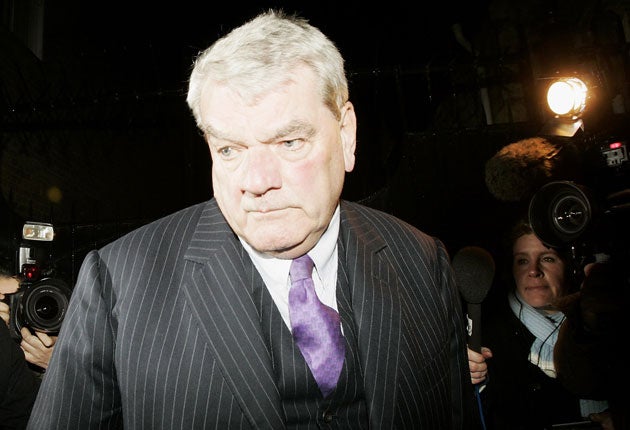
Eminent historians have condemned a Spanish newspaper's decision to interview the controversial historian David Irving as part of its coverage to mark the 70th anniversary of the Second World War.
The Hitler specialist Sir Ian Kershaw, whose interview last Monday launched El Mundo's commemorative series, said he – and most historians – would have pulled out had they known of Mr Irving's participation.
In the interview published yesterday, Mr Irving once again played down the slaughter of millions of Jews during the Second World War, despite having served time in an Austrian jail for his extremist views.
"The Holocaust is just a slogan, a product like Kleenex or Xerox printers. They've turned it into a commercial phenomenon, and succeeded in making money out of it – producing films about it which have made millions," said the 71-year-old Mr Irving, prompting fury and dismay in Israel.
Israel's ambassador in Madrid, Raphael Schutz, condemned the interview as an insult to readers, to legitimate historians and to the concept of free speech. Mr Schutz said: "Everyone who knows anything about the issue knows that David Irving is nothing but... a con man."
El Mundo justified publication on the grounds of freedom of expression and because Mr Irving was at the centre of a wider debate about the criminalisation of opinion.
But Avner Shalev, the director of Israel's Holocaust Museum, responded in a letter published by El Mundo: "There are subjects about that don't permit a 'for' and 'against'. The paper gives legitimacy to a man who doesn't deserve it... It is inconceivable that a serious newspaper should provide a platform for anti-Semitism."
The notion of the Holocaust was built up decades after the event, Mr Irving argues. "Until the 1970s it was just a speck of dust on the horizon," he tells El Mundo. "The proof is that it doesn't appear in any of the biographies of the great leaders of the Second World War. But from then on it became fashionable. The Jews turned it into a brand, using the same technique as Goebbels. They invented a slogan... and repeated it ad nauseam."
Asked if he continued to believe that the figure of six million Jews exterminated was an exaggeration, Mr Irving replied: "I'm not interested in figures. I don't count bodies. I'm not all that interested in the Holocaust."
How come, the interviewer persisted, you are the only historian to deny that the concentration camp at Auschwitz contributed to the Holocaust? "Because they all copy each other. To jump off the rails would condemn them to jail and poverty, which is what happened to me."
Mr Irving served 11 months in an Austrian jail in 2006 for denying that the Nazis killed six million Jews.
He insisted yesterday that Hitler was not responsible, being merely the dupe of smarter collaborators. "Hitler was a simple man constantly deceived by his subordinates." The allegation that the Nazi leader sought to exterminate the Jews was, he said, "a propaganda lie. In Hitler's speeches there is only one anti-Semitic sentence. Something about 'when the war begins, I want the Jews to suffer'. But that's just a stereotypical expression."
Goebbels and Himmler were more to blame, he said, but Churchill – "a corrupt politician" – was responsible for the war: "He pushed the UK into the war and destroyed the British empire. Churchill was in the hands of the Jews, and if he'd surrendered he'd have gone down in history as a failure. People would have laughed at him." So should he have made a pact with Hitler? "Of course. We were very close to ending the war in 1940."
Join our commenting forum
Join thought-provoking conversations, follow other Independent readers and see their replies
Comments
Bookmark popover
Removed from bookmarks